
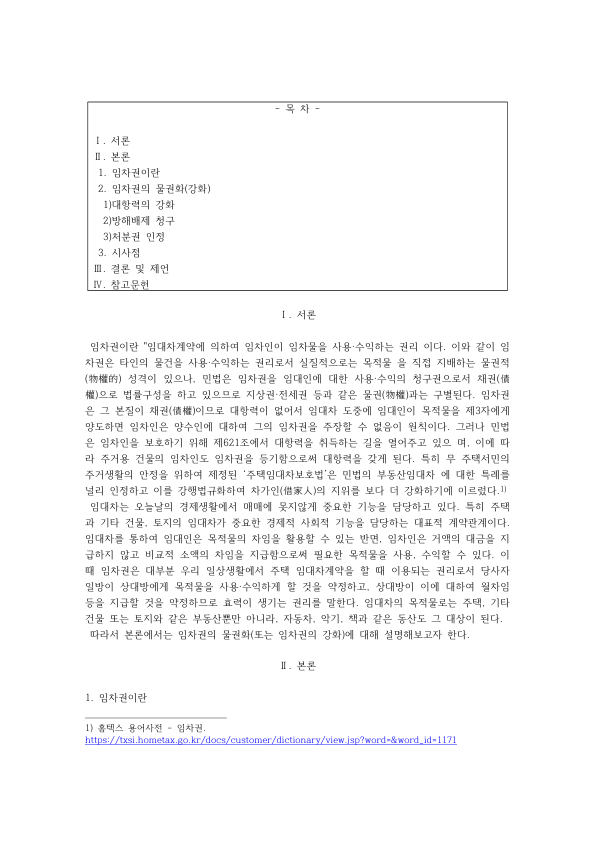
Page 1 is shown as is; from page 2 on, the preview is blurred. Buy it to download the complete original file right away (the file itself is written in Korean).
Packed with real examples and experience. Download it now and save time.
Save your valuable time
Buyer ratings
Fast, accurate and useful.
No ratings yet. Be the first to rate it.


Strengthening Lease Rights in Korea: Registered Leases Under Civil Code Article 621, Tenant Priority Under the Housing Lease Protection Act, and Lease Registration Reform
※ You can preview page 1 as is. Buy it to download the complete original file right away. The file itself is written in Korean.
■ Strengthening Lease Rights in Korea: Registered Leases Under Civil Code Article 621, Tenant Priority Under the Housing Lease Protection Act, and Lease Registration Reform — Overview
A 4-page Korean civil law paper on how a lease, legally a personal claim, gets property-like protection. It covers why a sale normally breaks a lease, the four ways tenants gain rights against new owners, injunctions against interference, and a proposal to publicize residential leases through the land register.
■ Strengthening Lease Rights in Korea: Registered Leases Under Civil Code Article 621, Tenant Priority Under the Housing Lease Protection Act, and Lease Registration Reform — Excerpt from the original document (English translation)
Adopting registration as one way to acquire, and publicize, a residential tenant's priority against third parties and right to preferential repayment would bring further benefits. First, it would lighten the burden on the parties concerned with those rights. Registration would not reduce what the tenant has to spend compared with the current method, but it would let the tenant avoid the risk of getting no protection at all when the house is sold or auctioned because of a wrong lot number or some small mistake. Potential interested persons, such as someone buying the house, currently have to check who occupies it, inspect the resident registration, check the fixed-date records at the issuing office and, if needed, compare the land register with the resident registration to reach a legal judgment. A registration system would spare them this effort and risk.
It would also sharply reduce the social costs surrounding residential leases. Clear publicity of tenants' priority and preferential repayment rights would prevent needless disputes in advance. If the same registration method were adopted for commercial leases, disputed cases could be resolved without difficulty, for example a building in which a tenant gained protection under the Housing Lease Protection Act and then, with the landlord's consent, converted it for business use and tried to register a business, or an officetel listed in public records as an office or neighborhood facility but used as a home.
In principle, a lease right is a personal claim and cannot be asserted against anyone other than the landlord. But because the lease right serves to secure housing for ordinary people, the Civil Code and the Housing Lease Protection Act give it property-like effect under certain conditions to protect the tenant. The ways to give it that effect include using a registered jeonse right or a mortgage under the Civil Code, and securing priority and preferential repayment under the Housing Lease Protection Act by registering a move-in and obtaining a fixed-date stamp.
To add: the guaranteed lease term, left as a heading only in the paper, is set by Article 4 of the Housing Lease Protection Act. A lease with no term or a term under two years is treated as two years, and since July 31, 2020 Article 6-3 lets the tenant request one renewal for two more years, with rent increases capped at 5%. A tenant who must move out without getting the deposit back can ask the court for a lease registration order after the lease ends and keep priority and preferential repayment (Article 3-3). For commercial leases, the renewal request can be used for up to ten years.
■ Strengthening Lease Rights in Korea: Registered Leases Under Civil Code Article 621, Tenant Priority Under the Housing Lease Protection Act, and Lease Registration Reform — Contents and key concepts
Does a lease survive when the landlord sells?
✦ At a glance
- Tenant rights against new owners in Korea
- Structure: nature of a lease → priority → injunctions → registration reform
- Useful for property and civil law courses
☰ What the paper covers
- What a lease right is
- Real covenants
- Ways to gain priority
- Injunctions and transfers
- Registration reform
✎ Leases after a sale in Korea and the U.S.
In Korea, a residential tenant who has moved in and registered a resident address gains rights against a buyer from the next day.
In the U.S., a lease generally binds a buyer who has notice of it, and state recording and landlord-tenant laws set the details.
Note: the paper itself is written in Korean and discusses Korean law. This page is general study information, not legal advice.
Related wiki: Property Deeds and Recording
■ Strengthening Lease Rights in Korea: Registered Leases Under Civil Code Article 621, Tenant Priority Under the Housing Lease Protection Act, and Lease Registration Reform References
- 지원림. (2015). 주택임차권 공시제도의 개선방안. 저스티스, , 5-39.
- 이춘원. (2017). 미국에서 부동산 임차권의 양도와 전대. 비교사법, 24(1), 335-372.
- 생활법률 카드뉴스(2016.11.08.) - 임차권, 확정일자와 전세권설정의 차이
Take a break with a quick personality test?
Ranked by actual participation. Results in about a minute.
Loading…
Most-read content
Loading view counts…

Campusdown is a lifelong-learning community in Korea offering study materials, information on government support, student loans and scholarships, and more. Don't miss our free resources.
Go to the Campusdown home page →Refund policy
- Change of mind / refund requested after partial use / more than 7 days after purchase
◆ Exceptions
- File errors / cannot download or open the file
◆ How to request a refund: send a 1:1 inquiry via Customer Service at the top