
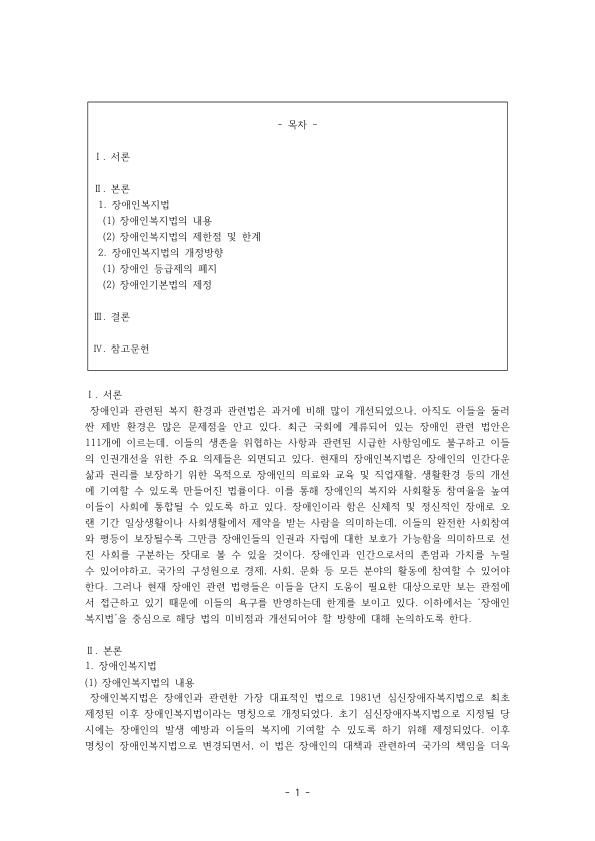
Page 1 is shown as is; from page 2 on, the preview is blurred. Buy it to download the complete original file right away (the file itself is written in Korean).
Packed with real examples and experience. Download it now and save time.
Save your valuable time
Buyer ratings
Fast, accurate and useful.
No ratings yet. Be the first to rate it.


Limits of Korea's Disability Welfare Act and Directions for Reform: Problems With the Disability Rating System, Its Abolition and the Case for a Framework Act on Disability
※ You can preview page 1 as is. Buy it to download the complete original file right away. The file itself is written in Korean.
■ Limits of Korea's Disability Welfare Act and Directions for Reform: Problems With the Disability Rating System, Its Abolition and the Case for a Framework Act on Disability — Overview
A 4-page Korean social welfare law paper on the Act on Welfare of Persons with Disabilities. It reviews the act's history, explains how the six-grade disability rating system tied services to medical grades and stigmatized people, and argues for abolishing it and passing a rights-based framework act in line with the UN disability convention.
■ Limits of Korea's Disability Welfare Act and Directions for Reform: Problems With the Disability Rating System, Its Abolition and the Case for a Framework Act on Disability — Excerpt from the original document (English translation)
Along with abolishing the disability rating system, I think a framework act on disability covering the Act on Welfare of Persons with Disabilities and other disability laws should be enacted. Current laws see persons with disabilities simply as people who need social help and support, and despite the Convention on the Rights of Persons with Disabilities adopted by the UN General Assembly in 2006, it has not been applied to fit Korea's situation. People with disabilities have physical or mental impairments, but that cannot be grounds for discrimination, and they too are equal members of society with the freedom to exercise rights and duties. Yet Korea's disability laws and systems have not kept up with the changed international paradigm, and instead the rating and registration systems treat them as a completely separate group, which is unfortunate. For the human rights and social inclusion of people with disabilities, the existing act alone is limited in reflecting their needs in policy. I think a framework act is urgently needed, so that disability laws and the ministries involved can carry out connected policies and lower-level laws can be organized under it. It should set the basic philosophy of disability policy and the goals and direction of all related policies, so that effective policies going beyond current systems can be made. This would let us respond effectively to social problems involving disability, and help people with disabilities drop the sense of being weak and stand independently as full members of society.
This paper reviewed the basic content of the Act on Welfare of Persons with Disabilities and its limits. Various bills to guarantee the rights and independence of people with disabilities are pending in the National Assembly, and I think the most urgent law to enact is a framework act on disability. Solving disability issues and achieving true social inclusion requires that social responsibility be built into institutions, which can take the form of law. But our society still lacks basic awareness of disability, and there is no law that considers the whole life course of people living with disabilities, so a system that governs this from a broader perspective is needed. Meeting the needs of the times requires a more rational and efficient legal system, and the current act falls short as an umbrella for all disability laws. To protect the basic rights of people with disabilities, the most fundamental law must serve as the foundation for all of this.
To add: the abolition of the rating system that the paper called for has actually happened. From July 1, 2019, the six grades were replaced with just two categories, people with severe disabilities and people with non-severe disabilities, and services such as personal assistance are now set by a comprehensive needs survey that looks at each person's needs and circumstances. The Convention on the Rights of Persons with Disabilities was adopted by the UN General Assembly in 2006 and ratified by Korea in 2008, and the Disability Discrimination Act took effect in April 2008. A framework act on disability has been discussed many times but remains a legislative task.
■ Limits of Korea's Disability Welfare Act and Directions for Reform: Problems With the Disability Rating System, Its Abolition and the Case for a Framework Act on Disability — Contents and key concepts
Why did Korea drop its six-grade disability system?
✦ At a glance
- Korea's disability rating system and reform
- Structure: the act → limits → abolition → framework act
- Useful for disability policy and welfare law courses
☰ What the paper covers
- History of the act
- Grades and registration
- Problems with grades
- Abolition and new definition
- UN convention and reform
✎ Disability law in Korea and the U.S.
Korea replaced its six grades with two categories in July 2019 and now sets support hours through a needs assessment.
In the U.S., the Americans with Disabilities Act of 1990 bans discrimination, while benefits such as SSDI and SSI use their own medical and work-capacity rules.
Note: the paper itself is written in Korean and discusses Korean law. This page is general study information, not legal advice.
■ Limits of Korea's Disability Welfare Act and Directions for Reform: Problems With the Disability Rating System, Its Abolition and the Case for a Framework Act on Disability References
- 에이블뉴스(2017.10.11.) 현재 국회에 계류중인 장애인관련 법률안의 주요내용 프레시안(2016.09.01.) '낙인의 사슬', 폐지가 답이다
Take a break with a quick personality test?
Ranked by actual participation. Results in about a minute.
Loading…
Most-read content
Loading view counts…

Campusdown is a lifelong-learning community in Korea offering study materials, information on government support, student loans and scholarships, and more. Don't miss our free resources.
Go to the Campusdown home page →Refund policy
- Change of mind / refund requested after partial use / more than 7 days after purchase
◆ Exceptions
- File errors / cannot download or open the file
◆ How to request a refund: send a 1:1 inquiry via Customer Service at the top