
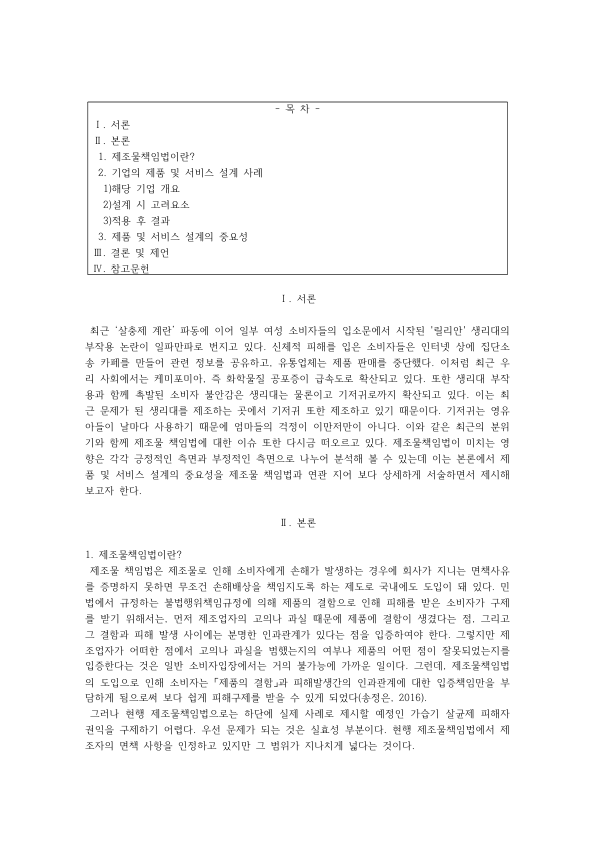
Page 1 is shown as is; from page 2 on, the preview is blurred. Buy it to download the complete original file right away (the file itself is written in Korean).
Packed with real examples and experience. Download it now and save time.
Save your valuable time
Buyer ratings
Fast, accurate and useful.
No ratings yet. Be the first to rate it.
Korea's Product Liability Act and the Humidifier Disinfectant Case: Defects and Burden of Proof, the Development Risk Defense and Limitation Periods, and Safe Product Design
※ You can preview page 1 as is. Buy it to download the complete original file right away. The file itself is written in Korean.
■ Korea's Product Liability Act and the Humidifier Disinfectant Case: Defects and Burden of Proof, the Development Risk Defense and Limitation Periods, and Safe Product Design — Overview
A 4-page Korean paper on product liability. It contrasts tort claims, which require proof of fault, with the Product Liability Act's defect-based liability, criticizes the development risk defense and the three-year limitation period, and analyzes the humidifier disinfectant disaster as a failure of product design and oversight.
■ Korea's Product Liability Act and the Humidifier Disinfectant Case: Defects and Burden of Proof, the Development Risk Defense and Limitation Periods, and Safe Product Design — Excerpt from the original document (English translation)
The government lost the golden time to find the cause and stop the harm from spreading as ministries passed responsibility to each other, while the disinfectant makers and raw material suppliers focused only on ways to avoid responsibility. In the meantime, at least 95 and as many as more than 200 precious lives were lost. At least 126 patients still endure each day in unimaginable breathing difficulty.
Through the Oxy disaster, our neighbors, including mothers and children at an age when they should have been living healthy lives, suffered from lung fibrosis, unable to breathe, and died. Those who barely survived stay alive only through the drastic step of lung transplants. Sales have now stopped, but the humidifier disinfectant case is still unfolding, because lawsuits between the manufacturer and the victims over compensation and apologies have begun.
It is deeply regrettable that everyone remained indifferent to a product that mixed a disinfectant into water and sent it into the lungs through the air people breathe, merely because it was considered safe for skin. With a little attention the problem could easily have been found, which makes it truly lamentable.
Taking the Oxy disaster as a lesson, Korean companies should take greater care in designing products and services. To carry out product liability measures effectively, companies should make product safety and user protection clear in their philosophy and management policy. The chief executive should declare a product safety policy inside and outside the company and actively support all the resources needed so that concrete measures can be prepared and carried out.
In everything, the best approach is to prevent problems before they occur. For product liability too, it is important first to prepare preventive measures so that products have no defects. That requires sound design and manufacturing and reliable quality inspection from the product's first release.
The Oxy disaster happened fundamentally because the company did not keep business ethics. It occurred because of corporate conduct that aimed only at maximizing profit without considering the impact on society. Its five years of silence, ignoring consumers despite repeated problems and repeated demands to disclose ingredients, deepened consumers' anger.
To add: the Product Liability Act was revised in April 2017, effective April 19, 2018, adding punitive damages of up to three times the loss when a manufacturer knew of a defect but took no action and caused serious harm to life or health (Article 3(2)), and a presumption of defect and causation when harm occurs during normal use (Article 3-2). The limitation period is three years from when the victim learned of the harm and the liable party, and ten years from when the product was supplied (Article 7). A special act for relief of humidifier disinfectant victims was also enacted in 2017.
■ Korea's Product Liability Act and the Humidifier Disinfectant Case: Defects and Burden of Proof, the Development Risk Defense and Limitation Periods, and Safe Product Design — Contents and key concepts
Who pays when a product hurts you in Korea?
✦ At a glance
- Product liability in Korea through a major case
- Structure: the act → case study → design lessons → conclusion
- Useful for civil law, consumer law and business ethics courses
☰ What the paper covers
- Tort vs. product liability
- Proving a defect
- Development risk defense
- The humidifier case
- Designing for safety
✎ Product liability in Korea and the U.S.
Korea added triple punitive damages and a presumption of defect to its Product Liability Act, effective in April 2018.
In the U.S., state courts have applied strict liability to defective products since the 1960s, and punitive damages have no fixed national cap.
Note: the paper itself is written in Korean and discusses Korean law. This page is general study information, not legal advice.
Related wiki: Product Liability
■ Korea's Product Liability Act and the Humidifier Disinfectant Case: Defects and Burden of Proof, the Development Risk Defense and Limitation Periods, and Safe Product Design References
- 송정은, 정남순. (2016). 가습기 살균제 사건의 민사적 쟁점. 환경법과 정책, 16, 1-33. 김호기. (2016). 개발위험의 항변과 형법적 제조물책임. 형사정책연구, 27(1), 167-198. 서준혁, 배성민. (2016). 제조물책임 대응시스템의 핵심요인이 PL성과에 미치는 연구. 대한산업공학회 춘계공동학술대회 논문집, , 6076-6081. 옥시레킷벤키저 개요 -
Take a break with a quick personality test?
Ranked by actual participation. Results in about a minute.
Loading…
Most-read content
Loading view counts…

Campusdown is a lifelong-learning community in Korea offering study materials, information on government support, student loans and scholarships, and more. Don't miss our free resources.
Go to the Campusdown home page →Refund policy
- Change of mind / refund requested after partial use / more than 7 days after purchase
◆ Exceptions
- File errors / cannot download or open the file
◆ How to request a refund: send a 1:1 inquiry via Customer Service at the top