
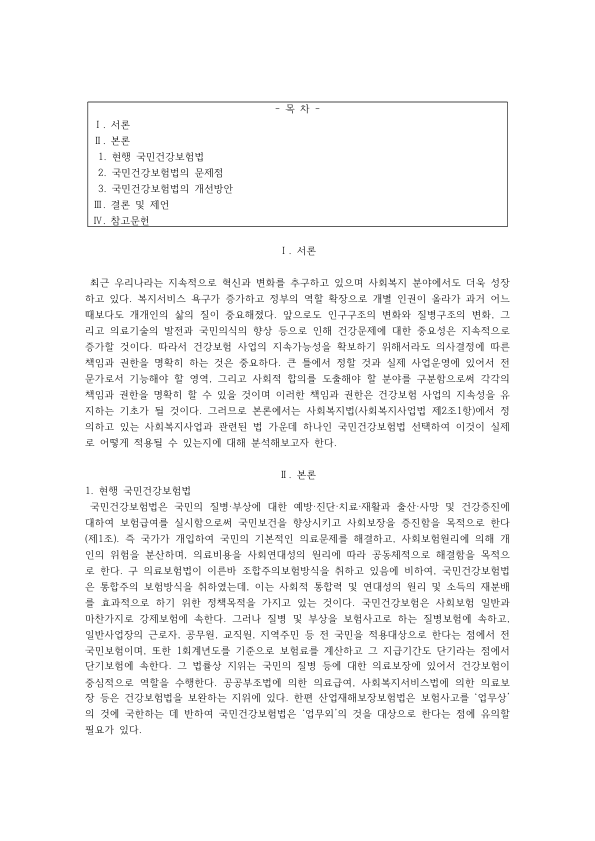
Page 1 is shown as is; from page 2 on, the preview is blurred. Buy it to download the complete original file right away (the file itself is written in Korean).
Packed with real examples and experience. Download it now and save time.
Save your valuable time
Buyer ratings
Fast, accurate and useful.
No ratings yet. Be the first to rate it.

Korea's National Health Insurance Act: Problems and Reforms in How Premiums and Benefits Are Decided, the Health Insurance Policy Deliberation Committee and the Insurer's Role
※ You can preview page 1 as is. Buy it to download the complete original file right away. The file itself is written in Korean.
■ Korea's National Health Insurance Act: Problems and Reforms in How Premiums and Benefits Are Decided, the Health Insurance Policy Deliberation Committee and the Insurer's Role — Overview
A 4-page Korean social welfare law paper on governance under the National Health Insurance Act. It explains the single-insurer system, shows how a Health Ministry committee rather than the National Health Insurance Service sets premiums and benefit standards, and proposes giving the insurer more authority and accountability.
■ Korea's National Health Insurance Act: Problems and Reforms in How Premiums and Benefits Are Decided, the Health Insurance Policy Deliberation Committee and the Insurer's Role — Excerpt from the original document (English translation)
Reorganizing decision-making to strengthen the insurer's role. Setting premiums, a key part of managing health insurance finances, directly affects members. It is therefore desirable to increase members' participation in setting premiums, and the insurer acting for members should be given the authority and responsibility to set premiums reflecting their views. To make the insurer's responsibility for managing the finances clear, it should be able to manage them in practice. Premiums should be decided through the Financial Management Committee of the National Health Insurance Service, and fees should be set through negotiation between the insurer and the providers, the medical institutions. Premiums are the core of insurance revenue. From the days of the Medical Insurance Act until the Special Act on the Financial Soundness of National Health Insurance was enacted, premiums were decided by the societies' operating committees and the Service's Financial Management Committee. In principle, members who bear the cost should take part in setting premiums based on future insurance finances. Health insurance is now divided into employee members and local members, whose types of income and rates of income identification differ, so a consultation process is needed in which the two groups adjust their shares of the burden to fix premiums. In short, it is reasonable for members to decide the share they pay. So the current structure, in which the Health Insurance Policy Deliberation Committee, where providers also take part, sets the premium rate, is undesirable. Setting the premium rate should be returned to the Financial Management Committee, a body that can fully reflect members' views, to raise public participation.
Korea has enacted various laws to address people's health problems and has given the state a duty to guarantee people's health. Among them, the National Health Insurance Act can be called the law that sets out the rational procedures and methods for deciding which medical services to provide, how to pay for them, and from whom and how much to collect. Under Article 4 of the current act, the Health Insurance Policy Deliberation Committee in practice decides all the main matters of the insurance program, from benefit standards and premium rates to relative value scores, fees for drugs and treatment materials, additional benefits and coverage of members.
To add: the National Health Insurance Act was enacted in 1999 and took effect in July 2000, and the employee and local funds were merged in July 2003. The Health Insurance Policy Deliberation Committee is still chaired by the Vice Minister of Health and Welfare and deliberates and decides premium rates and benefit standards (Article 4), and a comprehensive national health insurance plan is drawn up every five years (Article 3-2). Fees for covered care are already set by contract between the head of the Service and representatives of the medical professions, and the committee decides only when no contract is reached (Article 45). The 2026 premium rate for employee members is 7.19%.
■ Korea's National Health Insurance Act: Problems and Reforms in How Premiums and Benefits Are Decided, the Health Insurance Policy Deliberation Committee and the Insurer's Role — Contents and key concepts
Who really decides Korea's health insurance premiums?
✦ At a glance
- Korea's national health insurance decision structure
- Structure: current law → problems → reforms → conclusion
- Useful for social welfare law and health policy courses
☰ What the paper covers
- Purpose of the act
- Single insurer system
- Deliberation committee
- Premium and fee reforms
- Author's conclusion
✎ Health coverage in Korea and the U.S.
Korea covers nearly everyone through one public insurer, the National Health Insurance Service, with premiums set by a committee under the Health Ministry.
The U.S. has no single national insurer: coverage comes from employer plans, Medicare, Medicaid and ACA marketplaces, each with its own rules.
Note: the paper itself is written in Korean and discusses Korean law. This page is general study information, not legal advice.
■ Korea's National Health Insurance Act: Problems and Reforms in How Premiums and Benefits Are Decided, the Health Insurance Policy Deliberation Committee and the Insurer's Role References
- 권오탁. (2016). 「국민건강보험법」상 의사결정구조의 문제와 개선방안. 사회보장법학 제5권 제1호. 5-38. 남선모. (2014). 국민건강보험법의 개정 및 제도개선에 관한 연구. 법학연구, 53, 109-132. 안영창. (2014). 국민건강보험 인식수준과 만족도의 관계. 한국콘텐츠학회논문지, 14(8), 277-286. 국가법령정보센터. “국민건강보험법”.
Take a break with a quick personality test?
Ranked by actual participation. Results in about a minute.
Loading…
Most-read content
Loading view counts…

Campusdown is a lifelong-learning community in Korea offering study materials, information on government support, student loans and scholarships, and more. Don't miss our free resources.
Go to the Campusdown home page →Refund policy
- Change of mind / refund requested after partial use / more than 7 days after purchase
◆ Exceptions
- File errors / cannot download or open the file
◆ How to request a refund: send a 1:1 inquiry via Customer Service at the top