
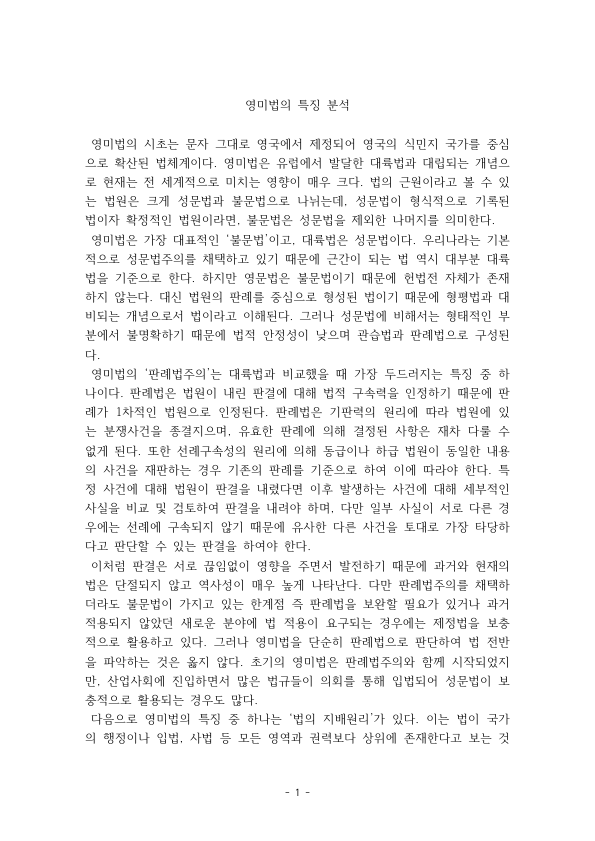
Page 1 is shown as is; from page 2 on, the preview is blurred. Buy it to download the complete original file right away (the file itself is written in Korean).
Packed with real examples and experience. Download it now and save time.
Save your valuable time
Buyer ratings
Fast, accurate and useful.
No ratings yet. Be the first to rate it.


Key Features of the Common Law System Compared with Civil Law: Precedent, Rule of Law, Jury Trials and Judicial Appointments
※ You can preview page 1 as is. Buy it to download the complete original file right away. The file itself is written in Korean.
■ Key Features of the Common Law System Compared with Civil Law: Precedent, Rule of Law, Jury Trials and Judicial Appointments — Overview
A 2-page Korean comparative law paper on the Anglo-American common law tradition. It explains why judicial decisions are a primary source of law, how stare decisis and distinguishing work, how the rule of law differs from the civil-law idea of the Rechtsstaat, how jury trials drove the growth of evidence law, and how appointing judges from experienced lawyers inspired Korea's move toward a unified legal profession.
■ Key Features of the Common Law System Compared with Civil Law: Precedent, Rule of Law, Jury Trials and Judicial Appointments — Excerpt from the original document (English translation)
Next, one of the features of Anglo-American law is the "rule of law." This holds that law exists above all areas and powers of the state, such as administration, legislation and the judiciary, and recognizes that all state power is under the law. Therefore, the law in the rule of law exists not merely as formal law but as substantive law embodying justice, moral values and rationality. Because law, under the principles of justice and morality, also influenced the interpretation and operation of law through principles such as due process and fairness and equity, laws enacted by Parliament came to bind everything. This ultimately meant the principle of parliamentary sovereignty, and protecting the individual through the supremacy of the judiciary is the most central aim of this principle. The rule of law has characteristics quite opposite to the Rechtsstaat principle of continental law: whereas the rule of law binds all exercises of power, the Rechtsstaat principle binds only the administration. In addition, because it regards formal content alone as sufficient for law, the administration, judiciary and legislature can have equal powers. However, as the modern Rechtsstaat principle has also developed from a formal to a substantive Rechtsstaat, most of the major differences that appeared between Anglo-American and continental law have disappeared.
For reference, the material writes that Anglo-American law is a concept contrasted with equity, but it is common law in the narrow sense that is contrasted with equity, while Anglo-American law in the broad sense includes both. The United Kingdom has no single codified constitution, but its constitutional order is made up of Acts of Parliament, case law and constitutional conventions. Korea has run citizen-participation trials, in which the jury's verdict has advisory effect, since 2008, and the career requirements for appointing judges under the unification of the legal profession have been adjusted several times by statutory amendment, so check the current standard.
■ Key Features of the Common Law System Compared with Civil Law: Precedent, Rule of Law, Jury Trials and Judicial Appointments — Contents and key concepts
What makes the common law different from civil law?
✦ At a glance
- Four features of the common law
- Structure: origins → precedent → rule of law → juries → judges
- Useful for comparative law and intro to U.S. law
☰ What the paper covers
- Origins and sources of law
- Precedent and distinguishing
- Rule of law vs. Rechtsstaat
- Juries and evidence law
- Judicial appointments
✎ Common law in practice
Common law courts follow precedent but can distinguish cases on their facts, and the highest court can overrule itself, as in Brown v. Board of Education, 347 U.S. 483 (1954), which rejected Plessy v. Ferguson.
The Sixth and Seventh Amendments guarantee jury trials in U.S. criminal and many civil cases, while Korea's citizen-participation trials since 2008 give jurors only an advisory verdict.
Note: the paper itself is written in Korean and discusses Korean law. This page is general study information, not legal advice.
Related wiki: Common Law vs. Civil Law
Take a break with a quick personality test?
Ranked by actual participation. Results in about a minute.
Loading…
Most-read content
Loading view counts…

Campusdown is a lifelong-learning community in Korea offering study materials, information on government support, student loans and scholarships, and more. Don't miss our free resources.
Go to the Campusdown home page →Refund policy
- Change of mind / refund requested after partial use / more than 7 days after purchase
◆ Exceptions
- File errors / cannot download or open the file
◆ How to request a refund: send a 1:1 inquiry via Customer Service at the top