
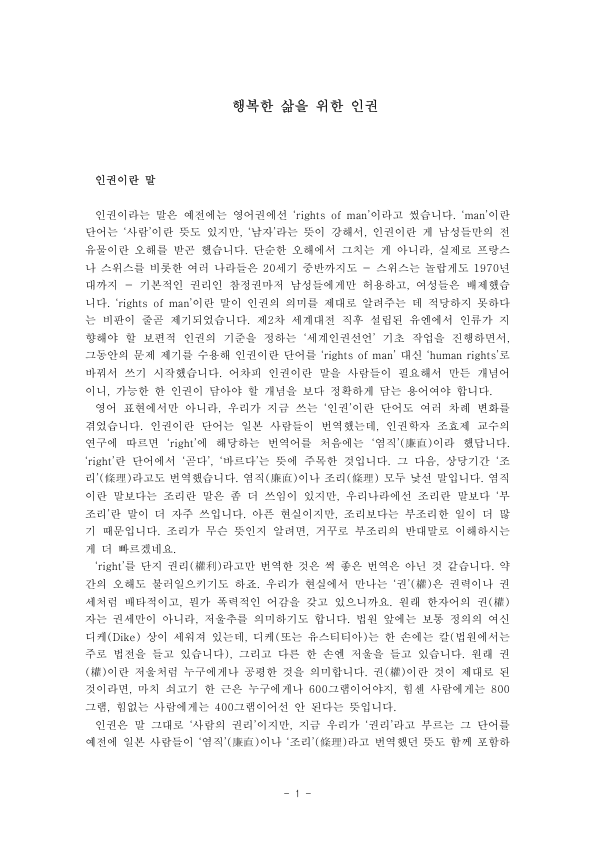
Page 1 is shown as is; from page 2 on, the preview is blurred. Buy it to download the complete original file right away (the file itself is written in Korean).
Packed with real examples and experience. Download it now and save time.
Save your valuable time
Buyer ratings
Fast, accurate and useful.
No ratings yet. Be the first to rate it.


Human Rights for a Happy Life: The Meaning of Rights, from Magna Carta to Article 10 of Korea's Constitution and Freedom of Assembly
※ You can preview page 1 as is. Buy it to download the complete original file right away. The file itself is written in Korean.
■ Human Rights for a Happy Life: The Meaning of Rights, from Magna Carta to Article 10 of Korea's Constitution and Freedom of Assembly — Overview
A 17-page lecture-style Korean essay on human rights. It explains how 'rights of man' became 'human rights' and how 'right' was translated into East Asian languages, contrasts minimalist and maximalist views of rights, discusses human dignity under Article 10 of the Korean Constitution, and applies the principle that individuals are the subjects of rights to assemblies and information rights.
■ Human Rights for a Happy Life: The Meaning of Rights, from Magna Carta to Article 10 of Korea's Constitution and Freedom of Assembly — Excerpt from the original document (English translation)
Magna Carta of 1215, often called the first human rights document, was itself drawn up by nobles to defend themselves against the king's unjust power. Its point was that anyone exercising power, king or state, must follow at least minimal procedures and must not act arbitrarily. Human rights therefore began as 'minimal rights,' the hope that the state would not violate individuals' rights. That is why, even today, the phrase 'minimal rights' comes to mind as soon as we hear the words human rights. This attitude sets a kind of bottom line, saying at least these rights must be guaranteed, but at the same time it limits the scope of human rights. After the Second World War, reflecting on humanity's horrific self-destruction, people began to think of human rights not as 'something minimal' but as something to be guaranteed as fully as possible. This was also when a positive role for the state, such as the welfare state, came to be stressed. People thought that to avoid repeating world war and crimes against humanity, the concept of human rights had to be redefined more richly. Human rights should be viewed not only from a minimalist perspective but from a maximalist one.
For those of us used to seeing human rights as minimal rights, the maximalist view of 'something maximal' is admittedly unfamiliar. The June Democratic Struggle of 1987 was the citizens' uprising that made the Sixth Republic possible. Following the March First Movement and the April Revolution, it was a momentous historical event that laid the foundation for Korea's constitutional values and ideals. The public's desire for democratization during the June Struggle was intense, and it was gathered into a single slogan: 'Win direct presidential elections!' As a result, direct presidential elections were restored, and Korea set out on the long road to democratization. Yet direct presidential elections were an important issue and one necessary condition of democratization; they did not in themselves mean democratization. The demands of the citizens who took part in the June Struggle were the same.
'Democratization' was a broader concept that included direct presidential elections but meant much more. It referred not just to how the president is chosen but to all the institutional and attitudinal changes needed to make our society more democratic. No one chanted slogans for full local self-government during the June Struggle, yet democratization included it. It also included hopes for peace and unification and a safer society, and above all the creation of a world worth living in, where poor people are not humiliated merely for lacking economic means and everyone can live with human dignity and worth. In short, democratization was understood from a 'maximalist' perspective. Today people speak of 'democracy after democratization' and stress tasks beyond particular institutions, but even during the June Struggle democratization meant as many things as there were people longing for it. The same view is needed to understand human rights. Human rights should not stop at freedom from unjust intervention, interference or violation by state power; rather than a passive, negative, minimalist view, they should be seen actively and positively, from a maximalist perspective.
Korea's Constitution already stated, in an express provision of the 1963 Third Republic Constitution, the principle of guaranteeing human rights to the fullest (a little awkward, since Park Chung-hee's military rule was just beginning).
The new view that human rights should be interpreted more actively spread around the world after the Second World War. As a result, the understanding of human rights itself changed greatly, and many social issues began to be reinterpreted in the name of human rights. In the past, human rights were attacked by progressives as meaning only a very narrow kind of freedom, but as the concept expanded, they were able to move beyond that limited image. Human rights began to extend into every area of people's lives.
To add: the clause on 'dignity and worth as human beings' was first added in the Fifth Amendment of 1962, and the 'right to pursue happiness' was added in the Eighth Amendment of 1980; both carried over into Article 10 of the 1987 Constitution. The whole provision the paper quotes was not in the 1963 Constitution as such. The UN Universal Declaration of Human Rights was adopted by the General Assembly in Paris on December 10, 1948, by 48 votes to 0 with 8 abstentions. Swiss women won the federal vote in a February 1971 referendum, and French women won the vote in 1944.
■ Human Rights for a Happy Life: The Meaning of Rights, from Magna Carta to Article 10 of Korea's Constitution and Freedom of Assembly — Contents and key concepts
What people are owed simply as people
✦ At a glance
- A plain-language lecture on what human rights mean
- Structure: words and history → principles → Constitution → everyday cases
- Useful for human rights education and general courses
☰ What the paper covers
- From rights of man to human rights
- Translating 'right'
- Minimal and maximal views
- Article 10
- Freedom of assembly
✎ Human dignity in Korea and the U.S.
Korea's Constitution opens its rights chapter with human dignity and the pursuit of happiness in Article 10.
The U.S. Constitution never mentions dignity, though the Declaration of Independence names the pursuit of happiness and the Supreme Court has invoked dignity in cases on liberty.
Note: the paper itself is written in Korean and discusses Korean law. This page is general study information, not legal advice.
Related wiki: Universal Declaration of Human Rights
Take a break with a quick personality test?
Ranked by actual participation. Results in about a minute.
Loading…
Most-read content
Loading view counts…

Campusdown is a lifelong-learning community in Korea offering study materials, information on government support, student loans and scholarships, and more. Don't miss our free resources.
Go to the Campusdown home page →Refund policy
- Change of mind / refund requested after partial use / more than 7 days after purchase
◆ Exceptions
- File errors / cannot download or open the file
◆ How to request a refund: send a 1:1 inquiry via Customer Service at the top