
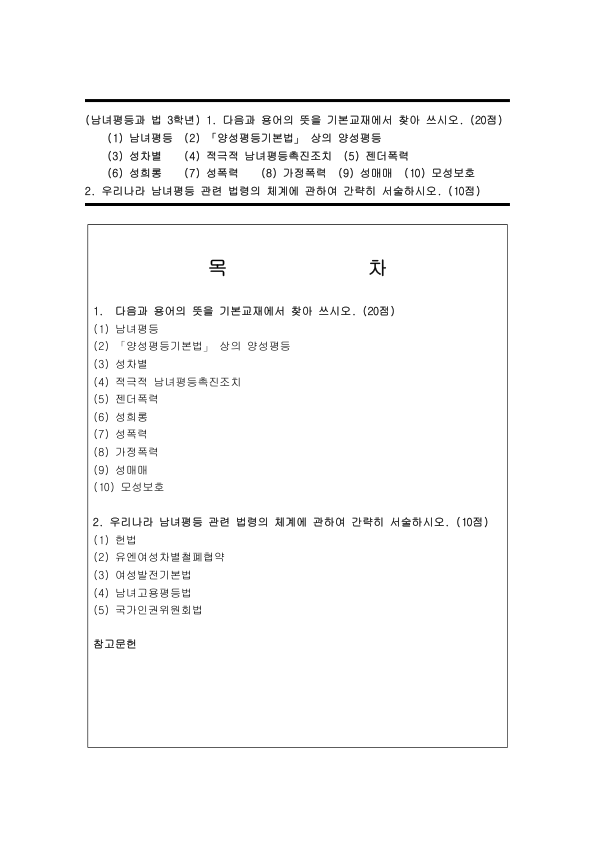
Page 1 is shown as is; from page 2 on, the preview is blurred. Buy it to download the complete original file right away (the file itself is written in Korean).
Packed with real examples and experience. Download it now and save time.
Save your valuable time
Buyer ratings
Fast, accurate and useful.
No ratings yet. Be the first to rate it.


Gender Equality and Law in Korea: Ten Key Terms from Gender Discrimination to Affirmative Action and the Framework of Equality Laws
※ You can preview page 1 as is. Buy it to download the complete original file right away. The file itself is written in Korean.
■ Gender Equality and Law in Korea: Ten Key Terms from Gender Discrimination to Affirmative Action and the Framework of Equality Laws — Overview
An 11-page Korean gender and law paper. It defines ten key terms, including gender equality under the Framework Act on Gender Equality, sexual harassment, gender violence and affirmative action, and explains how the Constitution, the UN women's convention, the gender equality framework act, the equal employment act and the human rights commission act fit together.
■ Gender Equality and Law in Korea: Ten Key Terms from Gender Discrimination to Affirmative Action and the Framework of Equality Laws — Excerpt from the original document (English translation)
Korea has expanded various legal and institutional mechanisms to realize the ideal of gender equality pursued by the Constitution. Yet despite equal rights provisions for women in law, law and reality remain apart, and women face unequal conditions due to structural discrimination. Recognizing that existing anti-discrimination laws were insufficient to remove this inequality, Korea has created a legal basis and institutions for affirmative measures to secure women's representation in politics, the economy, society and culture, eliminate sex discrimination and promote women's advancement. Historically, first, from the 1980s the state paid attention to gender equality and created legal grounds banning sex discrimination, achieving equality in a passive sense. Second, from the 1990s laws have been enacted and amended not only to eliminate discrimination but also to provide concrete affirmative measures to secure women's representation.
The preamble of the current Constitution states that it will 'afford equal opportunities to every person in all fields of political, economic, social and cultural life and elevate the quality of life for all citizens,' and Article 11(1) provides that 'all citizens shall be equal before the law, and there shall be no discrimination in political, economic, social or cultural life on account of sex, religion or social status,' declaring equality before the law and the prohibition of sex discrimination. The constitutional right to equality is the methodological basis for realizing fundamental rights, guaranteeing that women and men have equal opportunities to participate in all areas of life and are both holders of all fundamental rights. It should therefore be seen as an equality mandate that includes both a ban on discrimination and a mandate for equal status aimed at realizing de facto equality, which justifies enacting sex-specific provisions to overcome women's social inequality.
Besides the equality clause, several other constitutional provisions address gender equality, yet reality remains unequal for women. To close the gap between law and reality, the state has a duty, grounded in the will of the Constitution, to establish concrete policies for active support and protection so that substantive gender equality is realized in all areas. This follows naturally from the Constitution's indirect adoption of the social state principle. Women's representation in politics is also required for democratic legitimacy as long as the Constitution adopts liberal democracy, and women's equal participation in political decision-making serves the interest of a community pursuing pluralistic democracy. However, because the constitutional right to equality means realizing de facto equality, modifications of formal legal equality are allowed but their requirements must be strict, and the constitutional limits on their scope, degree and form are key issues. The fundamental rights involved differ by the area and form of an affirmative measure, and conflicting values should be reconciled at a point where each takes the fullest possible effect rather than choosing one over the other.
Article 4(1) of the UN Convention on the Elimination of All Forms of Discrimination against Women provides that temporary special measures adopted to achieve de facto equality between men and women are not considered discrimination. Korea obtained National Assembly consent to ratify the convention in December 1984 and it took effect domestically in 1985; the Optional Protocol was ratified in October 2006 and took effect on January 18, 2007. With ratification, the government began to pay attention to women-related legislation and policy.
To add: the Framework Act on Women's Development was wholly amended in 2014 and became the Framework Act on Gender Equality on July 1, 2015, so the paper's 'Article 6 of the current Framework Act on Women's Development' corresponds to Article 20 (affirmative measures) of today's Framework Act on Gender Equality. The 1994 special act on sexual violence the paper mentions was the Act on the Punishment of Sexual Crimes and Protection of Victims, which was split into a punishment act and a victim protection act in 2010. The Equal Employment Act was renamed in 2007 as the Equal Employment Opportunity and Work-Family Balance Assistance Act, and since May 2022 victims of sex discrimination in employment and workplace sexual harassment can seek corrective orders from the Labor Relations Commission. The paper's statistics are as of the time of writing.
■ Gender Equality and Law in Korea: Ten Key Terms from Gender Discrimination to Affirmative Action and the Framework of Equality Laws — Contents and key concepts
From formal to substantive equality
✦ At a glance
- Key gender equality terms and the framework of equality laws in Korea
- Structure: ten definitions → framework of laws
- Useful for gender and law, women's studies and constitutional law courses
☰ What the paper covers
- Opportunity, condition and outcome
- Gender equality and harassment defined
- Affirmative action terms
- Gender violence definitions
- Constitution to commission act
✎ Gender equality law in Korea and the U.S.
Korea combines a framework act on gender equality with an equal employment act that allows temporary affirmative employment measures.
In the U.S., Title VII of the Civil Rights Act of 1964 bans sex discrimination in employment and Title IX covers education, while the Equal Rights Amendment was never fully ratified.
Note: the paper itself is written in Korean and discusses Korean law. This page is general study information, not legal advice.
Related wiki: Affirmative Action
■ Gender Equality and Law in Korea: Ten Key Terms from Gender Discrimination to Affirmative Action and the Framework of Equality Laws References
- 김엘림, 「남녀평등과 법」(2022년 전면개정판), KNOUPRESS, 2022.7.
- 김엘림, 「남녀평등과 법 워크북」(2022년 전면개정판), KNOUPRESS, 2022.7.
- 양돈규, 김정인 (2016). 대학생의 양성평등의식이 성희롱 문제인식과 성희롱 행동경험에 미치는 영향. 여성연구. 사단법인 한국헌법학회, 헌법주석[Ⅰ], ㈜박영사(2013)
Take a break with a quick personality test?
Ranked by actual participation. Results in about a minute.
Loading…
Most-read content
Loading view counts…

Campusdown is a lifelong-learning community in Korea offering study materials, information on government support, student loans and scholarships, and more. Don't miss our free resources.
Go to the Campusdown home page →Refund policy
- Change of mind / refund requested after partial use / more than 7 days after purchase
◆ Exceptions
- File errors / cannot download or open the file
◆ How to request a refund: send a 1:1 inquiry via Customer Service at the top