
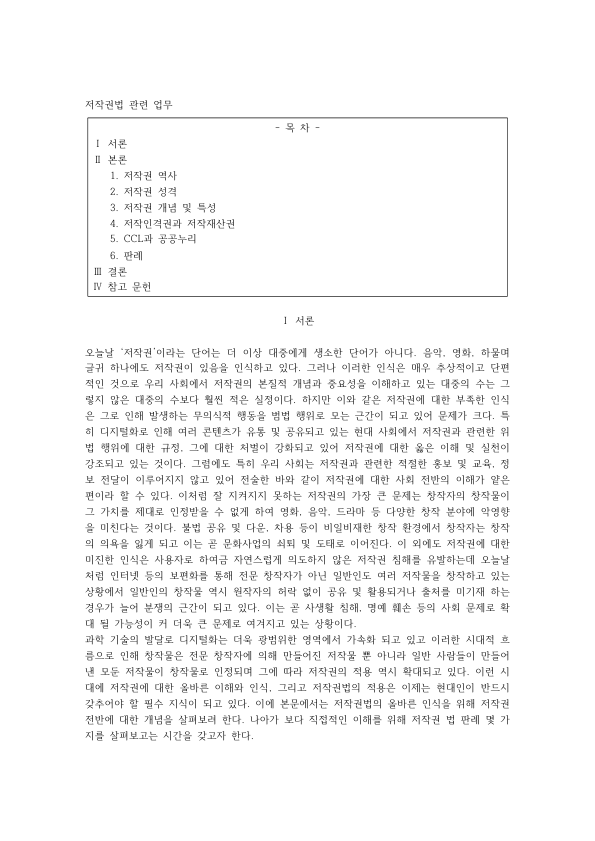
Page 1 is shown as is; from page 2 on, the preview is blurred. Buy it to download the complete original file right away (the file itself is written in Korean).
Packed with real examples and experience. Download it now and save time.
Save your valuable time
Buyer ratings
Fast, accurate and useful.
No ratings yet. Be the first to rate it.
Basics of Korean Copyright Law: Moral Rights and Economic Rights, Creative Commons and Korea Open Government License, and Three Court Cases
※ You can preview page 1 as is. Buy it to download the complete original file right away. The file itself is written in Korean.
■ Basics of Korean Copyright Law: Moral Rights and Economic Rights, Creative Commons and Korea Open Government License, and Three Court Cases — Overview
A 6-page Korean copyright law paper. It traces the history of copyright, explains moral rights such as attribution and integrity and seven economic rights, and covers Creative Commons and Korea's public-sector license. It closes with three cases on transferring moral rights, altering a commissioned character design and quoting film clips on TV.
■ Basics of Korean Copyright Law: Moral Rights and Economic Rights, Creative Commons and Korea Open Government License, and Three Court Cases — Excerpt from the original document (English translation)
Missionary group A had its director, the plaintiff and instructors belonging to the group produce a Korean language textbook for foreigners. The co-authors agreed to transfer to group A both economic rights, such as publication and translation rights, and moral rights in the textbook. Group A then omitted the plaintiff's name, as a co-author, when publishing the book. A argued that because the moral rights had been transferred, omitting the name did not infringe them. The court, however, held that moral rights cannot be transferred or assigned because they are personal to the author. It therefore ruled that changing or concealing an author's name or title on a work, whether intentionally or negligently, infringes moral rights. In other words, unlike economic rights, moral rights cannot be transferred or assigned, and while their exercise may be delegated to an agent, this must be done within limits that do not infringe the essence of moral rights. That is, even if the author agreed to transfer, assignment, agency or delegation, moral rights still belong to the author.
This case involved 'Lotty,' the main character of Hotel Lotte. Hotel Lotte held a contest for character designs, and the applicant's raccoon design won. After the award, the respondent proposed that the applicant revise and supplement the entry to develop applied designs, offered to pay fees for the applied designs, and in return asked for transfer of all rights including copyright. The applicant agreed and a contract was signed. The applicant then completed a basic design through several rounds of work and presented applied designs based on it, but the respondent was dissatisfied and asked for further revisions. When the applicant refused, the respondent gave the applicant's earlier designs to an animation producer for reference and commissioned a new character design, which it received, named 'Lotty' and used in its business. The applicant then sought an injunction, arguing that even though he had transferred the economic rights, he still held moral rights, so modifying and using his design without permission infringed his right of integrity. The court held that the respondent did not infringe the right of integrity because the applicant had refused to perform his duty to revise the design after the respondent asked for revisions. The court treated this as implied consent to changes in the design. Therefore, the respondent's modifying part of the design and using it commercially was hard to see as infringement of the right of integrity.
In a segment called 'Star UCC,' which highlighted little-known episodes from celebrities' pasts, the defendant broadcaster aired about three minutes of scenes from a film to confirm that actor Lee Soon-jae had appeared in it. It did not seek the consent or permission of the plaintiff, the film's copyright holder. The defendant broadcaster argued that this was a permitted quotation and that it was not liable.
To add: Creative Commons is a nonprofit founded in 2001 by U.S. legal scholar Lawrence Lessig and others; rather than arising directly from Richard Stallman's free software movement, as the paper says, it is more accurate to say it was influenced by it. Korea joined the Berne Convention in 1996, and since July 2013 economic rights have lasted for 70 years after the author's death. The 2011 amendment to the Copyright Act introduced a U.S.-style fair use provision (then Article 35-3, now Article 35-5), which allows fair use more broadly beyond quotation under Article 28. The paper's statements about Venice in 1517 and a German emperor in 1684 differ from accounts in other sources in their dates and details.
■ Basics of Korean Copyright Law: Moral Rights and Economic Rights, Creative Commons and Korea Open Government License, and Three Court Cases — Contents and key concepts
Which rights stay with the author after copyright is sold?
✦ At a glance
- Core concepts of Korean copyright law and three cases
- Structure: history → concepts → rights → licenses → cases
- Useful for intro copyright and media law courses
☰ What the paper covers
- History and treaties
- Copyright and related rights
- Moral vs. economic rights
- CCL and KOGL
- Three court cases
✎ Moral rights in Korea and the U.S.
Korea protects moral rights of attribution, integrity and disclosure for all works, and they cannot be transferred even when economic rights are sold.
The U.S. protects moral rights mainly for visual art under the Visual Artists Rights Act of 1990, and relies on the four-factor fair use test in 17 U.S.C. § 107.
Note: the paper itself is written in Korean and discusses Korean law. This page is general study information, not legal advice.
Related wiki: Fair Use
■ Basics of Korean Copyright Law: Moral Rights and Economic Rights, Creative Commons and Korea Open Government License, and Three Court Cases References
- 지예진, 음악저작권 개선방안 연구 : 한·미·일 음악저작권 판결사례 분석을 통한 개선방안 연구, pp.7-8, 한세대학교 석사 학위논문, 2008.
- 김덕정, 저작권 교육에 대한 교사의 태도와 요구 분석, pp.7, 성균관대학교 석사 학위논문, 2011.
- 판례로 풀어보는 저작권 상담 사례, pp.99,103,121, 한국저작권위원회, 2010.
- 저작인격권, 저작권-편집자를 위한 저작권 지식,
- CCL, 선샤인 논술사전,
Take a break with a quick personality test?
Ranked by actual participation. Results in about a minute.
Loading…
Most-read content
Loading view counts…

Campusdown is a lifelong-learning community in Korea offering study materials, information on government support, student loans and scholarships, and more. Don't miss our free resources.
Go to the Campusdown home page →Refund policy
- Change of mind / refund requested after partial use / more than 7 days after purchase
◆ Exceptions
- File errors / cannot download or open the file
◆ How to request a refund: send a 1:1 inquiry via Customer Service at the top