
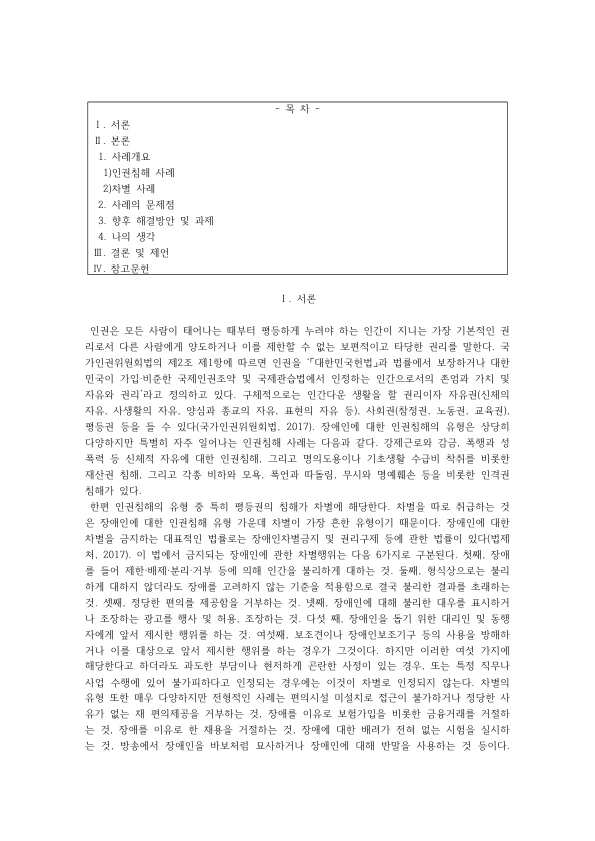
Page 1 is shown as is; from page 2 on, the preview is blurred. Buy it to download the complete original file right away (the file itself is written in Korean).
Packed with real examples and experience. Download it now and save time.
Save your valuable time
Buyer ratings
Fast, accurate and useful.
No ratings yet. Be the first to rate it.


Abuse and Discrimination Against People With Disabilities in Korea: Residential Facility Abuse, Denied Test Accommodations and the Disability Discrimination Act
※ You can preview page 1 as is. Buy it to download the complete original file right away. The file itself is written in Korean.
■ Abuse and Discrimination Against People With Disabilities in Korea: Residential Facility Abuse, Denied Test Accommodations and the Disability Discrimination Act — Overview
A 6-page Korean social welfare law paper on disability rights. It defines human rights and the six kinds of discrimination banned by the Disability Discrimination Act, then examines abuse in residential facilities and a human rights commission ruling on denied test accommodations. It ends with causes and proposals such as whistleblower protection.
■ Abuse and Discrimination Against People With Disabilities in Korea: Residential Facility Abuse, Denied Test Accommodations and the Disability Discrimination Act — Excerpt from the original document (English translation)
The problem with the second case is that people with disabilities are discriminated against in various tests compared with others. It was revealed that although language tests with listening sections are required to provide accommodations for people with disabilities, many do not comply because of cost. Voices from many quarters also say it is unacceptable that people with disabilities, who need far more time than others just to use the restroom and also take longer to eat, are given less time than people without disabilities.
One of the fundamental factors behind violating the basic rights of socially vulnerable people or failing to consider them is the "culture of discrimination" against them. Overcoming a sense of discrimination against others and an obsession with differences will be the most important precondition for creating harmony and universal human rights. Social integration of people with disabilities, that is, accepting them as neighbors who live, work and talk with us in our society, becomes possible only when obsession with differences and prejudice are overcome, because discrimination means that others or society culturally devalue one side.
It is true that welfare policies for people with disabilities in our society have improved a great deal compared with the past. According to the Korea Institute for Health and Social Affairs report released in 2016 on changes in the economic activity of people with disabilities and policy tasks, the economic activity of people with disabilities has recently increased and their life satisfaction has also risen (Choi Eun-hee, 2016). Looking at the 2014 survey results, 47.8% of people with disabilities who did not take part in economic activity said they were satisfied with their current life, while among those who did take part the figure reached 69.5%.
Nevertheless, the survey found that discrimination still exists. 35.4% of people with disabilities said they experienced discrimination when trying to get a job. In particular, 52.9% of people with severe disabilities said they experienced discrimination when seeking employment, which shows how serious the problem is. The report also found that 23.7% of people with disabilities experienced discrimination in earned income, and that they also face discrimination in relationships with coworkers.
Although it is fortunate that welfare support for people with disabilities has improved, social prejudice against them is still pointed out as a serious problem. In particular, the fact that people with mild disabilities benefit from various welfare policies while people with severe disabilities, who need more attention and protection than others, are excluded even from opportunities to take part in social activities shows where we currently stand on disability.
Experts stress that our policy toward people with disabilities should now move beyond basic welfare support and focus on substantive human rights protection and independence. It should not simply look after material convenience but remove prejudice and treat people with disabilities as equal subjects of human rights.
The harm that people with disabilities suffer from others ranges widely, from the harm of rape, violence, abuse and other wrongs committed by others or by those with power to harm that even leads to death.
To add: the Anti-Discrimination Against and Remedies for Persons with Disabilities Act was enacted in 2007 and took effect in April 2008, and victims of discrimination can file a petition with the National Human Rights Commission or ask a court for damages and affirmative relief. A 2017 amendment to the Act on Welfare of Persons with Disabilities set up central and regional disability rights advocacy agencies that receive and investigate reports of abuse, and abuse can be reported to 112 or to the advocacy agency (1644-8295). In July 2019 the disability grading system was abolished and replaced by a distinction between severe and non-severe disabilities, and in 2021 the government announced a roadmap to support deinstitutionalization. The statistics and cases in the paper are based on reports from 2014 to 2017.
■ Abuse and Discrimination Against People With Disabilities in Korea: Residential Facility Abuse, Denied Test Accommodations and the Disability Discrimination Act — Contents and key concepts
Why does abuse in disability facilities keep happening?
✦ At a glance
- Korean disability rights cases and the law
- Structure: definitions → cases → problems → solutions → author's view
- Useful for social welfare law and disability policy courses
☰ What the paper covers
- Human rights definition
- Six kinds of discrimination
- Abuse in a residential facility
- Denied test accommodations
- Whistleblower protection
✎ Disability rights law in Korea and the U.S.
Korea's Anti-Discrimination Against Persons With Disabilities Act took effect in 2008 and treats refusing reasonable accommodation as discrimination unless it imposes an undue burden.
In the U.S., the Americans with Disabilities Act of 1990 requires reasonable accommodations and accessible testing, and Olmstead v. L.C. (1999) held that unjustified institutionalization can be discrimination.
Note: the paper itself is written in Korean and discusses Korean law. This page is general study information, not legal advice.
Related wiki: Americans with Disabilities Act (ADA)
■ Abuse and Discrimination Against People With Disabilities in Korea: Residential Facility Abuse, Denied Test Accommodations and the Disability Discrimination Act References
- 최은희. (2016). 장애인 인권보호 안전망 작동을 위한 과제. 충북 FOCUS, (125), 1-16. 제철웅. (2015). 장애인 인권 보호를 위한 입법적 과제. 법학연구, 44, 153-182. 임성택. (2012). 장애인 생활시설에서의 인권 침해, 그 현황과 대책. 저스티스, 7-59. 서미경, 김재훈, 이진향. (2008). 정신보건시설에서의 정시장애인 권리침해에 관한 연구 . 정신보건과 사회사업, 29, 330-367.
- 사례출처: 에이블뉴스(2014.06.16.), “지난해 장애인 인권침해 주요사례 살펴보기“ 사례출처: 인천일보(2017.09.08.), “사각지대에 놓인 장애인 인권. 반복되는 장애인 인권침해“
Take a break with a quick personality test?
Ranked by actual participation. Results in about a minute.
Loading…
Most-read content
Loading view counts…

Campusdown is a lifelong-learning community in Korea offering study materials, information on government support, student loans and scholarships, and more. Don't miss our free resources.
Go to the Campusdown home page →Refund policy
- Change of mind / refund requested after partial use / more than 7 days after purchase
◆ Exceptions
- File errors / cannot download or open the file
◆ How to request a refund: send a 1:1 inquiry via Customer Service at the top