
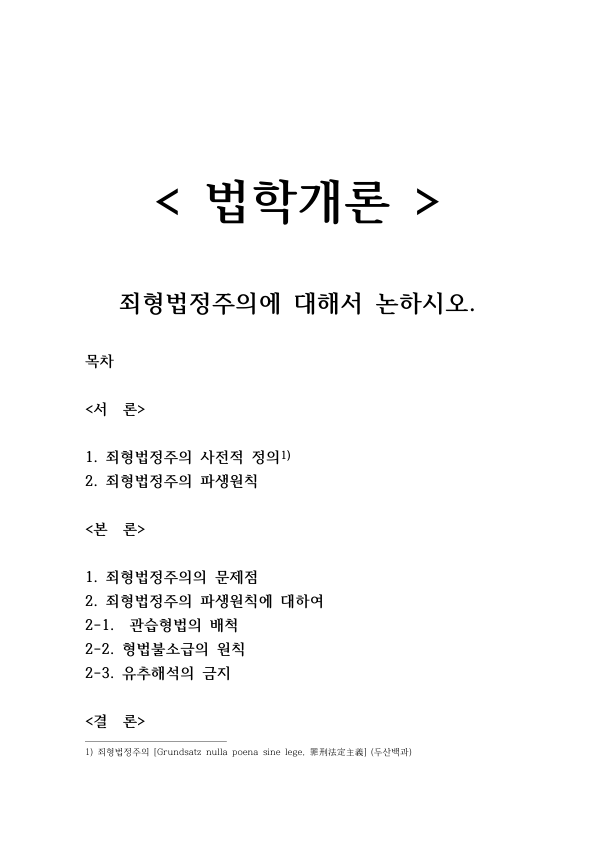
Page 1 is shown as is; from page 2 on, the preview is blurred. Buy it to download the complete original file right away (the file itself is written in Korean).
Packed with real examples and experience. Download it now and save time.
Save your valuable time
Buyer ratings
Fast, accurate and useful.
No ratings yet. Be the first to rate it.


The Principle of Legality in Korean Criminal Law: Ban on Customary Criminal Law, Non-Retroactivity, Ban on Analogy and Their Problems
※ You can preview page 1 as is. Buy it to download the complete original file right away. The file itself is written in Korean.
■ The Principle of Legality in Korean Criminal Law: Ban on Customary Criminal Law, Non-Retroactivity, Ban on Analogy and Their Problems — Overview
A Korean introduction to law essay on nullum crimen sine lege. It explains the clarity requirement and its problems in modern society, then discusses the ban on customary criminal law, non-retroactivity, the ban on analogy and the ban on absolutely indeterminate sentences, pairing each with its benefits and side effects, and concludes with a call for concrete and systematic legislation.
■ The Principle of Legality in Korean Criminal Law: Ban on Customary Criminal Law, Non-Retroactivity, Ban on Analogy and Their Problems — Excerpt from the original document (English translation)
Under nulla poena sine lege, if it is not sufficiently announced in advance which acts are punishable under penal provisions, and at the same time the provisions are unclear so that their interpretation or application may be exercised arbitrarily, the demands of nulla poena sine lege would be ignored. Therefore, the principle of clarity is the argument that vague and unclear provisions cannot be called proper laws and also violate nulla poena sine lege in that they harm the protective function of criminal law. Modern nulla poena sine lege cannot be valid literally today. On the legislative side, a tendency has arisen for legal provisions to become generalized in response to complex realities, and in sentencing, too, judges' discretion is gradually expanding. In addition, the shift from retributive punishment to educative punishment eases the limits on judges' conduct. These various factors call for reconsidering the significance, ideals and functions of nulla poena sine lege.
As described above, nulla poena sine lege shows problems in various respects in modern society. So it is necessary to look at what the other principles derived from nulla poena sine lege are specifically, and whether they have resulting problems.
2-1. Exclusion of customary criminal law: crimes and punishments must be set by "statutes" enacted in statutory form by the National Assembly. Customary law is not included here, because its content cannot be said to be widely known to the general public, and its scope is also unclear, making it unsuitable as a norm whose legal effect is punishment. However, there are cases in which social customs must be taken into account in interpreting individual elements of offenses or judging the unlawfulness of conduct.
The principle prohibiting customary criminal law has both positive and negative aspects.
Nulla poena sine lege is the first chapter of general criminal law and a topic connected to the constitutional freedom of the person, so it appears on exams in introduction to law, criminal law and constitutional law alike. Organizing each principle by pairing its strengths and limits, as this material does, gives you practice writing concept explanations and critical views in one flow for essay questions, and you can enrich your answers by adding cases on the prohibition of retroactive effect and analogical interpretation. In particular, topics such as the tension between public sentiment and legal stability and legislative gaps for new types of crime are also good for expanding into debate classes or presentation topics.
■ The Principle of Legality in Korean Criminal Law: Ban on Customary Criminal Law, Non-Retroactivity, Ban on Analogy and Their Problems — Contents and key concepts
The Principle of Legality in Korean Criminal Law
✦ At a glance
- The four corollaries of the principle of legality
- Structure: introduction → clarity → corollaries → conclusion
- Useful for introductory law and criminal law essays
☰ What the paper covers
- Meaning and history of the principle
- Clarity and its limits
- Customary law, retroactivity and analogy
- Indeterminate sentences
✎ Background in brief
The principle of legality means no crime and no punishment without a prior written law.
Each corollary protects citizens but can also create gaps that legislators must fill.
Note: the paper itself is written in Korean and discusses Korean law. This page is general study information, not legal advice.
Related wiki: Nulla Poena Sine Lege
Related wiki: Electronic Monitoring and Ankle Monitors
Take a break with a quick personality test?
Ranked by actual participation. Results in about a minute.
Loading…
Most-read content
Loading view counts…

Campusdown is a lifelong-learning community in Korea offering study materials, information on government support, student loans and scholarships, and more. Don't miss our free resources.
Go to the Campusdown home page →Refund policy
- Change of mind / refund requested after partial use / more than 7 days after purchase
◆ Exceptions
- File errors / cannot download or open the file
◆ How to request a refund: send a 1:1 inquiry via Customer Service at the top