
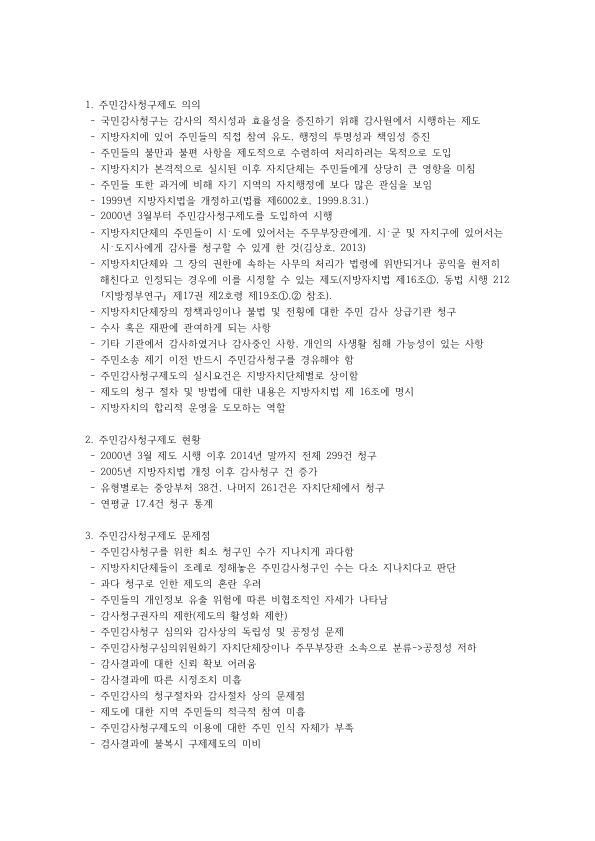
Page 1 is shown as is; from page 2 on, the preview is blurred. Buy it to download the complete original file right away (the file itself is written in Korean).
Packed with real examples and experience. Download it now and save time.
Save your valuable time
Buyer ratings
Fast, accurate and useful.
No ratings yet. Be the first to rate it.

Resident Audit Requests in Korean Local Government: Purpose, Use, Problems and Reforms, Requirements Under the Local Autonomy Act and the Link to Resident Lawsuits
※ You can preview page 1 as is. Buy it to download the complete original file right away. The file itself is written in Korean.
■ Resident Audit Requests in Korean Local Government: Purpose, Use, Problems and Reforms, Requirements Under the Local Autonomy Act and the Link to Resident Lawsuits — Overview
A 4-page Korean local government paper on resident audit requests, which let residents ask a higher authority to audit unlawful or wasteful acts by their local government. It covers the 2000 launch, what can and cannot be requested, low use through 2014, and problems such as high signature thresholds and weak independence of review bodies.
■ Resident Audit Requests in Korean Local Government: Purpose, Use, Problems and Reforms, Requirements Under the Local Autonomy Act and the Link to Resident Lawsuits — Excerpt from the original document (English translation)
Under the Local Autonomy Act, an ordinance on resident audit requests was enacted in June 2000, allowing residents to request audits of the administration directly from higher authorities. Audit requests can cover matters in which the handling of affairs within the powers of a local government or its head clearly violates the law or the public interest, and residents can jointly sign to request that the province audit city or county affairs.
This resident audit request system was expected from the start not only to raise transparency and trust by feeding residents' views about the administration directly into audits, but also to serve as a safeguard against the misconduct or arbitrary rule of elected local leaders that began to be raised after local autonomy was introduced.
But 17 years after its launch, residents hardly use it. Observers explain that the system has become an empty shell because unlawful matters other than the mayor's political decisions can be handled as ordinary civil complaints, and because the procedures and rules for audit requests are complicated.
A resident audit request goes through a complicated process taking 60 days in total, including applying for and receiving a representative's certificate, collecting residents' signatures and submitting the list of petitioners, publishing the request and making the list available for inspection, carrying out the audit, and publishing and notifying the results. In Gimje City, for example, the ordinance requires at least 200 residents to sign, which critics say is too many in practice. On top of that, filing easy online complaints has recently become common, and the city promoted the system only briefly in its first year, so it has not had the effect originally hoped for.
Despite the good intention of having direct resident participation complement indirect democracy and revitalize local autonomy, the system fails to do its job, and since critics say the number of required signatures was set unreasonably high from the start, it needs to be adjusted so that it can take root. If Gyeonggi Province insists on around 6,000 petitioners, the system will hardly be effective. The number of petitioners should be cut sharply now, with measures to prevent excessive requests and side effects, for example by excluding matters involved in investigations or trials, matters that may invade privacy, and matters under audit by other agencies. In any case, I hope this system takes root and helps improve residents' welfare, ending the practice of higher authorities judging group complaints at will and closing them with a brief inquiry, and the practice of the Ombudsman ignoring its own guidelines on resolving multi-party complaints.
To add: the Local Autonomy Act, fully revised in 2021 and in force since January 13, 2022, moved resident audit requests to Article 21, lowered the eligible age from 19 to 18, and lowered the cap on the required number of petitioners, to be set by ordinance within 300 for provinces, 200 for cities with 500,000 or more people and 150 for cities, counties and districts. The period for filing was also extended from two to three years after the affairs were handled or ended. Residents who filed an audit request can bring a resident lawsuit (Article 22) if they are dissatisfied with the audit results.
■ Resident Audit Requests in Korean Local Government: Purpose, Use, Problems and Reforms, Requirements Under the Local Autonomy Act and the Link to Resident Lawsuits — Contents and key concepts
How can residents in Korea demand an audit of their local government?
✦ At a glance
- Korea's resident audit request system
- Structure: purpose → use → problems → reforms
- Useful for local government and public administration courses
☰ What the paper covers
- Launch in 2000
- What can be requested
- Link to resident suits
- Low use
- Problems and reforms
✎ Citizen oversight in Korea and the U.S.
Korea's 2021 Local Autonomy Act lowered the age and signature thresholds for audit requests and extended the filing period to three years.
Many U.S. states let citizens petition the state auditor for an audit, and taxpayers can often sue to stop illegal spending of public funds.
Note: the paper itself is written in Korean and discusses Korean law. This page is general study information, not legal advice.
Related wiki: Freedom of Information Act (FOIA)
■ Resident Audit Requests in Korean Local Government: Purpose, Use, Problems and Reforms, Requirements Under the Local Autonomy Act and the Link to Resident Lawsuits References
- 조성제. (2016). 주민감사청구제도의 실효성 제고를 위한 감사위원회 설치에 관한 소고. 한양법학, 27`1(1), 235-264. 236 김상호. (2013).
- 비교적 관점에서 현행 주민감사청구제도의 문제점과 개선방안. 지방정부연구, 17(2), 211-232.
- 211-212 주영화(2010). 주민감사청구제도 개선방안에 관한 연구. 동국대학교 박사학위 논문. 36, 59-70 허훈. (2003).
- 주민감사청구제도의 운용실태와 개선방안. 한국지방자치학회보, 15(1), 5-24.
- 12-15 한국지방자치학회(2000), 한국지방자치론, 삼영사 한국정책학회(2015). 주민참여제도 현황 및 활성화 방안 연구
Take a break with a quick personality test?
Ranked by actual participation. Results in about a minute.
Loading…
Most-read content
Loading view counts…

Campusdown is a lifelong-learning community in Korea offering study materials, information on government support, student loans and scholarships, and more. Don't miss our free resources.
Go to the Campusdown home page →Refund policy
- Change of mind / refund requested after partial use / more than 7 days after purchase
◆ Exceptions
- File errors / cannot download or open the file
◆ How to request a refund: send a 1:1 inquiry via Customer Service at the top