
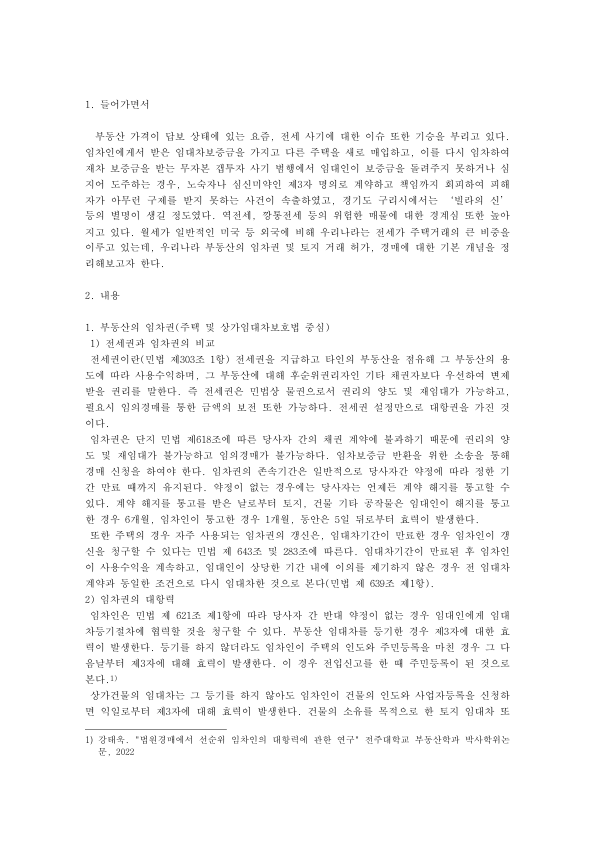
Page 1 is shown as is; from page 2 on, the preview is blurred. Buy it to download the complete original file right away (the file itself is written in Korean).
Packed with real examples and experience. Download it now and save time.
Save your valuable time
Buyer ratings
Fast, accurate and useful.
No ratings yet. Be the first to rate it.

Korean Jeonse Deposits Explained: Jeonse Rights vs. Lease Rights, Tenant Protection Under the Housing Lease Protection Act, Lease Registration Orders and Auction Terms
※ You can preview page 1 as is. Buy it to download the complete original file right away. The file itself is written in Korean.
■ Korean Jeonse Deposits Explained: Jeonse Rights vs. Lease Rights, Tenant Protection Under the Housing Lease Protection Act, Lease Registration Orders and Auction Terms — Overview
A 4-page Korean property law paper written against the background of jeonse (lump-sum deposit lease) fraud. It compares a registered jeonse right under Article 303 of the Korean Civil Act with an ordinary lease right under Article 618, explains how tenants gain priority under the Housing Lease Protection Act through move-in and resident registration, the lease registration order used when a deposit is not returned, the Commercial Building Lease Protection Act, the land transaction permit system, and basic court auction terms.
■ Korean Jeonse Deposits Explained: Jeonse Rights vs. Lease Rights, Tenant Protection Under the Housing Lease Protection Act, Lease Registration Orders and Auction Terms — Excerpt from the original document (English translation)
No permission is required for certain items, such as inheritance or gifts without payment of consideration, land smaller than the area subject to permission, acquisition by agreement, expropriation or use under the Act on Acquisition of and Compensation for Land, etc. for Public Works Projects, and dispositions on default of national and local taxes and compulsory execution. Where a contract is concluded without permission for an area requiring permission, imprisonment of up to two years or a fine is imposed. A charge for compelling compliance is also imposed where land acquired with permission is not used for the permitted purpose.
Many people are interested in real-estate auctions because they allow real estate to be bought below market price, but it is also a field that requires thorough preparation because of uncertainty caused by information asymmetry. To learn about the property in question, one must check the certified copy of the register and the like, and the related terms are as follows.
1) Mortgage (Civil Act Article 356): the right to receive payment in priority over other creditors from real estate that the debtor or a third party has provided as security for an obligation without transferring possession. Since it is a real right, a right in a thing, it is established only with a mortgage agreement and registration. Its objects include real estate, superficies and jeonse rights, mining rights, automobiles and the like.
2) Revolving mortgage (geun-mortgage): whereas a mortgage is a security right for a currently fixed amount, a revolving mortgage is a security right for an unfixed amount that can change. With a mortgage, the claim is extinguished upon repayment, but a revolving mortgage is not extinguished before the settlement date even if repayment is made.
To become subject to auction, seizure or the like must be carried out.
3) Seizure: a means of preservation for carrying out compulsory execution based on a final judgment or the like. It means preventing the debtor from exercising rights at will, such as selling the property, before the property is put up for auction.
4) Provisional seizure: a temporary measure taken on the debtor's assets after filing suit and before carrying out compulsory execution. Since compulsory execution takes time, it is meant to prevent the sale or concealment of property in the meantime.
Auctions include voluntary auctions and compulsory auctions, defined as follows.
5) Voluntary auction: a procedure in which a party holding a security right such as a mortgage, jeonse right or lien voluntarily takes the collateral, converts it into money, and receives repayment of the secured claim from the proceeds.
6) Compulsory auction: a procedure for seizing real estate owned by the debtor, converting it into money, and satisfying a monetary claim with the sale proceeds.
The lease system has continued to change since the material was written. The July 2020 amendment to the Housing Lease Protection Act introduced the tenant's right to demand contract renewal (once, for two years) and a 5% cap on increases in rent and deposits, and in June 2023 the Special Act on Support for Victims of Jeonse Fraud and Housing Stability took effect, creating support systems such as victim determination, postponement of auctions and a preferential purchase right. The threshold amounts for top-priority repayment to small-sum tenants also change by Enforcement Decree, so for assignments or actual contracts be sure to check the latest provisions at the National Law Information Center.
■ Korean Jeonse Deposits Explained: Jeonse Rights vs. Lease Rights, Tenant Protection Under the Housing Lease Protection Act, Lease Registration Orders and Auction Terms — Contents and key concepts
How do Korean tenants protect a large lease deposit?
✦ At a glance
- Jeonse rights vs. lease rights and tenant priority rules
- Structure: jeonse fraud background → lease rights → land permits → auction terms
- Useful for property law, everyday law and anyone studying Korean housing
☰ What the paper covers
- Jeonse fraud background
- Jeonse right vs. lease right
- Priority under the Housing Lease Protection Act
- Lease registration orders
- Land permits and auction vocabulary
✎ Tenant protection in Korea
A tenant who moves in and registers residence gains priority against a new owner from the next day, and a fixed-date stamp on the contract adds priority in auction payouts.
Since 2020 tenants may request one two-year renewal with rent increases capped at 5%, and a 2023 special act supports victims of jeonse fraud.
Note: the paper itself is written in Korean and discusses Korean law. This page is general study information, not legal advice.
Take a break with a quick personality test?
Ranked by actual participation. Results in about a minute.
Loading…
Most-read content
Loading view counts…

Campusdown is a lifelong-learning community in Korea offering study materials, information on government support, student loans and scholarships, and more. Don't miss our free resources.
Go to the Campusdown home page →Refund policy
- Change of mind / refund requested after partial use / more than 7 days after purchase
◆ Exceptions
- File errors / cannot download or open the file
◆ How to request a refund: send a 1:1 inquiry via Customer Service at the top