
Page 1 is shown as is; from page 2 on, the preview is blurred. Buy it to download the complete original file right away (the file itself is written in Korean).
Packed with real examples and experience. Download it now and save time.
Save your valuable time
Buyer ratings
Fast, accurate and useful.
No ratings yet. Be the first to rate it.

Delegated Legislation in Korea and Its Limits: Executive Decrees in the Four Major Rivers Project and the Sewol Ferry Special Act
※ You can preview page 1 as is. Buy it to download the complete original file right away. The file itself is written in Korean.
■ Delegated Legislation in Korea and Its Limits: Executive Decrees in the Four Major Rivers Project and the Sewol Ferry Special Act — Overview
A 4-page Korean public law paper on delegated legislation, where bodies other than the National Assembly make general rules under statutory authority. It explains why delegation grew with the modern administrative state, then uses two controversies, the Four Major Rivers Restoration Project and the enforcement decree of the Sewol Ferry Special Act, to show how executive decrees can sidestep legislative debate or exceed the scope of the parent statute.
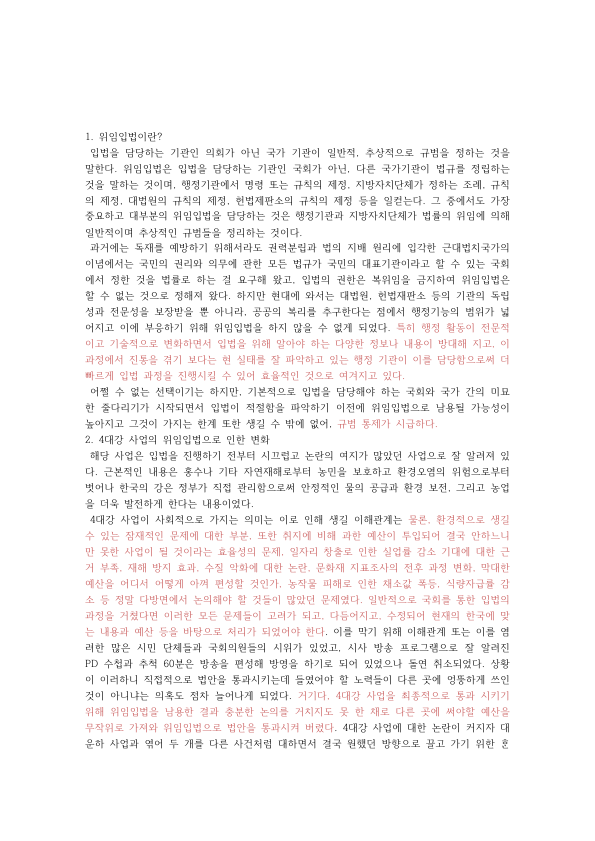
■ Delegated Legislation in Korea and Its Limits: Executive Decrees in the Four Major Rivers Project and the Sewol Ferry Special Act — Excerpt from the original document (English translation)
The social significance of the Four Major Rivers Project involved a great many matters to be discussed from many angles: not only the conflicts of interest it would create, but also potential environmental problems; the efficiency issue that an excessive budget relative to its purpose would make it a project worse than doing nothing; the lack of grounds for the expected reduction in unemployment through job creation; disaster-prevention effects; controversy over deteriorating water quality; changes before and after surface surveys of cultural heritage; where and how to save and allocate the enormous budget; soaring vegetable prices due to crop damage; and a decline in the food self-sufficiency rate. Had it gone through the ordinary process of legislation by the National Assembly, all these issues should have been considered, refined and revised, and handled on the basis of content and a budget suited to today's Korea. To prevent this, there were protests by many civic groups and lawmakers who had interests at stake or were concerned, and the well-known current-affairs programs PD Note and Chuchuk 60 Minutes had scheduled broadcasts that were suddenly cancelled. Under these circumstances, suspicions gradually grew that the efforts that should have gone into passing the bill directly had been spent elsewhere. Moreover, as a result of abusing delegated legislation to finally pass the Four Major Rivers Project, the bill was passed through delegated legislation without sufficient discussion, arbitrarily taking budget that should have been used elsewhere. It was also enough to provoke public anger that, as controversy over the project grew, it was linked to the Grand Canal project and the two were treated as separate matters, used as a tool to ultimately steer things in the desired direction.
This is drawing strong criticism that, rather than trying to resolve the Four Major Rivers issue quickly because it was important and urgent, the aim was to get good results in judgments about what achievements had been made within the term of office. This issue drew intense reactions and interest not only in Korea but also from foreign media. Critics have argued that the Four Major Rivers Project, with unclear purposes, is a clearly environmentally destructive project that violates the Ramsar Convention and the Convention on Biological Diversity and must be stopped. Ryoichi Hori, Japan representative of the Ramsar Network, "said strongly that Korea hosted the 2008 Conference of the Parties to the Ramsar Convention and promised to protect the world's wetlands, so destroying wetlands like this is unthinkable and must be stopped immediately." Afterward, the Ministry of Land, Transport and Maritime Affairs tried to prove the project's results by issuing a press release saying it contributes greatly to job creation and revitalizing local economies, but even now, as of 2016, attempts to properly assess the economic ripple effects of the Four Major Rivers Restoration Project appear to have produced no notable results.
For reference, Article 75 of the Constitution provides that the President may issue Presidential Decrees on matters delegated by statute with their scope specifically defined, and Article 95 provides for Prime Ministerial Decrees and Ordinances of Ministries. Where whether orders or rules violate the Constitution or statutes is a premise of a trial, the Supreme Court has final review (Article 107(2) of the Constitution), and Article 98-2 of the National Assembly Act requires enforcement decrees and the like to be submitted to the competent standing committee of the National Assembly. The policy assessments and media reports in the material are the author's summary, so when citing them in an assignment check the original texts and provisions directly.
■ Delegated Legislation in Korea and Its Limits: Executive Decrees in the Four Major Rivers Project and the Sewol Ferry Special Act — Contents and key concepts
How far can a Korean statute hand lawmaking to the executive?
✦ At a glance
- Delegated legislation and its limits
- Structure: definition → two case studies → core problems
- Useful for administrative and constitutional law classes
☰ What the paper covers
- What delegated legislation is
- Why delegation expanded
- The Four Major Rivers Project
- The Sewol Ferry Act decree
- Weakened legislative control
✎ Delegation in Korea and the U.S.
Article 75 of the Korean Constitution allows presidential decrees only on matters a statute delegates with a specific scope, which the Constitutional Court reads as requiring that the outline of the decree be foreseeable from the statute itself.
U.S. law has a parallel nondelegation doctrine requiring an intelligible principle, J.W. Hampton, Jr. & Co. v. United States, 276 U.S. 394 (1928), and Loper Bright Enterprises v. Raimondo (2024) ended Chevron deference to agency interpretations.
Note: the paper itself is written in Korean and discusses Korean law. This page is general study information, not legal advice.
Related wiki: Nondelegation Doctrine
Related wiki: Legislative vs. Interpretive Rules
■ Delegated Legislation in Korea and Its Limits: Executive Decrees in the Four Major Rivers Project and the Sewol Ferry Special Act References
- 위임입법 http://terms.naver.com/entry.nhn?docId=1131870&cid=40942&categoryId=31696
- 국회 입법과정 개선에 관한 연구 [2015, 곽홍규, 창원대학교]
- 委任立法의 限界에 관한 硏究 [2003, 김성수, 건국대학교]
- 행정위임입법 https://ko.wikipedia.org/wiki/%ED%96%89%EC%A0%95%EC%9C%84%EC%9E%84%EC%9E%85%EB%B2%95
- 정의당, 박원석 보도자료 입법조사처 세월호 특별법시행령안 모범위임범위 일탈 http://blog.naver.com/justiceparty/220329370124
- 위임입법 한계의 일탈과 무효선언 http://blog.naver.com/kspala/220215398008
- 법위의 시행령, 위임입법 견제장치 유명무실 http://lawinside.com/index.php?mid=lawnews&page=2&document_srl=2047
- 4대강 정비사업에 대한 비판 https://ko.wikipedia.org/wiki/4%EB%8C%80%EA%B0%95_%EC%A0%95%EB%B9%84_%EC%82%AC%EC%97%85%EC%97%90_%EB%8C%80%ED%95%9C_%EB%B9%84%ED%8C%90#.EB.B9.84.ED.8C.90
- 탕탕탕으로 날치기 통과시킨 4대강, 결국 부메랑이 될것 http://www.ohmynews.com/NWS_Web/View/at_pg.aspx?CNTN_CD=A0001277699
- 절차와 상식 없는 4대강 사업 예산 날치기 통과 http://kfem.or.kr/?p=9678
- 조사방해 막자 세월호 유가족 특별법 개정 청원 http://www.ohmynews.com/NWS_Web/View/at_pg.aspx?CNTN_CD=A0002183142
- 세월호 시행령 특별법 입법취지 어긋나 http://www.jeonmin.co.kr/news/articleView.html?idxno=130305
- 국회 입법조사처 세월호 특별법 시행령 법적으로 문제 http://www.ohmynews.com/NWS_Web/View/at_pg.aspx?CNTN_CD=A0002098670
- 여야 냉전중이라도 비쟁점법안은 합의 처리 시켜야 http://www.newsis.com/ar_detail/view.html?ar_id=NISX20160429_0014054358&cID=10301&pID=10300
- 여야 세월호 특별법 TF에 협상 전권 위임 http://news.newsway.co.kr/view.php?tp=1&ud=2014072113250893847&md=20140721134305_AO
- 세월호 특별법부터 시행령이 모법 침해 못하도록 http://www.hg-times.com/news/articleView.html?idxno=90470
- 세월호 특별법 1년 아직 조사는 시작도 못했다 http://www.mediatoday.co.kr/news/articleView.html?idxno=125824
Take a break with a quick personality test?
Ranked by actual participation. Results in about a minute.
Loading…
Most-read content
Loading view counts…

Campusdown is a lifelong-learning community in Korea offering study materials, information on government support, student loans and scholarships, and more. Don't miss our free resources.
Go to the Campusdown home page →Refund policy
- Change of mind / refund requested after partial use / more than 7 days after purchase
◆ Exceptions
- File errors / cannot download or open the file
◆ How to request a refund: send a 1:1 inquiry via Customer Service at the top