
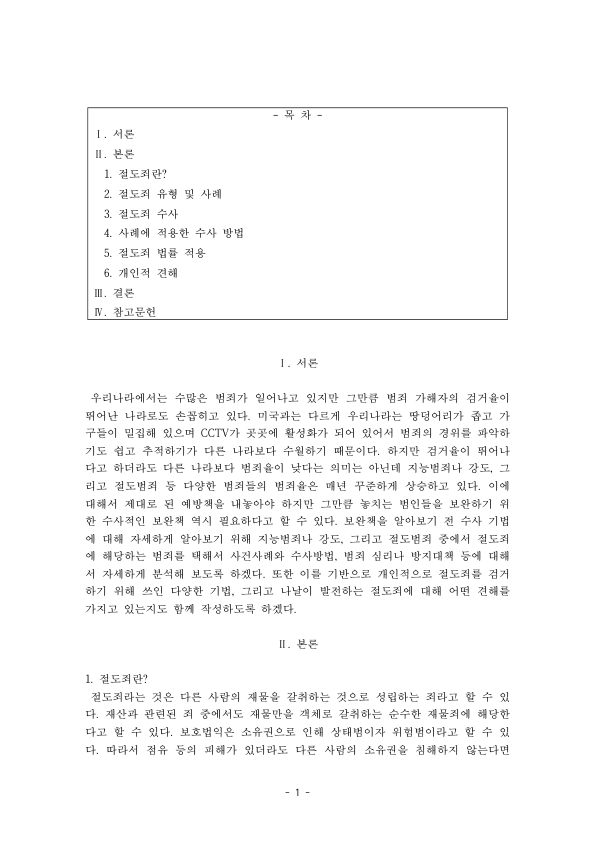
Page 1 is shown as is; from page 2 on, the preview is blurred. Buy it to download the complete original file right away (the file itself is written in Korean).
Packed with real examples and experience. Download it now and save time.
Save your valuable time
Buyer ratings
Fast, accurate and useful.
No ratings yet. Be the first to rate it.


Theft under the Korean Criminal Act and How Police Investigate It: Types of Theft, Intent to Appropriate, Case Law and Investigation Steps
※ You can preview page 1 as is. Buy it to download the complete original file right away. The file itself is written in Korean.
■ Theft under the Korean Criminal Act and How Police Investigate It: Types of Theft, Intent to Appropriate, Case Law and Investigation Steps — Overview
An 11-page Korean criminal law and investigation paper. It explains theft and its difference from robbery, the types of theft in Articles 329 to 332 of the Criminal Act and cases on intent to appropriate, then walks through initial, crime-scene, suspect and follow-up investigation and applies them to car theft.
■ Theft under the Korean Criminal Act and How Police Investigate It: Types of Theft, Intent to Appropriate, Case Law and Investigation Steps — Excerpt from the original document (English translation)
Simple theft is a crime under Article 329 of the Criminal Act committed by stealing another person's property. There are various specific types of theft: theft by night entry, under Article 330, is committed by entering at night a residence or guarded house, building or vessel and stealing another's property.
Aggravated theft falls under Article 331 and covers entering a residence or guarded house, building or vessel at night after breaking a door, wall or other part of a building. It also covers stealing another's property while carrying a dangerous weapon or jointly with two or more people. A dangerous weapon here means a tool made to kill or injure people or to damage property. Unauthorized use of a motor vehicle, under Article 331-2, is committed by temporarily using another person's car, vessel, aircraft or motorized bicycle without the owner's consent. However, it does not apply where there was no time to obtain consent in advance and approval was obtained after the temporary use.
Habitual offenders who repeatedly commit crimes under Article 329 or 331-2 receive heavier punishment, and the special rule for crimes between relatives is also among the types of theft. This rule, known as chinjok sangdorye, means that certain crimes between relatives are either exempt from punishment or can be prosecuted only upon a complaint by the relative. For theft between close relatives, punishment is exempted, and there are many domestic cases of these various types of theft. Theft by night entry, such as breaking into an inhabited but empty house to steal, keeps occurring even though widespread CCTV has some deterrent effect.
Looking briefly at Korean court decisions on theft, one case held that the victim's possession of their belongings continues after death, so taking items the victim carried at the scene of the killing with intent to appropriate them infringed the victim's possession and was theft. A Supreme Court decision of December 9, 1969 held that a resident registration card is property and can be the object of theft, and another held that breaking into an orchard storehouse at night to steal was theft by night entry even though no one lived there. Notably, one case held that a soldier who took another unit's rifle to replace one he had lost was not guilty of theft because he lacked the intent to appropriate it, while another held that taking a book after pretending to read it in front of its owner was theft because the book was still in the owner's possession. With this in mind, I will look at how theft is investigated, including investigation methods, criminal psychology and prevention, and then apply them to a concrete case.
First, because theft occurs mainly in daily life, clues can be obtained when the victim reports it.
To add: on June 27, 2024 the Constitutional Court held that Article 328(1) of the Criminal Act, which uniformly exempted from punishment property crimes between lineal blood relatives, spouses, relatives living together and others, violated victims' right to make statements at trial, and issued a decision of nonconformity suspending its application (2020Hun-Ma468 and others). A Criminal Act amendment passed by the National Assembly in December 2025 made property crimes between relatives offenses that can be prosecuted only upon the victim's complaint. The paper's statement that punishment is exempted between close relatives therefore no longer reflects current law. The protected interest in theft is generally seen as ownership, though some scholars hold that possession is also protected, and the paper's vehicle registration figures are as of the time of writing.
■ Theft under the Korean Criminal Act and How Police Investigate It: Types of Theft, Intent to Appropriate, Case Law and Investigation Steps — Contents and key concepts
From the elements of theft to the steps of investigation
✦ At a glance
- Theft offenses and investigation methods in Korea
- Structure: elements → types and cases → investigation → car theft → views
- Useful for criminal law, police administration and investigation courses
☰ What the paper covers
- Theft vs. robbery
- Articles 329 to 332
- Intent to appropriate
- Investigation checklists
- Car theft and prevention
✎ Theft law in Korea and the U.S.
Korea's Criminal Act grades theft by night entry, use of weapons and group action, and since a 2025 amendment property crimes between close relatives require a complaint.
In the U.S., theft is mostly state law, often consolidated from larceny, embezzlement and false pretenses, and burglary is a separate offense of unlawful entry.
Note: the paper itself is written in Korean and discusses Korean law. This page is general study information, not legal advice.
Related wiki: Nulla Poena Sine Lege
■ Theft under the Korean Criminal Act and How Police Investigate It: Types of Theft, Intent to Appropriate, Case Law and Investigation Steps References
- 형사수사론. 박두칠. 동민. 2001.
- 범죄수사론. 손봉선. 법문사. 2000.
- 수사실무. 박상림. 엑스퍼트. 2001.
- 경찰수사론. 이무영. 경찰대. 1998.
Take a break with a quick personality test?
Ranked by actual participation. Results in about a minute.
Loading…
Most-read content
Loading view counts…

Campusdown is a lifelong-learning community in Korea offering study materials, information on government support, student loans and scholarships, and more. Don't miss our free resources.
Go to the Campusdown home page →Refund policy
- Change of mind / refund requested after partial use / more than 7 days after purchase
◆ Exceptions
- File errors / cannot download or open the file
◆ How to request a refund: send a 1:1 inquiry via Customer Service at the top