
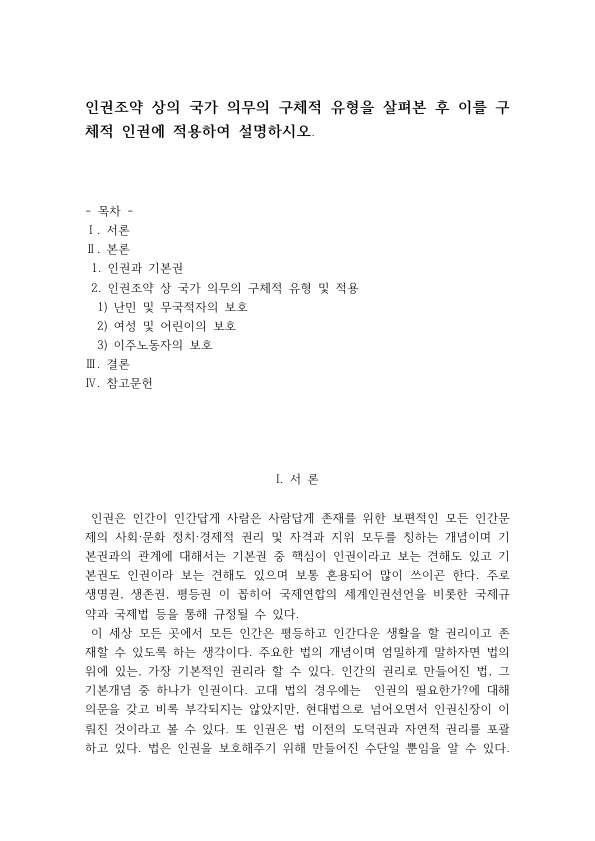
Page 1 is shown as is; from page 2 on, the preview is blurred. Buy it to download the complete original file right away (the file itself is written in Korean).
Packed with real examples and experience. Download it now and save time.
Save your valuable time
Buyer ratings
Fast, accurate and useful.
No ratings yet. Be the first to rate it.
State Obligations under Human Rights Treaties: Rights and Basic Rights, the Treaty System, and Protecting Refugees, Women, Children and Migrant Workers
※ You can preview page 1 as is. Buy it to download the complete original file right away. The file itself is written in Korean.
■ State Obligations under Human Rights Treaties: Rights and Basic Rights, the Treaty System, and Protecting Refugees, Women, Children and Migrant Workers — Overview
An 8-page Korean international human rights law paper. It compares the concepts of human rights and constitutional rights, lists the main UN and regional human rights treaties by field, and applies treaty obligations to refugees (including non-refoulement and Korea's strict screening), women and children, and migrant workers, concluding that Korea should adopt international standards more actively.
■ State Obligations under Human Rights Treaties: Rights and Basic Rights, the Treaty System, and Protecting Refugees, Women, Children and Migrant Workers — Excerpt from the original document (English translation)
The National Human Rights Commission Act, enacted in 2001, holds that the inviolable basic human rights everyone has must be protected and that human worth and dignity must be realized by raising the level of human rights, with the aim of establishing a basic democratic order.
The Act also defines human rights as 'the dignity, worth, liberty and rights of human beings guaranteed by the Constitution and laws or recognized by international human rights treaties that Korea has joined or ratified and by customary international law,' giving human rights a constitutional guarantee.
The term basic rights was first set out in the Constitutional Court Act, enacted in 1988, which provides that 'any person whose basic rights guaranteed by the Constitution are infringed by the exercise or non-exercise of public power, excluding court rulings, may file a constitutional complaint with the Constitutional Court.'
6-1. Protocol Instituting a Conciliation and Good Offices Commission to be Responsible for Seeking the Settlement of any Disputes which may Arise between States Parties to the Convention against Discrimination in Education
10. Convention against Torture and Other Cruel, Inhuman or Degrading Treatment or Punishment
Refugees are people who leave for another country or region to escape persecution, disaster or war arising from differences in religion, race or political ideas. Under international law, a refugee is 'a national or stateless person who, owing to a well-founded fear of being persecuted for reasons of religion, race, nationality, membership of a particular social group or political opinion, is outside the country of residence or nationality and is unable or unwilling to avail himself of the protection of that country.' A refugee must not be expelled or returned in any manner to the frontiers of territories where his life or freedom would be threatened on account of race, religion, membership of a particular social group or political opinion.
After joining the refugee conventions in 1992, the Korean government did not recognize a single refugee until 2000, and recognized its first refugee only in 2001. Korea's refugee screening is strict: from 1994 to October 2015, there were only 13,888 refugee applicants in Korea, of whom only about 11 obtained refugee status, just 0.16% of the total. Even so, Korea is said to grant humanitarian stay to many who are not recognized as refugees. Refugee recognition is said to have improved gradually, but compared with the reality that refugee applicants in Korea have exceeded 1,000, refugee policy can be called poor. And unlike recognized refugees, people on humanitarian stay are not guaranteed benefits such as health insurance and social security. Korea's refugee screening is said to fall far short in the expertise, objectivity and transparency of the UN or related organizations, and in staffing relative to the country's size and the expertise required. Humanitarian support policies for refugees and stateless people in Korea are needed.
Women's policy refers to a field that proposes women's policies and studies the advancement of women's rights. Its broad goal is the development of women's policy for realizing a gender-equal society. Women's policy works on enacting laws and institutionalizing social participation related to protecting women's human rights, gender equality and economic activity. Its goals focus on achieving substantive gender mainstreaming in law, supporting capacity building and jobs for vulnerable women and diverse families in step with government programs and rapid social change, and social integration through spreading awareness of gender equality and establishing women's human rights. The government has consistently presented policy tasks and goals on promoting gender equality through the Ministry of Gender Equality and Family, the basic direction of women's policy, women's welfare and wider social participation. It has announced that a comprehensive plan for women's policy is drawn up and carried out every five years under the Framework Act on Women's Development.
Child pornography refers to live-action media depicting a person under 13 as a sexual object.
Note: Korea joined the Refugee Convention and Protocol on December 3, 1992, and enacted a separate Refugee Act on February 10, 2012, in force from July 1, 2013. The paper's figure of 'about 11 recognized out of 13,888 applicants (0.16%)' does not add up and its source could not be confirmed, so check the Ministry of Justice's latest statistics. The paper describes child sexual exploitation material as involving people 'under 13,' but the Act on the Protection of Children and Youth against Sex Offenses defines children and youth as people under 19. The Framework Act on Women's Development cited in the paper was replaced by the Framework Act on Gender Equality from July 1, 2015.
■ State Obligations under Human Rights Treaties: Rights and Basic Rights, the Treaty System, and Protecting Refugees, Women, Children and Migrant Workers — Contents and key concepts
The promises a state makes when it joins a treaty
✦ At a glance
- How human rights treaties bind states, applied to vulnerable groups
- Structure: rights → treaty system → refugees → women and children → migrants
- Useful for international human rights law courses
☰ What the paper covers
- Human rights and basic rights
- The treaty system
- Non-refoulement
- Women and children
- Migrant workers
✎ Treaty obligations in Korea and the U.S.
Under Article 6 of Korea's Constitution, ratified treaties have the same effect as domestic law, and Korea enacted a separate Refugee Act in force from 2013.
In the U.S., the Refugee Act of 1980 brought U.S. law in line with the 1967 Protocol, though many human rights treaties are ratified as non-self-executing.
Note: the paper itself is written in Korean and discusses Korean law. This page is general study information, not legal advice.
Related wiki: Universal Declaration of Human Rights, Hate Speech
■ State Obligations under Human Rights Treaties: Rights and Basic Rights, the Treaty System, and Protecting Refugees, Women, Children and Migrant Workers References
- 참고도서 국제인권법, 임재홍, 정경수, 한국방송통신대학교출판부, 2014. 1. 25.
- 국제인권법, 박찬운 지은이, 한울아카데미, 1999. 9. 10.
- 국제인권법, 토마스 버겐탈 지은이, 양건 옮긴이, 교육과학사, 2001. 4. 20.
- 국제인권법원론, 한희원 지은이, 삼영사, 2012. 2. 10 국제인권조약, 정인섭 편역, 유네스코한국위원회, 도서출판 사람생각, 2000. 12. 23.
- 난민인권센터, 행정정보공개청구 결과, 법무부 난민과, 2015. 6. 24.
- 인권의 역사, 스기하라 아스오 지은이, 석인석 번역, 한울총서, 1995. 9. 1. 2.
- 참고사이트 국제인권선언 www.unesco.or.kr/hrtreaty 위키백과 기본권 https://ko.wikipedia.org/wiki/%EA%B8%B0%EB%B3%B8%EA%B6%8C#.EB.8C.80.ED.95.9C.EB.AF.BC.EA.B5.AD
Take a break with a quick personality test?
Ranked by actual participation. Results in about a minute.
Loading…
Most-read content
Loading view counts…

Campusdown is a lifelong-learning community in Korea offering study materials, information on government support, student loans and scholarships, and more. Don't miss our free resources.
Go to the Campusdown home page →Refund policy
- Change of mind / refund requested after partial use / more than 7 days after purchase
◆ Exceptions
- File errors / cannot download or open the file
◆ How to request a refund: send a 1:1 inquiry via Customer Service at the top