
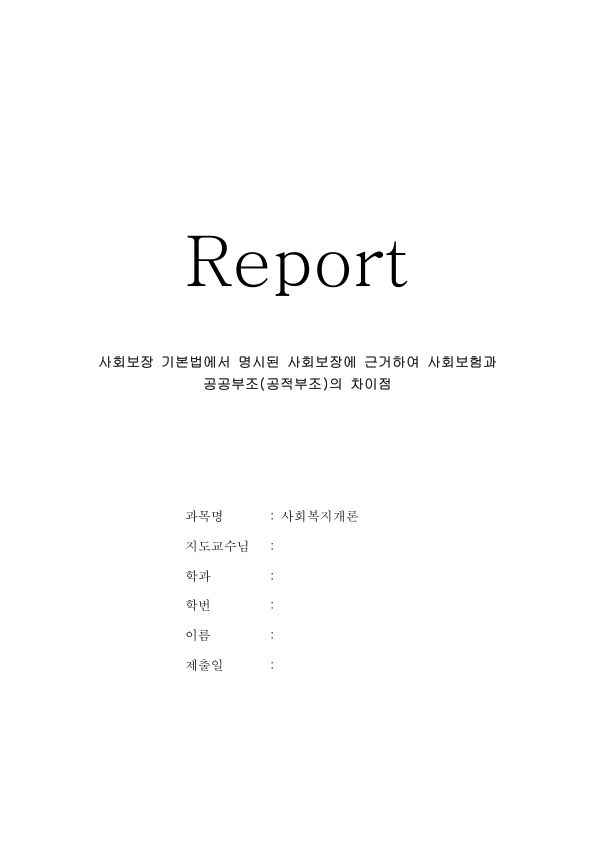
Page 1 is shown as is; from page 2 on, the preview is blurred. Buy it to download the complete original file right away (the file itself is written in Korean).
Packed with real examples and experience. Download it now and save time.
Save your valuable time
Buyer ratings
Fast, accurate and useful.
No ratings yet. Be the first to rate it.
Social Insurance vs. Public Assistance in Korea: Definitions in the Framework Act on Social Security and a Comparison of Funding, Eligibility and Means Testing
※ You can preview page 1 as is. Buy it to download the complete original file right away. The file itself is written in Korean.
■ Social Insurance vs. Public Assistance in Korea: Definitions in the Framework Act on Social Security and a Comparison of Funding, Eligibility and Means Testing — Overview
A 6-page Korean social welfare paper. Using the definitions in Korea's Framework Act on Social Security, it explains the nature and history of social insurance, from pensions and industrial accident insurance to employment insurance, and of public assistance under the National Basic Livelihood Security Act, then compares the two in a table.
■ Social Insurance vs. Public Assistance in Korea: Definitions in the Framework Act on Social Security and a Comparison of Funding, Eligibility and Means Testing — Excerpt from the original document (English translation)
The purpose of public assistance is to help people in need regain the ability to support themselves as quickly as possible, return them to ordinary life and free them to some degree from poverty. Public assistance benefits are generally paid only to people who can prove they are poor, and the final decision on the amount is made by the government that runs the program. Public assistance plans take into account income levels, unemployment, dependents and disability.
In Korea, public assistance is provided mainly under the National Basic Livelihood Security Act, in force since October 2000. The act aims to provide necessary benefits to people in hardship, guarantee their minimum living standard and promote self-support, thereby contributing to social welfare.
Recipients under the National Basic Livelihood Security Act are, among others, households whose recognized income, the sum of average household income and the income equivalent of their assets, is at or below the minimum cost of living and who have no person legally obliged to support them, or whose obligated supporters cannot or do not support them.
The provisions of the Framework Act on Social Security that mention public assistance are as follows. Article 3(3): 'public assistance' means a system under which the state, under the responsibility of local governments, guarantees the minimum living of citizens who cannot support themselves or live in hardship and supports their independence. Article 22(2): in building and running a lifelong social safety net, the state and local governments must provide public assistance for socially vulnerable groups to guarantee their minimum living. Article 25(5): social insurance is in principle run under the responsibility of the state, and public assistance and social services under the responsibility of the state and local governments, though this may be adjusted by consultation in light of their finances. Article 28(3): the state and local governments bear all or part of the cost of public assistance and of social services for people below a certain income level set by law.
Social insurance: finances are relatively easy to predict.
Public assistance: finances are hard to predict.
Social insurance: benefits are paid under legal rules regardless of the recipient's needs or financial situation.
Public assistance: a statutory amount is paid according to the applicant's needs.
This paper has examined the differences between social insurance and public assistance as set out in the Framework Act on Social Security.
To add: Article 3(3) of the Framework Act on Social Security defines public assistance as a system under which, 'under the responsibility of the state and local governments,' the minimum living of citizens who cannot support themselves or live in hardship is guaranteed and their independence supported. The paper's comparison table, which lists public assistance as 'not a legal right,' should be corrected: benefits under the National Basic Livelihood Security Act are a legal right that can be claimed once the requirements are met, and a refusal can be challenged by objection and administrative litigation. Public assistance is also not limited to people with 'no ability to work at all.' Since July 2015, selection standards for each benefit have been set by the standard median income instead of the minimum cost of living, and the supporter-obligation rule for livelihood benefits was abolished in principle in October 2021 (with exceptions for high-income, high-asset supporters).
■ Social Insurance vs. Public Assistance in Korea: Definitions in the Framework Act on Social Security and a Comparison of Funding, Eligibility and Means Testing — Contents and key concepts
Paying premiums vs. tax-funded support
✦ At a glance
- How social insurance and public assistance differ in Korea
- Structure: background → social insurance → public assistance → comparison
- Useful for social welfare and social security courses
☰ What the paper covers
- Social security after 1997
- History of social insurance
- Basic livelihood security
- Key articles of the framework act
- Comparison table
✎ Social insurance and public assistance in Korea and the U.S.
Korea runs five compulsory social insurance programs alongside tax-funded basic livelihood benefits that require a means test.
In the U.S., Social Security and Medicare are contributory social insurance, while SNAP, Medicaid and SSI are means-tested public assistance.
Note: the paper itself is written in Korean and discusses Korean law. This page is general study information, not legal advice.
Related wiki: Public Assistance Programs
■ Social Insurance vs. Public Assistance in Korea: Definitions in the Framework Act on Social Security and a Comparison of Funding, Eligibility and Means Testing References
- 강신욱, 사회보장기본법 개정의 의의와 과제, 보건복지포럼, 2012
- 이종걸, 사회보장법의 헌법적 기초와 개선방안, 명지대학교, 2005
- 이종수, 행정학사전, 대영문화사, 2009
- 김유성, 한국사회보장법론, 법문사, 2002
- 유지태, 행정법신론, 신영사, 1996
Take a break with a quick personality test?
Ranked by actual participation. Results in about a minute.
Loading…
Most-read content
Loading view counts…

Campusdown is a lifelong-learning community in Korea offering study materials, information on government support, student loans and scholarships, and more. Don't miss our free resources.
Go to the Campusdown home page →Refund policy
- Change of mind / refund requested after partial use / more than 7 days after purchase
◆ Exceptions
- File errors / cannot download or open the file
◆ How to request a refund: send a 1:1 inquiry via Customer Service at the top