
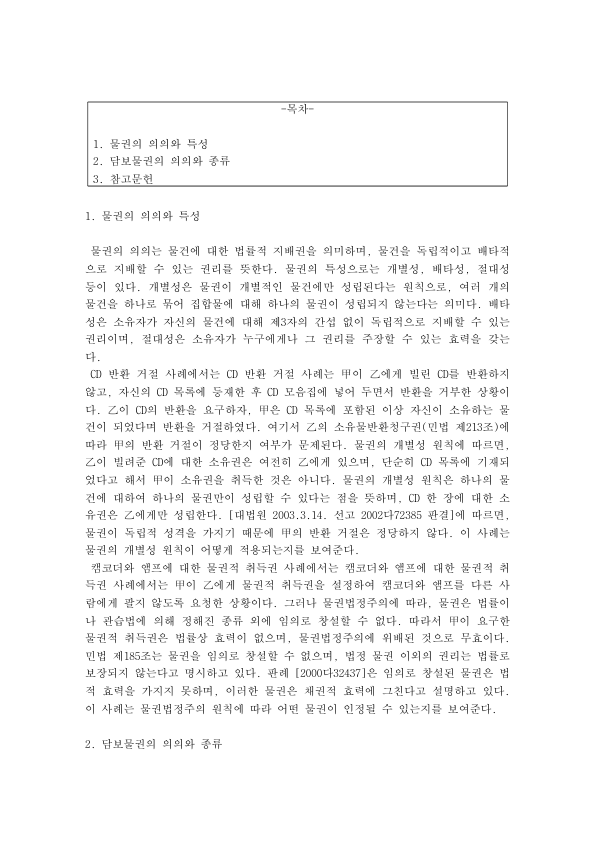
Page 1 is shown as is; from page 2 on, the preview is blurred. Buy it to download the complete original file right away (the file itself is written in Korean).
Packed with real examples and experience. Download it now and save time.
Save your valuable time
Buyer ratings
Fast, accurate and useful.
No ratings yet. Be the first to rate it.
Security Interests and Basic Property Rights Principles in Korean Civil Law: Numerus Clausus, One Thing One Right, and Mortgage Priority
※ You can preview page 1 as is. Buy it to download the complete original file right away. The file itself is written in Korean.
■ Security Interests and Basic Property Rights Principles in Korean Civil Law: Numerus Clausus, One Thing One Right, and Mortgage Priority — Overview
A 3-page Korean civil law paper explaining property rights through everyday examples: a borrowed CD a friend refuses to return, a made-up right over a camcorder, a ring pledged for a loan, and land mortgaged twice before an auction. It defines property rights and their features, explains the fixed list of property rights under Civil Act Article 185, and compares liens, pledges and mortgages.
■ Security Interests and Basic Property Rights Principles in Korean Civil Law: Numerus Clausus, One Thing One Right, and Mortgage Priority — Excerpt from the original document (English translation)
Security interests are broadly divided into statutory security interests and contractual security interests. Statutory security interests are security interests that arise automatically under the provisions of law, and they include the right of retention and preferential privileges. The right of retention is the right of a creditor who possesses another person's thing to retain possession without returning the thing until the claim is paid.
Contractual security interests are security interests established by contract between the creditor and the debtor. These include pledges and mortgages. A pledge is a right established over movable property as security under which, if the debtor fails to perform the obligation, the creditor disposes of the collateral and obtains payment. For example, if A borrows money from B and leaves a ring as security, B can sell the ring to satisfy the claim if A does not repay. A mortgage is a right established over real estate as security under which, if the debtor fails to perform the obligation, the creditor can have the real estate auctioned and receive payment with priority. Mortgages are paid with priority according to their rank, and where multiple mortgages are established, payment proceeds according to priority.
In the mortgage-priority and auction case, the mortgage-priority and auction case is a situation where Gap (甲) borrowed 100 million won from Eul (乙) and established a mortgage on his land, and then also established a mortgage of 200 million won on the same land in favor of Byeong (丙). When Gap fails to repay his debt to Byeong and Byeong initiates auction proceedings, Eul, who has the right to priority payment, receives a distribution of 100 million won first from the auction proceeds, and Byeong receives the remainder from the amount left. This shows the principle that the priority of security interests is determined by chronological order. [Article 91 of the Civil Execution Act] specifies that, in auction proceedings, the senior mortgagee receives payment with priority.
For reference, the material cites the right of retention and preferential privileges as statutory security interests, but preferential privileges are a concept of the Japanese Civil Code; the statutory security interests in the Korean Civil Act are the right of retention, the statutory pledge (Articles 648 and 650), and the statutory mortgage (Article 649). Security by transfer is an atypical security not named in the Civil Code, governed by case law and the Provisional Registration Security Act, among others. Also, as an exception to the principle of one thing, one right, case law recognizes security by transfer over a collection of things whose scope is specified, such as inventory goods, so organizing this as an exceptional case together with the part on the characteristics of real rights will make your answer considerably more accurate.
■ Security Interests and Basic Property Rights Principles in Korean Civil Law: Numerus Clausus, One Thing One Right, and Mortgage Priority — Contents and key concepts
How do Korean security interests protect a lender?
✦ At a glance
- Korean security interests in plain examples
- Structure: property rights → security rights → priority
- Useful for intro property law
☰ What the paper covers
- Features of property rights
- The borrowed CD case
- Fixed list of property rights
- Liens, pledges and mortgages
- Mortgage priority at auction
✎ Security interests in Korea and the U.S.
Korea's Civil Act allows only property rights created by statute or custom, and mortgages rank in the order they are registered.
U.S. law follows a similar numerus clausus idea in property, while personal property security interests are governed by UCC Article 9, where priority usually follows the order of filing or perfection.
Note: the paper itself is written in Korean and discusses Korean law. This page is general study information, not legal advice.
■ Security Interests and Basic Property Rights Principles in Korean Civil Law: Numerus Clausus, One Thing One Right, and Mortgage Priority References
- 교재 및 강의안
Take a break with a quick personality test?
Ranked by actual participation. Results in about a minute.
Loading…
Most-read content
Loading view counts…

Campusdown is a lifelong-learning community in Korea offering study materials, information on government support, student loans and scholarships, and more. Don't miss our free resources.
Go to the Campusdown home page →Refund policy
- Change of mind / refund requested after partial use / more than 7 days after purchase
◆ Exceptions
- File errors / cannot download or open the file
◆ How to request a refund: send a 1:1 inquiry via Customer Service at the top