
Page 1 is shown as is; from page 2 on, the preview is blurred. Buy it to download the complete original file right away (the file itself is written in Korean).
Packed with real examples and experience. Download it now and save time.
Save your valuable time
Buyer ratings
Fast, accurate and useful.
No ratings yet. Be the first to rate it.


Regulating Online Misogynistic Hate Speech in Korea: Definitions, Foreign Laws, and the Clash with Freedom of Expression
※ You can preview page 1 as is. Buy it to download the complete original file right away. The file itself is written in Korean.
■ Regulating Online Misogynistic Hate Speech in Korea: Definitions, Foreign Laws, and the Clash with Freedom of Expression — Overview
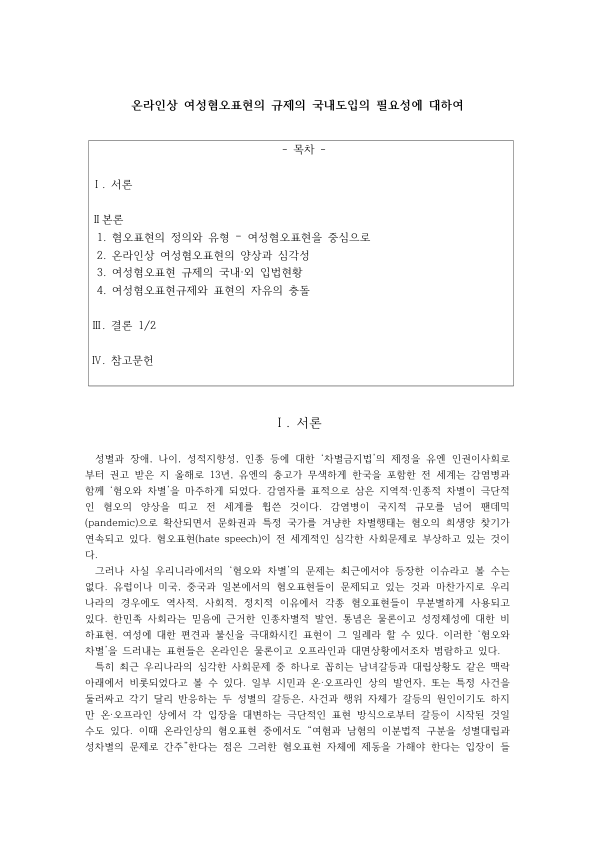
An 8-page Korean constitutional and gender law paper on online misogynistic hate speech. It reviews how hate speech is defined and classified, describes its spread online, compares laws in Germany, the U.K., France and Belgium with the 1992 U.S. Supreme Court ruling, presents arguments for and against regulation, and proposes an explicit legal ban.
■ Regulating Online Misogynistic Hate Speech in Korea: Definitions, Foreign Laws, and the Clash with Freedom of Expression — Excerpt from the original document (English translation)
The term hate speech came into social use in Korea relatively recently compared with the West. In the international community, such as the UN Human Rights Council and the Council of Europe, there is no universal treaty or agreement on hate speech, but it is applied in various ways by country or by state. There is no direct definition or rule, but the common thread is a ban on discrimination based on differences such as race, religion, skin color, descent and ethnicity. In Korea, by contrast, there has been no process of debate on how to define hate speech, so it is defined differently by different scholars. In addition, because 'hate' is an abstract noun expressing a particular human emotion, using it as a legal term as is could make interpretation difficult, which has stalled efforts. Since there is not even a definition of hate speech yet, in many cases it cannot be punished, on the ground of constitutional freedom of expression, unless it amounts to insult or defamation. Punishment may be possible only once hate speech is defined, but there has been no definition, nor any process of debate and deliberation.
So, although there may be room for disagreement, hate speech can generally be described as 'a speaker's own expression or statement containing a strongly negative evaluation of specific targets other than the speaker.' It is said to 'appear not only in verbal but also in nonverbal and symbolic forms, and to include not only expressions aimed directly at a target group but also those inciting hostility toward a target group in society as a whole' (Lee Seung-hyun, 2016). Definitions vary by country according to their background, but hate speech is generally described as an attack on or expression against a particular group or its members. By type it can be divided into discriminatory harassment, acts implying discriminatory intent, public contempt, insult or threats, and incitement to hatred; that is, it is marked by hostility such as enmity, slander, insult, ridicule, belittling and incitement to violence. It is not merely 'a statement that makes people feel bad or is immoral, but one that causes hatred and discrimination,' and it 'reproduces and entrenches ideas of prejudice and discrimination.' Based on underlying prejudice against the target group, it can lead from slander and ridicule as verbal expressions of hatred all the way to physical violence and murder.
Recognizing the violence inherent in hate speech is related to the point that hateful and discriminatory remarks about minority groups are not merely a passing trend. Hate speech and hate crimes have in common that they are based on hatred, discrimination and hostility, and hate speech often develops into hate crimes. In this light, treating the recent conflict between men and women only as an emotional clash between two equal groups covers up the seriousness of the violent and hate crimes that sparked the conflict. It is like dismissing as a gender conflict the voices of women who protested the violence of the Gangnam Station murder, in which the killer said 'women ignored me,' and thereby burying the crime itself. Such a leap from a murder to a gender conflict can 'disrupt daily life, including mental stress, because of stigma and prejudice against the target group harmed and exposed to hatred' (National Human Rights Commission, 2017). Moreover, because intentional or implicit acts of expressing hatred may gradually lead to serious physical violence, we must move beyond defining hate speech to regulation and remedies.
Note: The anti-discrimination bill submitted by the Ministry of Justice in December 2007 lapsed when the 17th National Assembly's term ended in May 2008, and later bills, including one introduced by Rep. Jang Hye-young and others in June 2020, were not passed either, so as of 2026 Korea has no comprehensive anti-discrimination law. The U.S. ruling the paper mentions is R.A.V. v. City of St. Paul, decided June 22, 1992. The U.K.'s Sex Discrimination Act (1975) and Equal Pay Act (1970) were consolidated into the Equality Act 2010, and Germany's General Act on Equal Treatment was enacted in 2006.
■ Regulating Online Misogynistic Hate Speech in Korea: Definitions, Foreign Laws, and the Clash with Freedom of Expression — Contents and key concepts
Between laws against hate and the freedom to speak
✦ At a glance
- The case for and against regulating online hate speech in Korea
- Structure: definition → online trends → foreign laws → the conflict → proposal
- Useful for constitutional law, gender and law, and media law courses
☰ What the paper covers
- Definition and types
- Online misogyny
- Foreign laws
- Arguments on both sides
- Legislative proposals
✎ Hate speech in Korea and the U.S.
Korea has no general law against hate speech aimed at groups, and a comprehensive anti-discrimination act has been proposed many times since 2007 without passing.
In the U.S., the First Amendment protects most hate speech, and R.A.V. v. City of St. Paul (1992) struck down a law that singled out bias-motivated expression.
Note: the paper itself is written in Korean and discusses Korean law. This page is general study information, not legal advice.
Related wiki: Hate Speech, The First Amendment and Free Speech
■ Regulating Online Misogynistic Hate Speech in Korea: Definitions, Foreign Laws, and the Clash with Freedom of Expression References
- 학술논문 조규범(2017). 헌법상 혐오표현 규제 가능성과 입법방향.
- <법학논총>, 24권 3호, 141-171p 박용숙(2018). 혐오표현에 대한 규제방법의 모색을 위한 시론적 연구.
- <전남대학교 법학연구소>, 2018년5월호 이승현(2016). 여성혐오적 표현과 표현의 자유의 한계. <이화젠더법학>, 8(2), 1-34p 이상경(2017).
- 온라인 혐오표현 등 혐오표현의 새로운 양상에 관한 연구.
- <헌법재판연구>, 제4권 제2호, 123-147p 권인숙(2019). 여성혐오표현 규제를 위한 법 제·개정 방안.
- <한국여성정책연구원>, 2019년호, 1-8p 이정훈(2019). ‘혐오표현’의 규제에 관한 비판적 성찰. <법학연구(연세대학교 법학연구원)>, 29권 4호, 195-223p 김수아(2015).
- 온라인상의 여성혐오표현. <페미니즘연구>, 15(2), 279-317p
- 온라인 자료 – 연구보고서 국가인권위원회 보도자료(2017). 인권위, 혐오표현 실태와 규제방안 실태조사. URL: https://www.humanrights.go.kr/site/progr
- 신문 기사 서울신문(2019.10.19.). “혐오·차별 거둬야” 차별금지법제정연대 서울 도심서 집회, 이종원 머니투데이(2020.05.12.).
- “여자가 어딜 감히?”· “남자는 군대나 가” 법으로 차별막자, 이원광, 강주헌, 유효송
Take a break with a quick personality test?
Ranked by actual participation. Results in about a minute.
Loading…
Most-read content
Loading view counts…

Campusdown is a lifelong-learning community in Korea offering study materials, information on government support, student loans and scholarships, and more. Don't miss our free resources.
Go to the Campusdown home page →Refund policy
- Change of mind / refund requested after partial use / more than 7 days after purchase
◆ Exceptions
- File errors / cannot download or open the file
◆ How to request a refund: send a 1:1 inquiry via Customer Service at the top