
What Do the Butterfly and the Porcelain Cup Mean? Yi Sang's Crow's-Eye View Poems No. 10 and No. 11 and Korean Modernism
- Yi Sang's Crow's-Eye View drew reader protests in 1934 and was halted after 15 poems.
- In Poem No. 10 a dying butterfly on torn wallpaper stands for the isolated poet.
- In Poem No. 11 a skull like a porcelain cup suggests a split self and approaching death.
Contents
Imagine opening your morning paper in 1934 to find a "poem" with no spaces between the words, strange numbered titles and lines about dying butterflies and porcelain skulls. Readers in colonial Seoul were furious. Today the same work is hailed as a landmark of Korean modernism. What changed? This guide reworks a Korean student's appreciation essay on Yi Sang's Crow's-Eye View, focusing on Poem No. 10, "Butterfly", and Poem No. 11. It explains the backlash, unpacks the key images and compares Yi Sang with the avant-garde poets that English-speaking readers already know.
Why did Crow's-Eye View cause an uproar?
Yi Sang, the pen name of Kim Hae-gyeong (1910-1937), trained as an architect before turning to literature. His sequence Crow's-Eye View began appearing in a Seoul daily newspaper in July 1934. Readers protested that the pieces had none of the qualities of real poetry and demanded to know why the paper was printing them, attacking both the newspaper and the poet. The source does not mention it, but the outcry was so strong that the series stopped after fifteen poems, about half of the thirty that had been planned.
Student money tip from CampusDown Repair UpIs a small leak worth a renters insurance claim? How to decide — compare the loss with your deductible, check who is responsible, and document it either way.
The source interprets the backlash as the reaction of a society that prized a fixed idea of what poetry should be and was more comfortable protecting the familiar than welcoming experiment. Even the title was a provocation. The Korean word for a bird's-eye view swaps one character for its near twin meaning "crow", so the familiar surveyor's term becomes something darker, a view of the world from the eye of a bird associated with death.
That strangeness made the first readers uneasy, but it is also what keeps the sequence feeling new. The verdict has been reversed so completely that the poems once dismissed as nonsense are now read as proof that Yi Sang was a sophisticated modernist.

How should we read Poem No. 10, "Butterfly"?
The poem opens, in a close English rendering: "I see a butterfly dying on torn wallpaper. It is a secret mouthpiece that comes and goes with the netherworld." The speaker looks at a dying butterfly and calls it a hidden channel constantly passing between this world and the world of the dead. If the butterfly can travel that freely to the other side, it is already almost touching death.
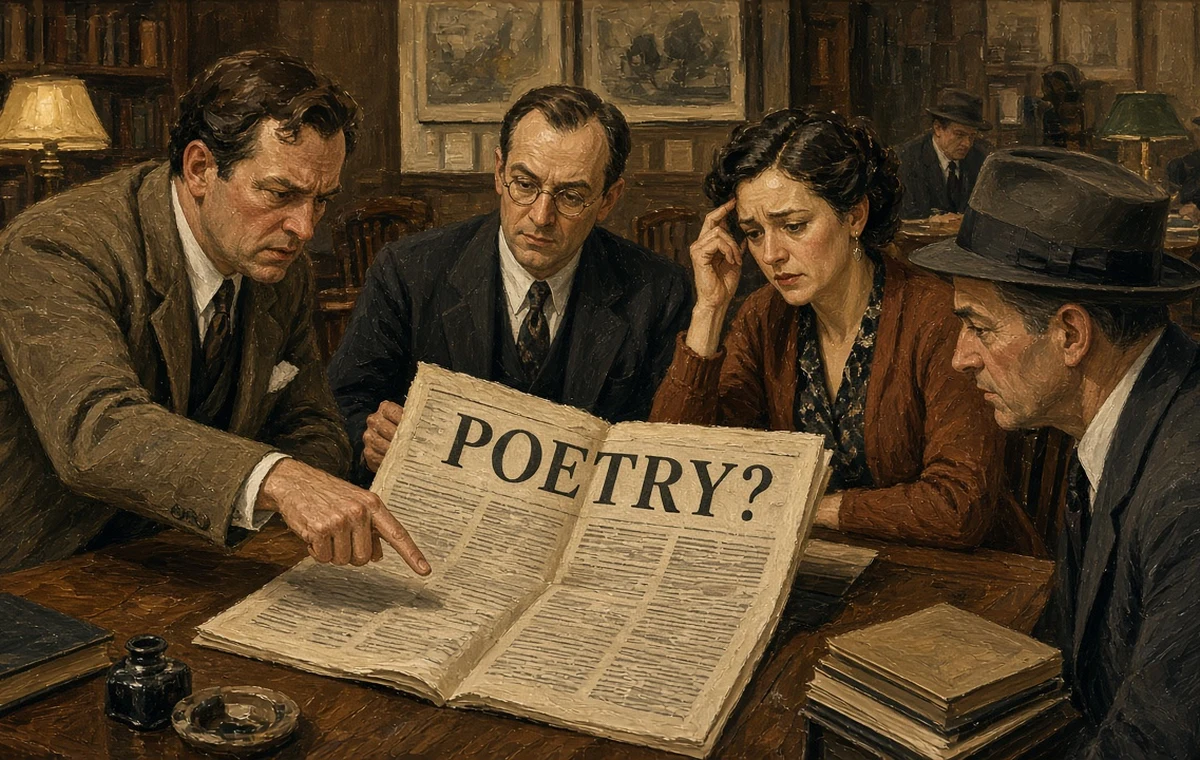
The angry faces in the reading room show the gap between the poem and its first audience. They expected rhyme, rhythm and a recognisable feeling; they got a fragment that seemed to refuse them all.
The butterfly then appears in a mirror, perched on the speaker's moustache, its wings drooping as it drinks "the poor dew" that forms from his breath. The source suggests that if we read the butterfly in the mirror as the speaker himself, it overlaps with the young Yi Sang, who wore a moustache. The poem ends with the speaker pressing his palm over the mouthpiece and resolving that, when he dies, the butterfly will fly off too, "as if rising after sitting", while making sure these words never leak out.
| Image | Interpretation |
|---|---|
| Intact wallpaper | A world made up of many individual lives |
| Torn wallpaper | Yi Sang's life, torn away from that world |
| Dying butterfly | Yi Sang himself |
| Hand covering the mouthpiece | A gesture to stop death and its secret from escaping |
Read this way, placing the butterfly on torn rather than intact wallpaper suggests that the poet's ideas were not accepted by the world of his time. The final resolution shows a lonely will: accepting extinction while guarding the secret to the end. The startling combination of images invites comparison with the techniques of surrealism, which Yi Sang's generation encountered through Japanese and European journals.
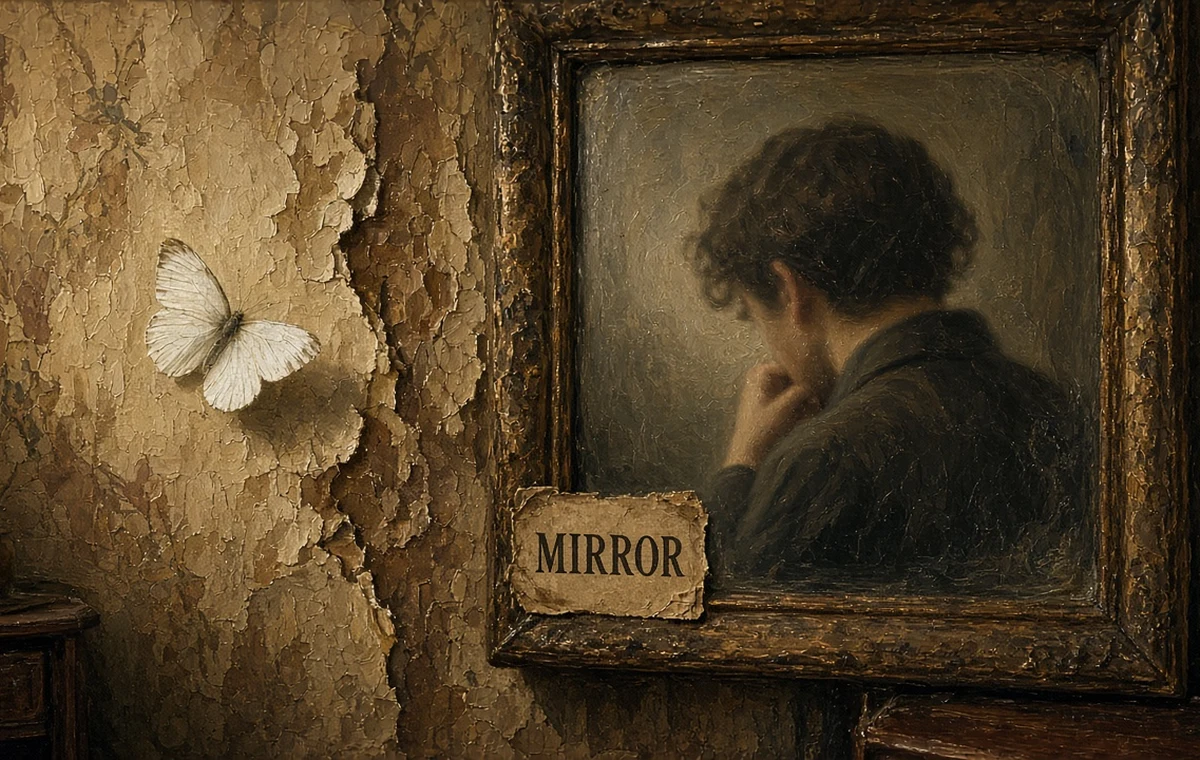
The picture keeps the face hidden on purpose. The poem is less a portrait of one man than an image of fragility looking back at itself.
Skimming the section headings first makes a long guide much easier to map out. Try writing down one question of your own as you read.
What does the porcelain cup in Poem No. 11 mean?
Poem No. 11 begins: "That porcelain cup resembles my skull." As the speaker grips the cup, a strange extra arm sprouts from his own like a graft, seizes the cup and smashes it on the floor. Yet his real arm is still guarding the cup, so what lies shattered, the poem says, must be his skull, the thing that looks like the cup. The source simplifies this as the skull being as easy to break as porcelain; the poem's twist is sharper, because the cup survives and the self breaks in its place.
The source reads the breakable skull as a sign of psychological splitting on one level and a premonition of death on the other. Yi Sang suffered from tuberculosis and died in Tokyo in 1937 at the age of 26, which makes that reading hard to ignore. Placed next to the dying butterfly of Poem No. 10, the cup shows the same anxiety through a different image: both are fragile things on the edge of breaking.
How does Yi Sang compare with Western avant-garde poets?
Typographic play and shock in Europe
English-speaking readers have met this kind of shock before. In France, Guillaume Apollinaire's Calligrammes of 1918 arranged words into pictures on the page, and the Dada movement turned performance and nonsense into weapons against tradition. André Breton's first Surrealist Manifesto of 1924 called for writing that released the unconscious, producing exactly the kind of startling image pairings found in "Butterfly". Yi Sang's refusal of spacing and his use of numbers and diagrams in other Crow's-Eye View poems belong to this international experiment.
Modernism and its first readers in Britain and America
In the English-speaking world, T. S. Eliot's The Waste Land of 1922 baffled many first readers with its fragments, quotations and abrupt shifts, and was attacked as obscure before becoming a cornerstone of modern poetry. The pattern is the same as in Seoul: outrage, then reappraisal. Yi Sang's poems have also reached English readers through translation, including a selected works volume published in the United States in 2020, which introduced his architecture-trained, numerical imagination to a new audience.
What does a side-by-side comparison show?
| Issue | Yi Sang, Crow's-Eye View (1934) | Apollinaire, Calligrammes (1918) | Eliot, The Waste Land (1922) |
|---|---|---|---|
| Main technique | No spacing, numbered titles, uncanny images | Words shaped into pictures | Fragments, quotations and shifting voices |
| First reaction | Reader protests; series halted after 15 poems | Admired in avant-garde circles, puzzling to many | Praised by some, attacked as obscure by others |
| Recurring theme | Fragile self, illness and death | War, love and modern life | Spiritual emptiness after war |
| Status today | Landmark of Korean modernism | Classic of visual poetry | Cornerstone of modern poetry in English |
The comparison helps an essay avoid treating Yi Sang as an isolated oddity. He was part of a worldwide modernist conversation, writing under colonial rule and in poor health, which gives his fragile images their particular urgency.
How should you write an appreciation essay on Crow's-Eye View?
The source offers practical advice. Quote the original lines and set out the symbolism of key words in a table. Give clear reasons for reading the speaker as the poet. Contrast the reaction at the time of publication with the poems' reputation now. Above all, remember that there is no single correct interpretation, so the persuasiveness of your essay depends on showing the evidence behind your reading.
Student money tip on CampusDown Repair Up: Is a small leak worth a renters insurance claim? How to decide.
- Have you quoted the poem accurately and noted it is a translation?
- Have you tabulated the main images and their meanings?
- Have you justified linking the speaker with Yi Sang?
- Have you compared the 1934 reaction with today's view?
- Have you placed the poems in the wider modernist movement?
Who will find this useful?
This approach suits students of Korean or comparative literature, world poetry and creative writing who are writing a close reading or appreciation essay. Translations vary, so name the version you quote and compare it with others where you can.
FAQ
Who was Yi Sang?
The pen name of Kim Hae-gyeong (1910-1937), a Korean modernist poet and writer who trained as an architect.
Why was Crow's-Eye View stopped?
Readers protested so strongly in 1934 that the newspaper series ended after fifteen of the planned thirty poems.
What does the title Crow's-Eye View mean?
It changes one character in the word for a bird's-eye view to the character for crow, a bird linked with death.
What does the butterfly symbolise in Poem No. 10?
In the source's reading, the dying butterfly on torn wallpaper represents Yi Sang himself, cut off from his world.
Is there one correct reading of Yi Sang's poems?
No. A good essay explains the evidence behind its own interpretation.