
Why Does One Ballerina Dance Both Swans in Swan Lake? Odette, Odile, 32 Fouettés and the Petipa–Tchaikovsky Classics
- Classical ballet values clarity, symmetry, order and flawless technique over free emotional expression.
- Swan Lake premiered in Moscow in 1877 but triumphed in the 1895 Petipa–Ivanov revival, where one ballerina dances good Odette and deceptive Odile.
- The Sleeping Beauty, based on Perrault's tale, is famed for lavish ensembles and a textbook grand pas de deux.
Contents
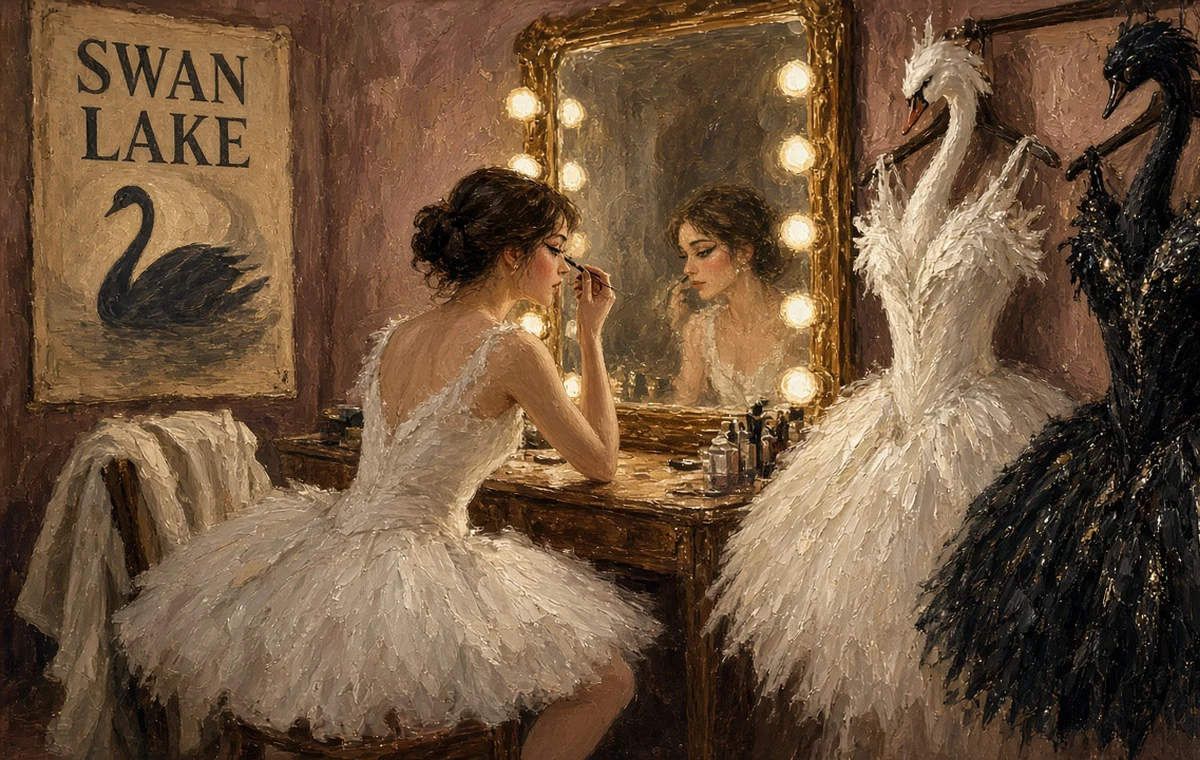
In Swan Lake one ballerina dances both Odette, the gentle White Swan, and Odile, the dazzling Black Swan, because the story turns on Prince Siegfried mistaking one for the other, and because since the 1895 Petipa–Ivanov revival the double role has been the ultimate test of a classical ballerina's technique and acting. Same face, opposite souls: the audience watches one body switch from fragile lyricism to the whiplash brilliance of 32 fouettés in a single evening.
This guide explains what makes classical ballet "classical", what Marius Petipa and Pyotr Tchaikovsky left behind, how Swan Lake went from a flop to the world's most famous ballet, how The Sleeping Beauty differs, and how the Royal Ballet, American Ballet Theatre and New York City Ballet each keep the tradition alive.
What makes classical ballet different from Romantic ballet?
Ballet is often called the purest form of theatrical dance. Romantic ballet, which peaked in the 1830s and 1840s with works like La Sylphide and Giselle, chased mood: moonlit forests, ghostly maidens, long misty skirts. Classical ballet, which flowered in late-nineteenth-century St Petersburg, put clarity, balance, symmetry and order first. Flawless execution mattered more than free emotional expression, so companies filled up with highly trained professional dancers.
Student money tip from CampusDown Life UpHow to search official databases for unclaimed money in your name — free state and federal searches, and how to avoid paid finders and scams.
| Feature | Romantic ballet | Classical ballet |
|---|---|---|
| Era and center | 1830s to 1840s, Paris | 1870s to 1890s, St Petersburg |
| Mood | Supernatural, melancholy, dreamlike | Grand, orderly, fairy-tale splendor |
| Costume | Long, bell-shaped Romantic tutu below the knee | Short, stiff "pancake" tutu that shows the legs and footwork |
| Signature works | La Sylphide, Giselle | Swan Lake, The Sleeping Beauty, The Nutcracker |
The tutu tells the story of that shift. As choreography demanded more turns, jumps and extensions, the skirt rose and stiffened until audiences could see every beat of the feet. When you watch a classical ballet, look beyond the plot to the alignment of the corps de ballet, the precision of each step and the balance of the stage picture.

What did Petipa and Tchaikovsky leave behind?
Marius Petipa, a Frenchman who spent most of his career at the Imperial Theatres in St Petersburg, is called the father of classical ballet. He made so many of the era's works that his way of building a ballet became the style of the age. He developed the divertissement, a run of dances enjoyed for their own sake apart from the plot, split acts for dramatic effect, and wove together pantomime, solos, pas de deux, big ensemble scenes, folk dances and character dances in a single evening.
- Divertissement: showpiece dances that pause the story, such as the national dances in Swan Lake's ballroom act.
- Finale: the whole cast returns for a grand closing tableau.
- Grand pas de deux: the lead couple's showpiece: entrée, adagio, two variations and a fast coda.
- Pantomime: a coded sign language; hands circling above the head mean "dance", a hand on the heart means "love".
Add Tchaikovsky's symphonic scores, and you get what are usually called the "big three" of ballet: Swan Lake (1877), The Sleeping Beauty (1890) and The Nutcracker (1892). Before Tchaikovsky, ballet music was often written to order as rhythmic accompaniment; he made it drama in its own right.
Skimming the section headings first makes a long guide much easier to map out. Try writing down one question of your own as you read.
How did Swan Lake go from flop to masterpiece?
Swan Lake was the first of the three to be composed and premiered at Moscow's Bolshoi Theatre in 1877 with choreography by Julius Reisinger. Critics complained that the music was too complex and symphonic for dancing, and the production faded. After Tchaikovsky's death in 1893, the Mariinsky Theatre in St Petersburg staged a new version in 1895: Petipa choreographed the palace acts, his assistant Lev Ivanov created the lakeside acts, and conductor Riccardo Drigo revised the score.
| Item | 1877 Moscow premiere | 1895 St Petersburg revival |
|---|---|---|
| Choreographer | Julius Reisinger | Marius Petipa (Acts 1 and 3) and Lev Ivanov (Acts 2 and 4) |
| Reception | Lukewarm, music called "undanceable" | Triumph, the template for nearly every later production |
| Odette / Odile | Casting of the two roles less settled | Pierina Legnani dances both and adds the 32 fouettés |
The story is simple and devastating. Odette, a princess turned into a swan by day by the sorcerer von Rothbart, falls in love with Prince Siegfried. At the palace ball, Rothbart presents his daughter Odile, disguised as Odette, and Siegfried swears his love to the wrong woman. The most common ending has the lovers die together and break the spell, but many companies stage happier or darker endings, so comparing endings is part of the fun.
Why does one ballerina dance both Odette and Odile?
Dramatically, it makes the deception believable: if the Black Swan looks exactly like the White Swan, the prince's mistake is tragic rather than foolish. Technically and artistically, it asks one dancer to master two opposite vocabularies.
| Odette, White Swan (Act 2) | Odile, Black Swan (Act 3) | |
|---|---|---|
| Character | Vulnerable, noble, trapped | Seductive, triumphant, mocking |
| Movement | Soft rippling "wing" arms, slow adagio, bent neck | Sharp attack, quick turns, flashy balances |
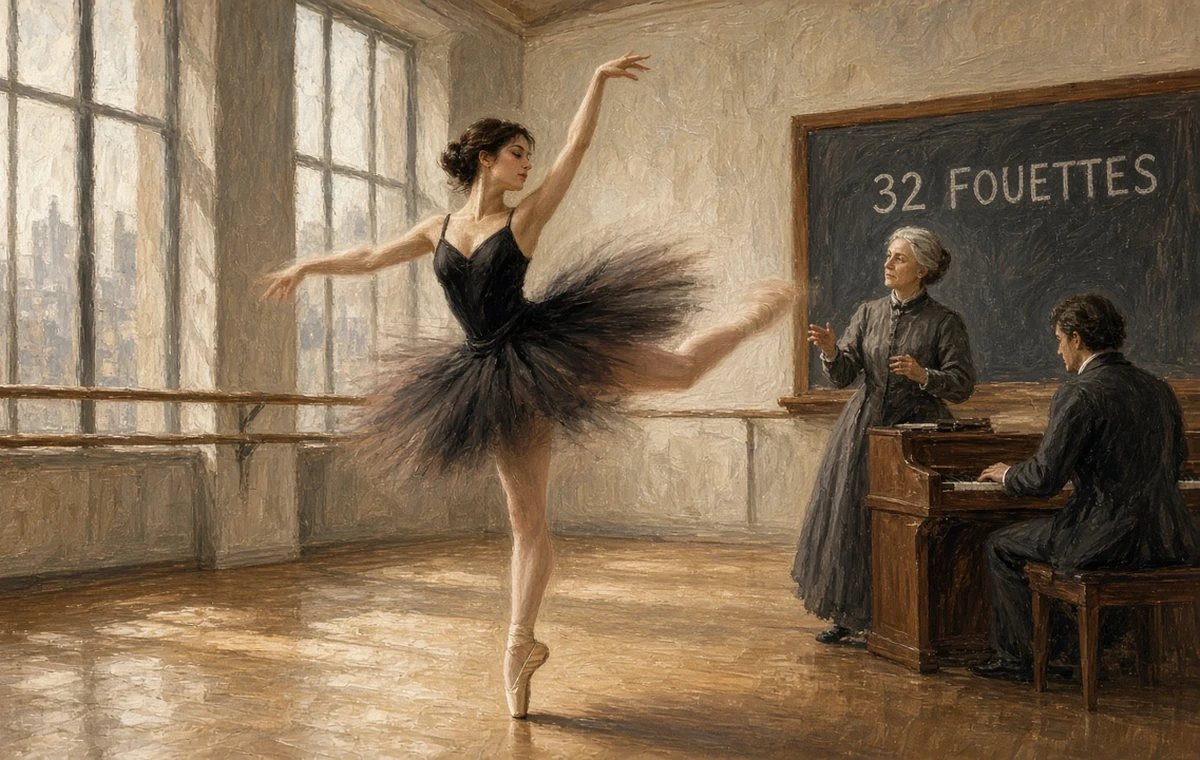
| Signature moment | The lakeside adagio with Siegfried | 32 fouettés en tournant in the coda |
| Challenge | Sustaining line and emotion at slow tempo | Stamina and spotting while staying in character |
Pierina Legnani first performed 32 consecutive fouettés in St Petersburg in 1893 and put them into the Black Swan coda in 1895. A fouetté is a whipping turn on one leg, powered by the other leg snapping out and in; doing 32 without traveling across the stage is still a rite of passage. Some ballerinas add doubles; the best keep Odile's sneer while doing it.
In the English-speaking world, Margot Fonteyn made the double role legendary at the Royal Ballet, Natalia Makarova and Misty Copeland shaped it at American Ballet Theatre, and Copeland's 2015 Odette/Odile at the Metropolitan Opera House was celebrated as a milestone. New York City Ballet took a different path: George Balanchine's 1951 one-act Swan Lake strips the story down to pure dance. And Matthew Bourne's 1995 London version, with male swans, proved how flexible the old score is.
How is The Sleeping Beauty different?
The Sleeping Beauty is based on Charles Perrault's 1697 fairy tale. In 1888 Ivan Vsevolozhsky, director of the Imperial Theatres, commissioned Tchaikovsky, and Petipa's 1890 production became the most aristocratic of the big three: a courtly spectacle in which every dancer, not just the leads, must be technically superb. In the Act 3 wedding, fairy-tale guests such as Puss in Boots and the Bluebird dance their own variations.
Its Act 3 grand pas de deux is often called the textbook of classical form, so if you are new to ballet, watching that one scene is a great shortcut to understanding the structure that Swan Lake also uses.
How do the works compare, and how should you watch them?
| Item | Key points |
|---|---|
| Classical ballet | Formal beauty, symmetry and flawless technique |
| Swan Lake | 1877 Moscow premiere, 1895 Petipa–Ivanov revival, Odette and Odile danced by one ballerina |
| The Sleeping Beauty | Based on Perrault, 1890 premiere, lavish ensembles and a model grand pas de deux |
Student money tip on CampusDown Life Up: How to search official databases for unclaimed money in your name.
Both works are the product of Petipa's structure and Tchaikovsky's music, so seeing one and then the other makes the shared grammar of classical ballet easy to spot. In London, the Royal Opera House streams and cinemas broadcast the Royal Ballet's seasons; in New York, ABT's spring season at the Met traditionally includes Swan Lake. Clap after variations and the fouettés, not during the adagio, and read the cast sheet: who dances Odette/Odile changes everything.
Common mistakes
- Thinking Swan Lake was a hit from its first night.
- Crediting all the choreography to Petipa and forgetting Ivanov's lakeside acts.
- Assuming every production has the same ending.
- Calling any spinning turn a fouetté.
Quick self-check
- Why does the double casting make the plot work?
- Who first danced 32 fouettés as Odile?
- Name the three Tchaikovsky ballets and their premiere years.
Compiled by the CampusDown editorial team from Jennifer Homans, Apollo's Angels: A History of Ballet (Random House, 2010), company archives of the Royal Ballet, ABT and NYCB, and standard ballet references. Reviewed November 2026.
FAQ
Why does one ballerina dance Odette and Odile?
The plot depends on the prince mistaking Odile for Odette, and since the 1895 revival the double role has been the classic test of a ballerina's technique and acting range.
What are the 32 fouettés?
Thirty-two consecutive whipping turns on one leg in the Black Swan coda, first performed in this role by Pierina Legnani in 1895.
When did Swan Lake premiere?
At the Bolshoi Theatre in Moscow in 1877; the version most companies build on is the 1895 Mariinsky revival by Petipa and Ivanov.
How does NYCB's Swan Lake differ?
New York City Ballet is known for George Balanchine's 1951 one-act version, which focuses on pure dance rather than the full four-act story.
What is The Sleeping Beauty based on?
Charles Perrault's 1697 fairy tale; Tchaikovsky's score was commissioned in 1888 and Petipa's ballet premiered in 1890.