
Vital Signs Normal Ranges and How to Measure Them: Temperature, Pulse, Respiration and Blood Pressure Step by Step
- Vital signs are temperature, pulse, respiration and blood pressure, often with oxygen saturation and pain added.
- In adults, a pulse of 60 to 100 beats per minute and respirations of 12 to 20 per minute are the usual ranges.
- A rest period before measuring and the right cuff size largely determine accuracy.
Contents
Taking vital signs is the first thing nursing students learn on placement and the thing they do most often. Because it happens every day, it is easy to become casual about it, yet a small error can lead to a wrong judgement about a patient. This guide covers normal ranges, accurate technique, the factors that distort readings, and how to document and report what you find.
Student money tip from CampusDown Law UpLead Paint in an Old Student Apartment: What Renters Should Know — Worried about lead paint in an old student apartment?

What are vital signs?
Vital signs show whether the basic functions needed to sustain life are working properly. The core four are temperature, pulse, respiration and blood pressure. Many hospitals also record oxygen saturation and a pain score alongside them. A single number matters less than change over time: the starting point for interpreting vital signs is to compare a reading with the same patient's earlier values and ask whether something has suddenly shifted.

What are the normal ranges?
| Vital sign | Usual adult range | Note |
|---|---|---|
| Pulse | 60 to 100 beats per minute | Count regular rhythm for 30 seconds and double; irregular for a full minute |
| Respiration | 12 to 20 breaths per minute | Count for a full minute without the patient noticing |
| Blood pressure | Below 120/80 mmHg counts as normal | Classification thresholds differ between guidelines |
| Temperature | Roughly 36.5 to 37.5 °C | Varies with site; always record oral, tympanic, axillary or temporal |
For blood pressure, the 2017 American College of Cardiology and American Heart Association guideline defines normal as a systolic pressure below 120 mmHg and a diastolic pressure below 80 mmHg. It calls 120 to 129 systolic with diastolic below 80 'elevated', 130 to 139 or 80 to 89 stage 1 hypertension, and 140/90 or higher stage 2. Many other guidelines, including European ones, still put the threshold for hypertension at 140/90 in the clinic, so it is worth knowing which standard your course and placement use. Persistently raised readings point towards hypertension, which is diagnosed from repeated measurements, never from a single reading.
Temperature norms vary slightly by site, so always record whether you measured orally, tympanically, in the axilla or at the temple. Children and older adults have different normal ranges from younger adults, so check an age-specific chart.
Skimming the section headings first makes a long guide much easier to map out. Try writing down one question of your own as you read.
How do you measure accurately?
Pulse. Feel the radial artery at the wrist with the pads of your index and middle fingers, never your thumb, which has its own pulse. If the rhythm is regular, count for 30 seconds and double it; if it is irregular, count for a full minute. Note the rhythm and strength as well as the rate.
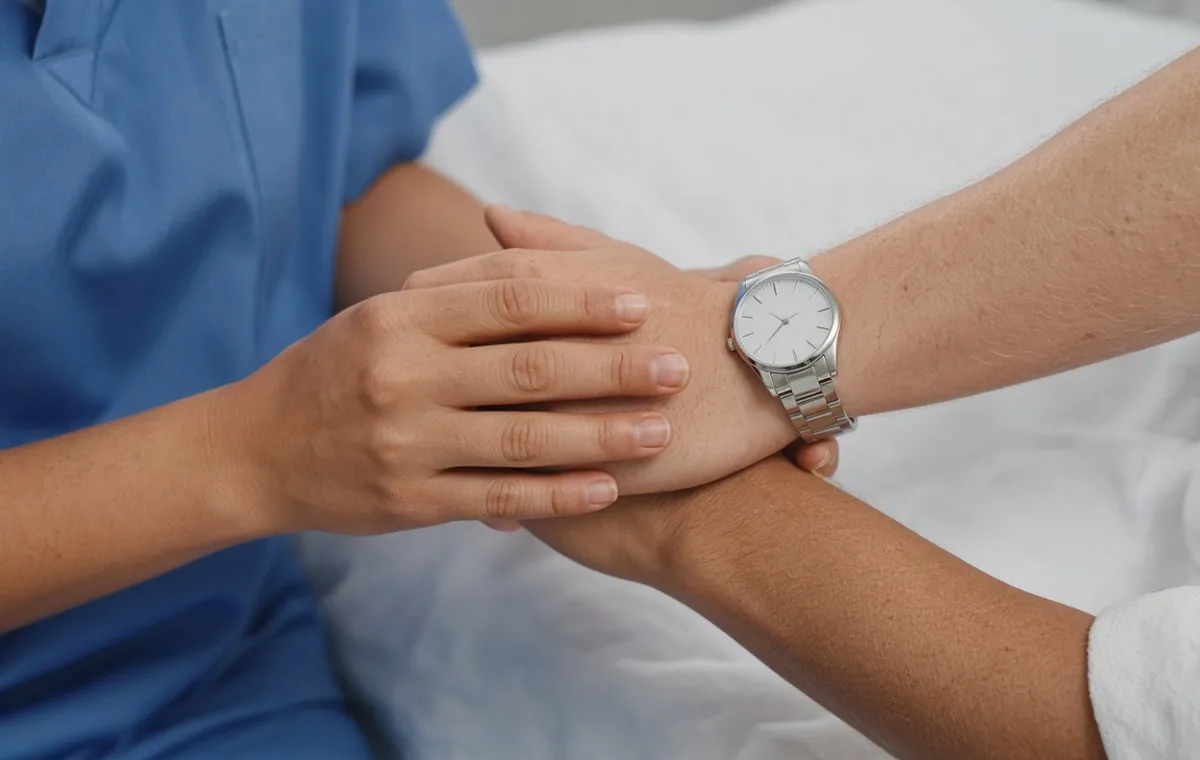
Respiration. Breathing changes easily when patients know it is being counted. Keep your fingers on the wrist as though you are still taking the pulse and watch the chest rise and fall. Count for a full minute. Breathing is slower than the pulse and can be irregular, so a 30-second count multiplies any error, and respiratory rate is one of the earliest indicators that a patient is deteriorating. It is also the measurement most often estimated rather than counted on a busy ward, so make the full minute a habit.
Blood pressure. Let the patient sit comfortably for about five minutes first, back supported and feet flat on the floor. Rest the arm at heart level and use a cuff that fits the arm circumference. A cuff that is too small gives a falsely high reading; one that is too large gives a falsely low reading. Ask about caffeine, smoking and exercise in the previous 30 minutes, and do not take a reading over clothing.
Temperature. Wait before taking an oral reading if the patient has just had a hot or cold drink. With tympanic thermometers, technique matters: a poorly positioned probe reads low.
What makes the numbers move?
Pain, anxiety and recent activity all raise the pulse and blood pressure. These changes in a tense body can be explained as the alarm reaction of Hans Selye's general adaptation syndrome, the body's first response to a stressor. Smoking and caffeine affect blood pressure and pulse, and a recent drink changes oral temperature. When a reading looks odd, find the cause, correct the conditions and measure again before drawing conclusions.
Pain and oxygen saturation
Pain is often called the 'fifth vital sign', a phrase that spread in the 1990s after the American Pain Society proposed that pain be assessed as routinely as the other vital signs. Pain is a subjective experience that only the patient can report, so choose a tool that suits the person: a 0 to 10 numeric rating scale for most adults, a faces scale for children, and behavioural observation scales for infants or patients who cannot communicate.
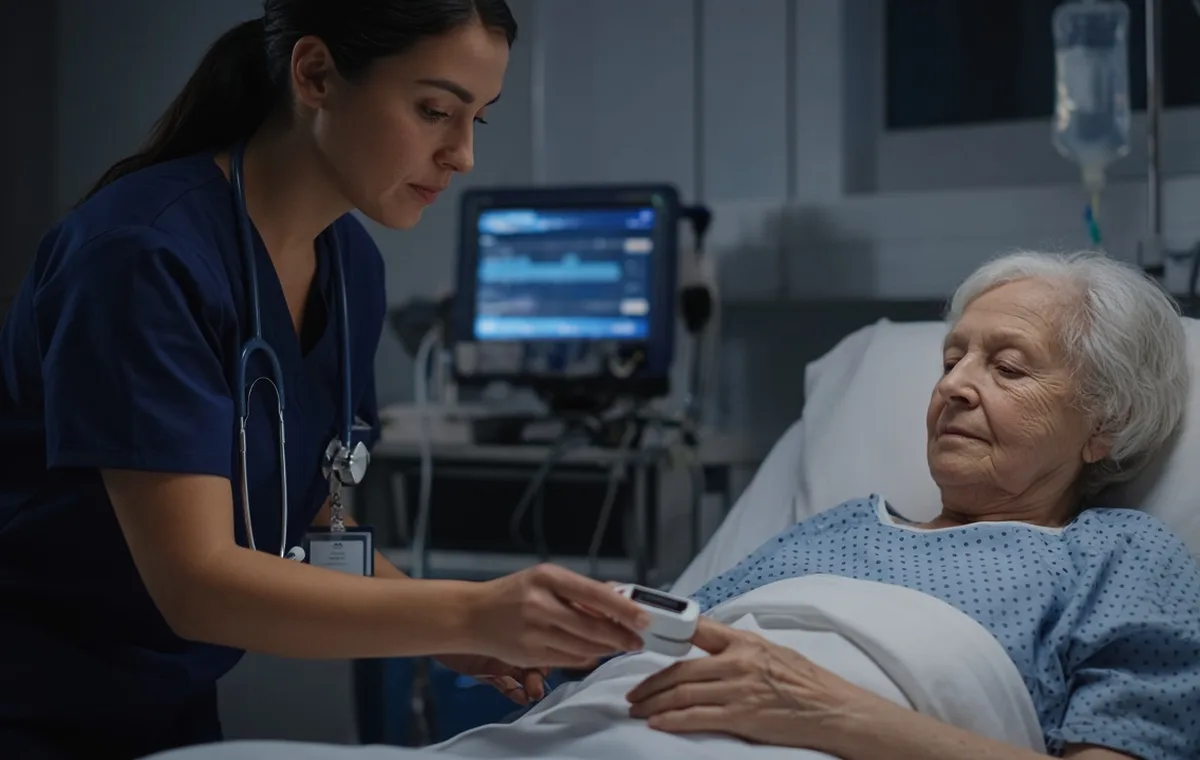
Oxygen saturation shows how much of the haemoglobin in the blood is carrying oxygen. It is easy to measure with a fingertip pulse oximeter, which is why many hospitals record it with the vital signs. Cold hands, nail polish and movement can produce inaccurate readings, so if a value looks wrong, check the probe site and the patient before acting on it.
What else to look at while you measure
- The location, intensity and character of any pain, and when it gets worse
- The depth of breathing and how much effort it takes, alongside oxygen saturation
- Level of consciousness and any change from the patient's usual behaviour
- Skin colour and temperature, and whether there is a cold sweat
- Changes in urine output and fluid intake
These observations reveal what numbers alone cannot. A patient whose blood pressure is within range but who is unusually drowsy and sweating is showing a warning sign in their own right. Age matters too: infants and children have faster pulse and breathing rates than adults, and older people may not run a high fever even with a serious infection. Use the values taken on admission as a baseline for later comparison.
How do early warning scores protect patients?
Early warning scores assign points to respiratory rate, oxygen saturation, temperature, blood pressure, pulse and level of consciousness, then add them together. The higher the score, the more likely the patient is deteriorating, and above a set threshold staff follow a defined escalation path, such as calling the responsible doctor or the rapid response team. The best-known system is the National Early Warning Score (NEWS), developed by the Royal College of Physicians in the UK in 2012 and updated as NEWS2 in 2017; many hospitals elsewhere run similar systems with their own thresholds. These tools matter because events such as cardiac arrest often look sudden but are frequently preceded by small changes in vital signs hours earlier.
Home blood pressure monitoring
For people with hypertension, readings taken at home are important for diagnosis and management. They help identify white-coat hypertension, where pressure is high only in the clinic, and masked hypertension, where it is normal in the clinic but high in daily life.
| Item | Recommended method | Why |
|---|---|---|
| Timing | In the morning after waking and in the evening before bed | Captures variation through the day |
| Preparation | Use the toilet, then sit quietly for about five minutes | Avoids rises from tension or a full bladder |
| Position | Sit with back supported and arm at heart level | Reduces positional error |
| Recording | Take two readings and record both | Smooths out momentary variation |
Documenting and reporting
Record the time, site and value straight away. If a reading differs markedly from the patient's usual values or crosses your ward's reporting threshold, tell the nurse in charge immediately. For patients at high risk of infection, such as people receiving chemotherapy, even a slight fever can be a significant signal.
Student money tip on CampusDown Law Up: Lead Paint in an Old Student Apartment: What Renters Should Know.
Add the conditions under which you measured: whether the patient was on oxygen, had just walked back from the bathroom, or took an antipyretic an hour ago. A temperature of 38 °C means something quite different straight after a dose of paracetamol. A short note such as 'measured after walking' or 'complaining of pain' lets the next nurse interpret the number correctly.
When you write about vital signs in an assignment or placement report, go beyond memorising normal ranges and connect each change to what it might mean and what action follows. Adding an early warning score perspective shows the clinical reasoning behind nursing judgement. Measurement and reporting standards vary between hospitals and professional bodies, so follow your institution's guidance. A machine may take the reading, but the judgement belongs to the nurse; the more you learn to read the person behind the numbers, the sooner you will spot when something is wrong.
CampusDown Editorial Team, reviewed November 2026. Sources: Potter and Perry, Fundamentals of Nursing; Whelton et al. (2017), ACC/AHA Guideline for High Blood Pressure in Adults; Royal College of Physicians (2017), National Early Warning Score 2.
FAQ
What is a normal adult pulse rate?
Usually 60 to 100 beats per minute.
How long do you count an irregular pulse?
Count for a full minute.
How long should a patient rest before a blood pressure reading?
About five minutes, sitting comfortably.