
Turning Discarded Clothes into Products: How an Upcycling Business Makes Money and How to Write the Business Plan
- Upcycling turns things that would be thrown away into new products by adding design and value.
- A steady material supply and consistent quality control are the core of the business.
- A business model canvas fits the whole structure onto one page.
Contents
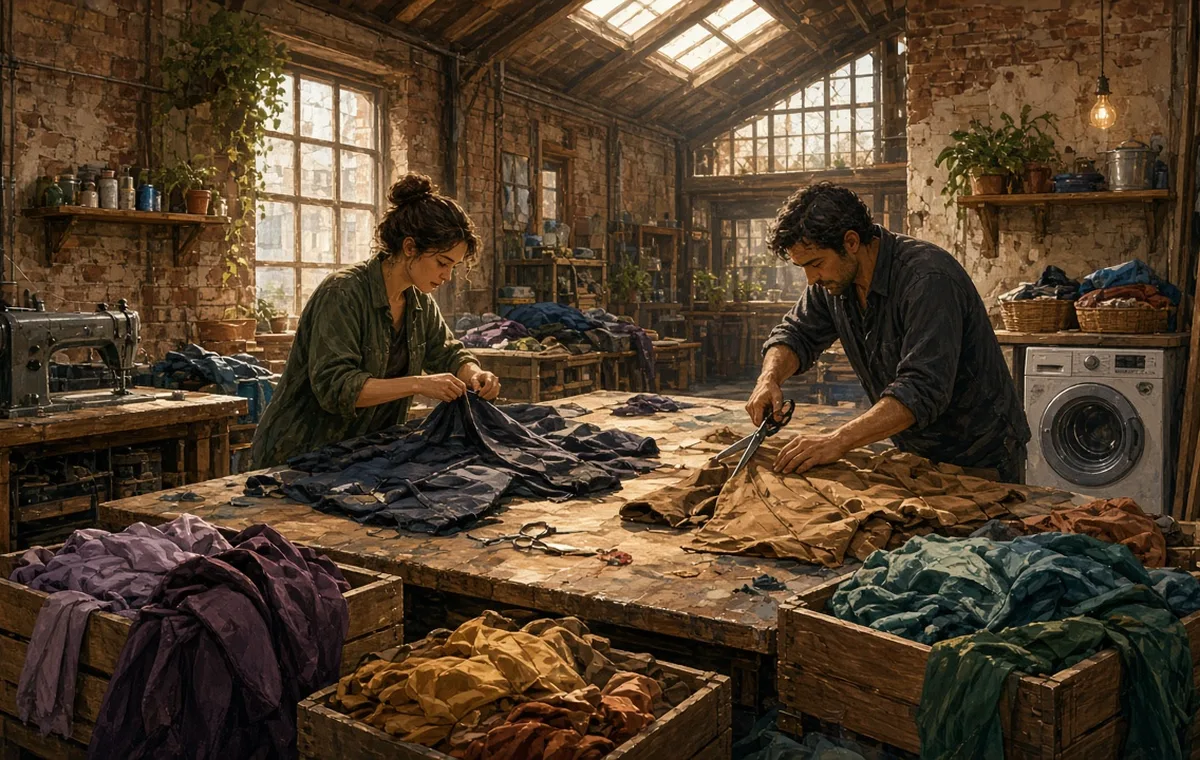
A lot of clothes are worn once or twice and then end up in landfill or an incinerator. Upcycling takes items like these and, instead of shredding or melting them, adds design to turn them into something worth more than before. Here is why it is getting attention, and how to structure the business if you want to start one.
Student money tip from CampusDown Repair UpRenters insurance water claim denied? What to do next — get the reason in writing, match it to your policy wording, gather proof and ask for a review.
One jacket on top of a pile of waste: this is where its value gets set all over again.
How is upcycling different from recycling?
Recycling turns an object back into raw material and then uses it again, as when PET bottles are melted down and spun into fibre. That takes energy and the quality often drops along the way. Upcycling keeps the original form and gives it a new use. Freitag, founded in Zurich in 1993 by brothers Markus and Daniel Freitag, makes bags from used lorry tarpaulins; when the traces of the old material become the design, the price can go up rather than down.

Why does upcycling matter so much in fashion?
The Ellen MacArthur Foundation's 2017 report A New Textiles Economy found that clothing production roughly doubled between 2000 and 2015, while the average number of times a garment is worn fell by 36%. It estimated that the equivalent of one rubbish truck of textiles is landfilled or burned every second, and that less than 1% of the material used to make clothing is recycled into new clothing. Fast fashion, buy quickly and throw away quickly, is generating enormous textile waste.
Policy is moving too: under the EU's revised Waste Framework Directive, member states have had to collect textiles separately since 1 January 2025. A business that reuses discarded clothes and fabric cuts waste and attracts customers who want their purchases to mean something. The story behind the product becomes a marketing asset in itself.
Skimming the section headings first makes a long guide much easier to map out. Try writing down one question of your own as you read.
How do you structure an upcycling business?
A business model canvas fits nine blocks, including customer segments, value proposition, channels, revenue streams and key resources, onto a single page. For upcycling, the key resources block is where you spell out exactly where your waste material comes from.
In the value proposition block you might put one-of-a-kind design, environmental impact and transparency about how each piece is made. You should be able to say in one sentence why a customer would pay more for this than for a new product. Testing that sentence quickly with real buyers, in the spirit of the lean start-up approach, is cheaper than perfecting it on paper.

What makes an upcycling start-up hard?
The biggest difficulty is that the raw material is never the same twice. Colour, size and condition vary from batch to batch, which makes it hard to produce the same item in volume and pushes up the share of handwork, and with it the cost. Washing and sanitising are costs you can't skip. To ease this, many makers sign agreements with companies to receive materials of similar specification, such as old event banners or retired workwear.
There are three broad ways to source material: donations from individuals and local residents; partnerships with textile banks and second-hand clothing dealers; and surplus stock and offcuts from factories and brands. Factory fabric is consistent and suits larger runs, while donated clothes are all different and suit limited editions. Heavily stained items or fabric that won't lose its smell should be rejected. If you plan to make products for children, check the safety rules that apply, such as the standard on cords and drawstrings in children's clothing, before you sell.
How should you price an upcycled product?
Leave behind the idea that the material is free and cost your working time from the start. Things to add up:
- The real cost of collecting, transporting and washing material
- Working time and labour for unpicking, cutting and sewing
- Trims and components: zips, thread, lining, swing tags
- Photography, packaging, delivery and platform fees
- Market prices for comparable handmade products, plus your product's own story
That last item is what holds up the price. If you can show customers which garment this bag came from and how much it saved, a price above mass-produced goods becomes easy to accept. After launch, log making time and sales for each product for the first few months, then simplify or drop items that take ages to make and don't sell.
Where do you start selling?
Rather than going straight onto a big marketplace, test demand on a small scale. Weekend markets and eco fairs let you hear customers' reactions directly and get a feel for whether your prices are right. From there, widen to social media and handmade-focused online marketplaces such as Etsy, and build the range around what sells.

Company partnerships are worth a look too. More firms are handing leftover banners or old uniforms to upcycling studios to be remade into merchandise. The company gets something to show for its sustainability commitments and the maker gets steady orders. Adding a B2B line like this to your plan makes the revenue model look far sturdier.
Branding matters from day one. "Ethical" alone rarely brings people back for a second purchase; the design and quality have to stand up against ordinary products. Successful upcycling brands tend to make something people want to use first and tell the material story second.
What goes into the business plan?
Work through problem definition, solution, target customers, material supply plan, pricing strategy, sales channels and how you will measure environmental impact. Choose indicators you can record yourself, such as how many garments you collected each month and how many products they became. A small number you actually measured is more convincing than a big statistic you can't back up. Investors and judges look first at whether the model can keep making money, so show how environmental value and profit move together. In the UK, government-backed Start Up Loans and local enterprise hubs are common first stops for funding and mentoring. CampusDown's business plan templates include a ready-made canvas you can adapt.
Student money tip on CampusDown Repair Up: Renters insurance water claim denied? What to do next.
Reviewed by the CampusDown editorial team, November 2026. Sources: Ellen MacArthur Foundation, A New Textiles Economy (2017); Osterwalder, A. & Pigneur, Y., Business Model Generation (2010); Directive (EU) 2018/851 amending the Waste Framework Directive.
FAQ
What does upcycling mean?
Turning items that would be discarded into products of higher value by adding design, without breaking them down into raw material.
How is it different from recycling?
Recycling returns an item to raw material, such as melting PET bottles into fibre, and then reuses that material.
What is the biggest challenge in an upcycling start-up?
Securing a reliable material supply and keeping quality consistent when every batch of waste is different.
Is the material really free?
Rarely. Collection, washing, unpicking and cutting take time and money, so labour has to be counted as part of the cost.