
Shakespeare's Four Great Tragedies Compared: Hamlet, Othello, King Lear and Macbeth and the Flaws That Undo Them
- Shakespeare's four great tragedies are Hamlet, Othello, King Lear and Macbeth.
- All four were written in the first decade of the 1600s.
- In each, a powerful hero is brought down by a flaw in his own character.
Contents
William Shakespeare (1564–1616) wrote comedies, histories and tragedies, but the four tragedies Hamlet, Othello, King Lear and Macbeth are the plays most literature courses keep coming back to. They were written one after another in the first years of the 1600s, and in each the hero's own character and choices set the catastrophe in motion. The grouping of these four as the "great" tragedies owes a lot to A. C. Bradley's lectures, published as Shakespearean Tragedy in 1904.
Indecision, jealousy, pride, ambition: one weakness each, and each one fatal.
What happens in Hamlet?
Prince Hamlet of Denmark is told by his father's ghost that his uncle Claudius poisoned the old king and then married Hamlet's mother, Gertrude. Hamlet puts on an "antic disposition", feigning madness, and stages a play to test Claudius's guilt. While he hesitates, he kills Polonius by mistake and Ophelia is driven to madness and death. In the final duel a poisoned blade and a poisoned cup kill Gertrude, Laertes, Claudius and Hamlet himself.
The wiki entry on the Oedipus complex sets out Freud's idea in more detail.
Student money tip from CampusDown Life UpHow to Find Unclaimed Money in Your Name — How to find unclaimed money in your name for free: official state databases via NAUPA and MissingMoney.com, federal searches like Treasury…
The "To be, or not to be" soliloquy captures the flaw most readers name: thought that keeps getting in the way of action. Freud linked Hamlet's delay to what he later called the Oedipus complex in The Interpretation of Dreams (1900), and Ernest Jones developed the idea in Hamlet and Oedipus (1949), a reading worth knowing even if you end up arguing against it.

What destroys Othello?
Othello, a Moorish general in the service of Venice, loves his wife Desdemona deeply but falls for the schemes of his ensign, Iago. A single handkerchief, planted and passed around, becomes "proof" that Desdemona has been unfaithful. Blinded by jealousy, Othello kills his innocent wife, and when the truth comes out he takes his own life. Suspicion and jealousy are his flaw; Iago, whose motives are never fully explained, is often discussed as something close to evil in pure form.
Skimming the section headings first makes a long guide much easier to map out. Try writing down one question of your own as you read.
How do Lear and Macbeth fall?
The ageing King Lear divides his kingdom by asking his daughters to declare their love. Goneril and Regan flatter him and are rewarded; Cordelia, the honest youngest, refuses to perform and is banished. Rejected by the daughters he favoured, Lear wanders a heath in a storm, loses his reason, and dies over Cordelia's body.
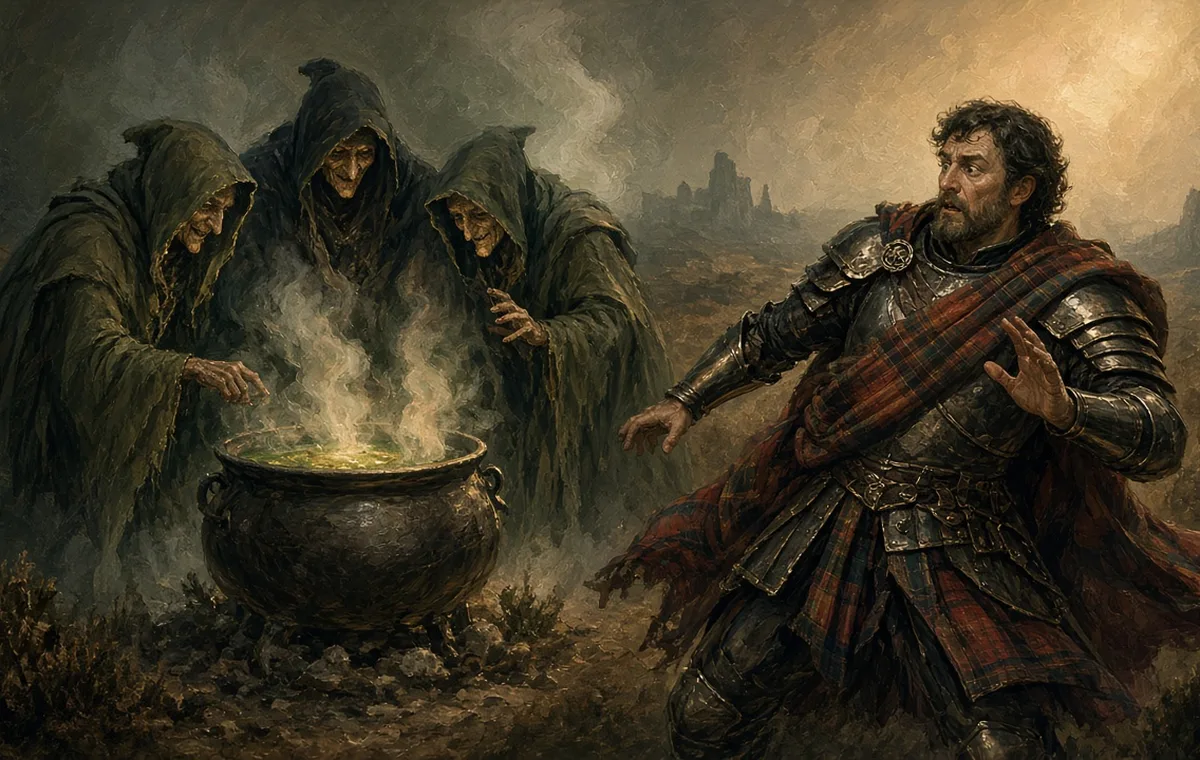
Macbeth, spurred on by the witches' prophecy and by his wife, murders King Duncan and takes the throne. Suspicion and fear push him into one killing after another until Macduff kills him. Lear's pride and Macbeth's ambition are the respective flaws.
What structure do the four plays share?
All four heroes hold high rank, and in each a flaw of character produces a wrong choice that leads to ruin. Aristotle's Poetics calls this hamartia. Strictly the word means an error or misjudgement rather than a moral defect, so it is worth a sentence in an essay to show you know the difference between Aristotle's term and the popular "tragic flaw".
Read through archetypal criticism, the approach associated with Northrop Frye and James Frazer that looks for patterns repeated across myth and literature, tragedy becomes Frye's "mythos of autumn": the story of a hero's fall and sacrifice. That lens lets you explain all four plays with a single structure.
| Play | Hero | Flaw | Trigger | Ending |
|---|---|---|---|---|
| Hamlet | Prince of Denmark | Indecision | The ghost | Hamlet, Claudius, Gertrude and Laertes die |
| Othello | Venetian general | Jealousy | Iago | Kills Desdemona, then himself |
| King Lear | King of Britain | Pride | The love test, Goneril and Regan | Dies grieving Cordelia |
| Macbeth | Scottish thane | Ambition | The witches, Lady Macbeth | Killed by Macduff |
In your conclusion, pick the flaw you think sits closest to a reader today and argue for it. The moment you choose between hesitation, jealousy, pride and ambition, a plot summary turns into criticism with your own view in it.
Why does the Globe matter for reading the plays?
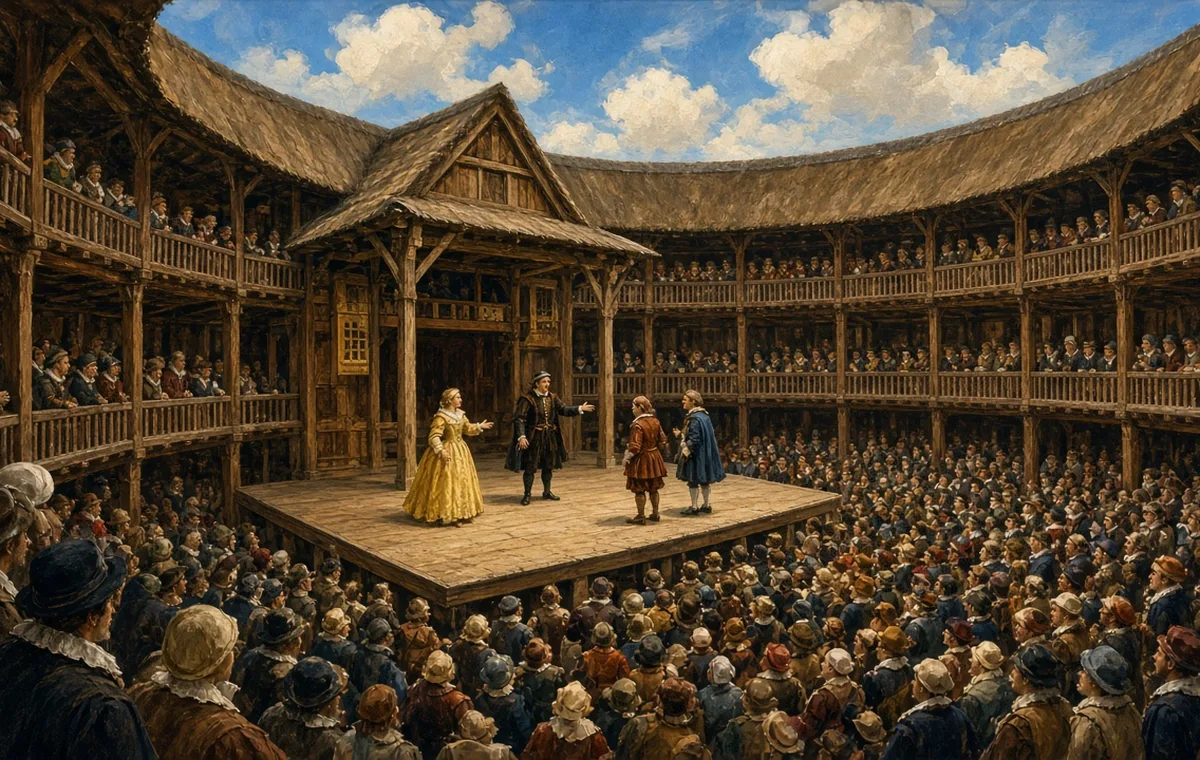
Many of these plays were first staged at the Globe, built in 1599 on Bankside, south of the Thames. It was an open-air, roughly circular playhouse with a stage thrusting into a standing crowd. Performances ran in daylight with almost no stage lighting, so night scenes had to be created in words, which is one reason Shakespeare's lines paint time, place and mood so vividly. Women were not allowed on the public stage, so boy actors played the female roles; some critics link the many heroines who disguise themselves as young men in Twelfth Night and As You Like It to that convention. The reconstructed Shakespeare's Globe, opened near the original site in 1997, is the closest you can get to hearing the plays as first audiences did.
What should you read after the four tragedies?
Once you've worked through the tragedies, moving into other genres shows how the same writer handles laughter and reconciliation. A sensible order:
- A Midsummer Night's Dream: short and light, an easy way into comic structure
- The Merchant of Venice: a comedy, but the arguments around Shylock make it a strong discussion text
- Romeo and Juliet: an earlier tragedy, good for comparison
- Richard III: a history-play villain to set beside Macbeth
- The Tempest: a late romance that ends in forgiveness
Setting Lear and Cordelia beside Prospero and Miranda is a neat example: the same writer takes a father-daughter bond to opposite endings, ruin in one play and reconciliation in the other.
Which editions and adaptations help?
For essays, use an annotated edition such as Arden, Oxford or Folger, and cite act, scene and line so your quotations can be checked. Watching adaptations widens the view: Akira Kurosawa moved Macbeth to feudal Japan in Throne of Blood (1957) and King Lear in Ran (1985). Comparing how the story shifts in another culture is a quick way to talk about both the universal and the period-specific. And catch a live or recorded performance if you can; these plays were written to be heard, and the rhythm and wordplay land differently in an actor's voice. CampusDown's English literature notes include quotation banks for each of the four plays.
Student money tip on CampusDown Life Up: How to Find Unclaimed Money in Your Name.
Reviewed by the CampusDown editorial team, November 2026. Sources: William Shakespeare, Hamlet, Othello, King Lear, Macbeth (Folger Shakespeare Library editions); Aristotle, Poetics; A. C. Bradley, Shakespearean Tragedy (1904); Northrop Frye, Anatomy of Criticism (1957).
FAQ
What are Shakespeare's four great tragedies?
Hamlet, Othello, King Lear and Macbeth, the grouping popularised by A. C. Bradley's Shakespearean Tragedy (1904).
Who deceives Othello?
His ensign, Iago, who uses Desdemona's handkerchief as false proof of her infidelity.
Who makes the prophecies to Macbeth?
The three witches, sometimes called the Weird Sisters.
What does hamartia mean?
Aristotle's term in the Poetics for the error or failing that leads to a tragic hero's downfall, often translated as 'tragic flaw'.