
What Kind of Story Is Kim Young-ha's "Vampire"? Reading a Short Story That Unsettles the Line Between Real and Fake
- "Vampire" unfolds through a letter in which a woman claims her husband is a vampire.
- Readers find it hard to decide, right to the end, whether to believe the letter.
- Kim Young-ha has written about urban isolation and desire since the 1990s.
Contents
- What happens in "Vampire"?
- What does the letter form achieve?
- What does the vampire stand for?
- Why does the line between reality and fantasy blur?
- How does it compare with Dracula?
- What are the features of Kim Young-ha's fiction?
- Analysing the story element by element
- Where should you go next in his work?
- FAQ
How would you react if you received a letter confessing that the writer's husband was a vampire? Kim Young-ha's short story "Vampire" begins with exactly that absurd premise, yet the further you read, the less it feels like fantasy and the more it feels like a story about ordinary life. This guide looks at how the story is built, what it means and what it shows about Kim Young-ha's fiction, one of the most widely translated bodies of work in contemporary Korean literature.
Student money tip from CampusDown Life UpHow to search official databases for unclaimed money in your name — free state and federal searches, and how to avoid paid finders and scams.
What happens in "Vampire"?
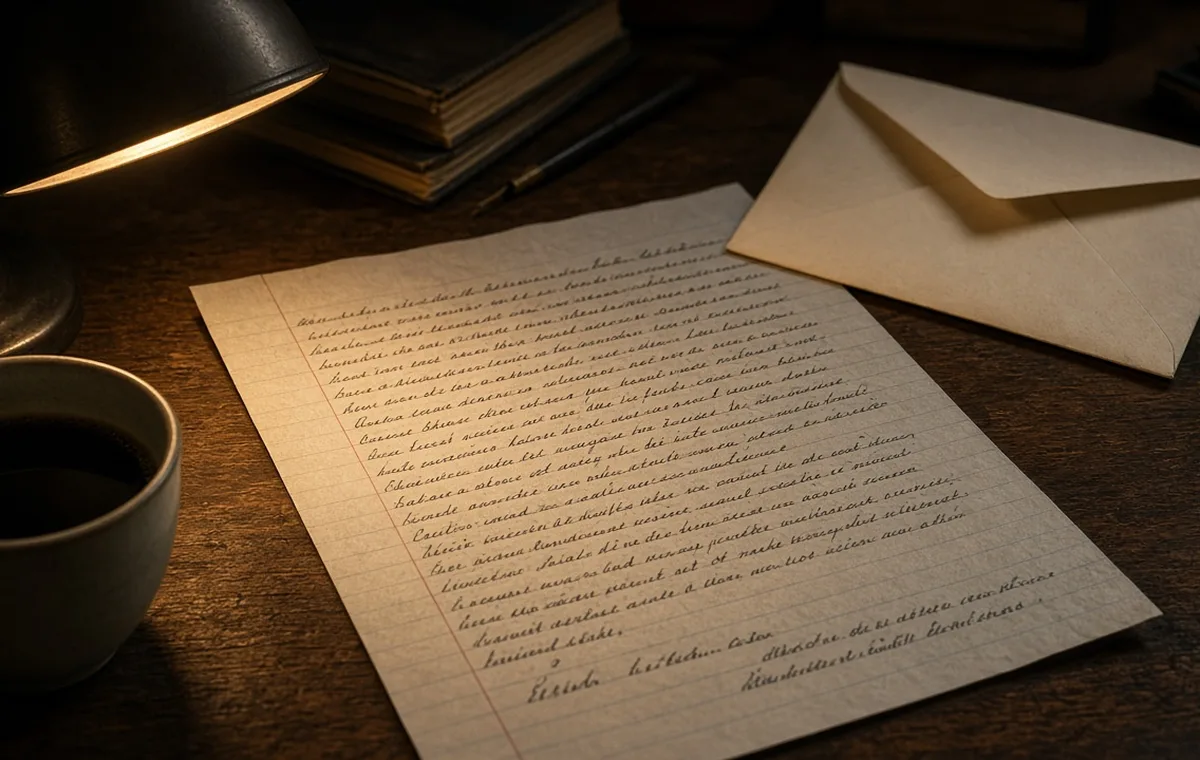
The story opens when the narrator, a novelist, receives a long letter from a woman named Kim Hui-yeon. In it she confides that her husband is a vampire and recounts their married life piece by piece. He barely moves during the day, avoids other people and never lets her into his world. As the letter goes on, the reader becomes less and less sure whether he really is a vampire or whether this is the story of a couple who have simply stopped communicating.

What does the letter form achieve?
Because the whole story reaches us through a single person's letter, we have no way to check whether what she says is true. The voice of an unreliable narrator, a term the critic Wayne Booth popularised in The Rhetoric of Fiction (1961), runs through the story and creates an uneasy tension. We are not told what to think; we are left alone with a voice that may be honest, deluded or both.
It is also striking that the person who receives the letter is himself a writer. As the line blurs between the person who writes stories and the story inside the story, a question emerges: is a story essentially a device for making us believe something? The letter is addressed to a novelist precisely because novelists are professional makers of belief.
A letter is, by its nature, written by one person for one other person. Reading a novel in letters therefore feels like secretly reading someone else's private mail. The story opens up gradually, like an unsealed envelope, and the writer's emotions arrive unfiltered, which makes them vivid. At the same time we are trapped inside her point of view, and that limitation is exactly what the story exploits.
Skimming the section headings first makes a long guide much easier to map out. Try writing down one question of your own as you read.
What does the vampire stand for?
A vampire drains the life of others while never ageing itself. The husband in the story seems to feed on his wife's life while giving nothing back to the relationship. Read that way, the vampire is less a supernatural monster than a figure for urban indifference and severed connection. A husband and wife who live in the same flat without knowing each other have been given the strange name of vampire.
The symbols repay close attention. Night, blood and closed curtains recur, and each can be read twice: as the trappings of a horror story and as images of withdrawal, exhaustion and a home that has become a hiding place. The sociological idea of anomie, the loosening of the bonds and norms that tie people to one another, offers one useful lens for that urban loneliness.

Why does the line between reality and fantasy blur?
Postmodern literature tends to prefer a state in which several interpretations coexist over a single, certain truth. "Vampire" handles fantastic material in a realistic, matter-of-fact style and hands the judgement of what is real to the reader. That approach turns the reader into an active interpreter. Because the ending offers no clear answer, each reader completes a slightly different story. The postmodernism entry sets out the wider movement this kind of writing belongs to.
Readers of English fiction will recognise the effect from Henry James's The Turn of the Screw (1898), where critics still argue over whether the ghosts are real or the governess who reports them is unravelling. Kim's story belongs to the same family of texts that refuse to settle the question and make the refusal the point.
How does it compare with Dracula?
The epistolary form has a long history. Bram Stoker's Dracula (1897) is itself stitched together from diaries, letters and newspaper cuttings. Comparing "Vampire" and Dracula at the point where the vampire and the letter meet shows how the same form can be used in two different ways. In Stoker, multiple documents gradually confirm the monster's existence and build terror; in Kim, a single document leaves its existence in doubt and exposes the cracks in everyday life. One uses letters to prove; the other uses a letter to unsettle.
What are the features of Kim Young-ha's fiction?
Kim Young-ha made his debut in 1995 and drew attention with his first novel, I Have the Right to Destroy Myself (1996). He went on to reach a wide readership with books including Black Flower (2003) and Diary of a Murderer (2013), and several of his novels are available in English translation. His fiction is known for dry, fast-moving sentences, the isolation and desire of city dwellers, and experiments that borrow the machinery of genre fiction. "Vampire" can be read as a compact version of all these traits.
Analysing the story element by element
| Element | Question to ask | Applied to "Vampire" |
|---|---|---|
| Point of view and narrator | Who speaks, and how much do they know? | The one-sided view of the letter writer |
| Form | What frame holds the story? | The double structure of the letter and the writer who receives it |
| Symbol | Which objects and images recur? | What the vampire, blood and night stand for |
| Ending | What is left open? | Whether it is true is left to the reader |
When you write a response essay, keep the plot summary short and choose two or three of these elements to explore in depth. An essay that develops one or two points with evidence is far more convincing than one that skims all of them. A practical exercise is to divide a page into two columns and copy sentences from the letter that sound factual into one and sentences that sound doubtful into the other. Finding the places where the two columns blur is the real pleasure of reading Kim Young-ha.
Where should you go next in his work?
If "Vampire" left you unsure where the real ends and the fake begins, his other books carry the same questions in new forms. Identity confusion, the border between reality and fantasy and the solitude of the individual in the city recur throughout, so reading several works in sequence gives you something like a map of his world.
Student money tip on CampusDown Life Up: How to search official databases for unclaimed money in your name.
- Early short stories such as "Vampire": an urban sensibility and fantastic premises
- I Have the Right to Destroy Myself: his first novel, about life, death and art, told through a man who helps people die
- Diary of a Murderer: a retired serial killer with Alzheimer's disease whose memory cannot be trusted, filmed in 2017 as Memoir of a Murderer
- Your Republic Is Calling You: one day in the life of a North Korean sleeper agent living as an ordinary Seoul family man
- Farewell: a recent novel that asks where the line between human and machine lies
Read in that order, the question "who am I?" appears in a different guise each time. The question of whether the husband in "Vampire" is really a vampire returns in Your Republic Is Calling You as an ordinary father who is secretly a spy, and in Farewell as the question of whether one is human or machine. Diary of a Murderer connects most directly, because it asks the same thing "Vampire" asks: how far should we trust the voice telling us the story?
Kim has also shared his thinking about literature and writing through essays and talks. What an author says about his own work is a helpful reference, but there is no need to hand interpretation over to the author. Building your own reading from evidence in the text is the real pleasure of studying literature, and comparing interpretations with a friend who has read the same story is a good way to test it.
Written by the CampusDown editorial team, reviewed November 2026. Sources: Kim Young-ha, "Vampire" (short story); Kim Young-ha, I Have the Right to Destroy Myself (1996); Bram Stoker, Dracula (1897); Wayne C. Booth, The Rhetoric of Fiction (1961).
FAQ
What form does "Vampire" take?
It is built around a letter a woman sends to a writer.
Who writes the letter?
A woman named Kim Hui-yeon.
What was Kim Young-ha's first novel?
I Have the Right to Destroy Myself (1996), published in English in 2007.
Which Kim Young-ha novel pairs well with "Vampire"?
Diary of a Murderer, whose narrator's memory cannot be trusted, makes a natural next read.