
From Bare Rock to Forest: How Plant Succession Works, With Real Examples
- Succession is the slow replacement of one plant community by another until a fairly stable forest forms.
- Primary succession starts without soil; secondary succession follows fires, storms or abandoned fields and is faster.
- Richer plant life supports richer food chains, and a healthy top predator is a sign the whole forest works.
Contents

Ecological succession is the gradual, fairly predictable replacement of one plant community by another on the same patch of ground, until a relatively stable community settles in. On bare rock the pioneers are lichens and mosses, which crumble the surface and add organic matter until grasses, shrubs and finally trees can take root. It sounds slow, and it is, but once you know the sequence you start spotting it everywhere, from abandoned car parks to railway embankments and old fields.
What exactly is plant succession, and why does it happen?
Each group of plants changes the place it lives in. Pioneers build soil, hold water and add shade; those new conditions then favour different species, which slowly crowd out the ones that made room for them. Ecologists Joseph Connell and Ralph Slatyer famously described three ways this can work: early species can facilitate newcomers, simply tolerate them, or actively inhibit them until a disturbance opens a gap.
Student money tip from CampusDown Repair UpIs a small leak worth a renters insurance claim? How to decide — compare the loss with your deductible, check who is responsible, and document it either way.
Light is the quiet driver behind most of the later stages. Sun-loving plants grow fast in the open, but their own seedlings struggle in the shade they create, while shade-tolerant trees can wait patiently under the canopy and take over when the old trees fall. All of it runs on photosynthesis, so the competition for light is really a competition for energy.
The Korean source article uses a classic textbook sequence from Korea's central region, which is a neat model even if you live far from Seoul. Read it as a general pattern rather than a fixed timetable, because local soil, climate and grazing change the details.
| Stage | Typical plants | What changes |
|---|---|---|
| Annual and short-lived herbs | Shepherd's purse, whitlow grass, horseweed | Bare soil is covered quickly; roots start holding it |
| Perennial herbs | Mugwort and other long-lived herbs | Deeper roots, more organic matter, denser cover |
| Shrubs | Sumac and other woody pioneers | First real shade; birds bring in tree seeds |
| Sun-loving (pioneer) forest | Pines | A canopy forms, but pine seedlings struggle in their own shade |
| Shade-tolerant forest | Oaks and other broadleaf trees | A layered, relatively stable forest develops |
One small correction to the original: horseweed is usually an annual or biennial rather than a true perennial, so it belongs with the early colonisers, while mugwort is the classic long-lived herb. Many textbooks also insert a mixed pine and broadleaf stage between the pine forest and the oak forest, and the final mix varies from region to region.

Primary, secondary and cyclic succession: how do they differ?
The starting point makes all the difference. Primary succession begins where there is no soil at all, such as fresh lava, a retreating glacier or a brand-new island, so it can take centuries. Secondary succession starts after a disturbance that leaves the soil behind, such as a fire, a storm or a field that stops being ploughed, and it moves far faster because seeds and roots are already waiting.
Britain has one of the best-known real experiments. At Rothamsted in Hertfordshire, part of the Broadbalk wheat field was left unharvested in the 1880s, and the "Broadbalk Wilderness" turned into woodland on its own, with oak establishing over the following decades. Few people get to watch a field become a forest, but researchers there have been recording it for well over a century.
North America offers dramatic primary and secondary examples. After Mount St Helens erupted in 1980, scientists tracked how plants returned to an apparently sterilised landscape, often helped by survivors buried under snow or soil. The huge Yellowstone fires of 1988 looked catastrophic at the time, yet lodgepole pines, whose cones open in heat, reseeded much of the burned area within a few years.
Iceland's Surtsey, an island that rose from the sea in a 1963 eruption, has been kept largely off limits so scientists can watch primary succession from scratch, with seeds arriving by wind, waves and birds. Cyclic succession, the third type, describes communities that loop through stages again and again, such as heathland where old heather dies back and regrows in patches.
Skimming the section headings first makes a long guide much easier to map out. Try writing down one question of your own as you read.
How do forest food chains work, and why are top predators so revealing?
As the plant community grows richer, so does the animal community. Plants are the producers, herbivores such as insects and deer are primary consumers, and predators sit higher up. Only a small fraction of the energy at each level reaches the next one, often summarised as roughly ten per cent, which is why there are always far fewer foxes than rabbits and far fewer hawks than mice.
| Level | Examples | Role in the forest |
|---|---|---|
| Producers | Trees, shrubs, mosses, wildflowers | Capture sunlight and build biomass |
| Primary consumers | Caterpillars, deer, voles | Eat plants and pass energy upward |
| Secondary consumers | Songbirds, shrews, weasels | Control herbivore numbers |
| Top predators | Hawks, owls, wolves where present | Shape the behaviour and numbers of everything below |
| Decomposers | Fungi, bacteria, earthworms | Return nutrients to the soil |
Because a top predator needs a large, healthy base beneath it, finding one is a good sign the whole system is working. Remove it and the effects can ripple downward in what ecologists call a trophic cascade, with herbivores multiplying and over-browsing young trees.
Yellowstone is again the famous example. Wolves were reintroduced in 1995, and many studies linked their return to changes in elk behaviour and the recovery of willows and aspens along some streams. Other researchers argue the effect has been overstated and that weather, bears and human hunting matter too, which makes it a great case for a class debate rather than a settled fact.
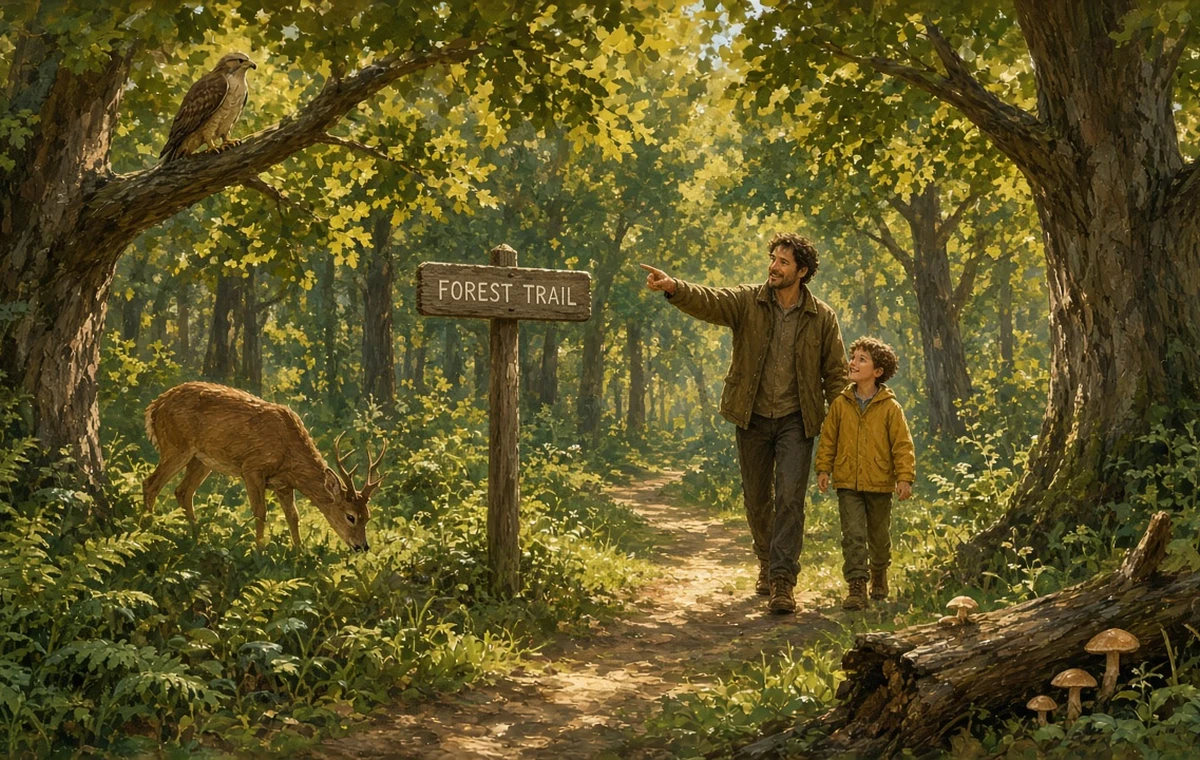
In Britain the conversation often turns to deer. With no wolves or lynx, roe and muntjac deer numbers have grown in many areas, and woodland managers worry about seedlings being browsed before they can replace the old trees. It is a real-world reminder that succession can stall when a link in the food web is missing.
What does a healthy, mature forest look like?
A forest near the end of succession is not frozen. It keeps changing in small ways as old trees fall and gaps fill, but its overall character stays steady. Ecologists usually look for a handful of signs when they judge whether a woodland is in good shape.
Student money tip on CampusDown Repair Up: Is a small leak worth a renters insurance claim? How to decide.
- Many species of plants, fungi and animals rather than one dominant type
- Clear vertical layers: canopy, understorey, shrub layer and ground flora
- Plenty of dead wood and leaf litter being broken down by decomposers
- Resilience: the ability to recover after storms, pests or drought
- Top predators and specialist species that only survive in complex habitats
If you want to see succession for yourself, look at a rewilding project, a disused quarry or the edge of an abandoned allotment. Note which plants arrive first, which ones shade them out, and which birds start visiting. In a few seasons you will have your own small field study, no lab required.
Compiled by the CampusDown editorial team from a Korean article on plant succession and forest food chains, with added public information on the Broadbalk Wilderness at Rothamsted, Mount St Helens, the 1988 Yellowstone fires, Surtsey and the Yellowstone wolf reintroduction. Reference: Connell, J. H. & Slatyer, R. O. (1977). Mechanisms of succession in natural communities and their role in community stability and organization. The American Naturalist, 111(982), 1119–1144. Reviewed November 2026. Educational content only.
FAQ
What is the difference between primary and secondary succession?
Primary succession starts where no soil exists, such as fresh lava; secondary succession starts after a disturbance that leaves soil and seeds behind, so it is much faster.
What are pioneer species?
They are the first organisms to colonise bare ground, such as lichens and mosses on rock or fast-growing annual weeds on bare soil.
Can I see succession in the UK?
Yes. The Broadbalk Wilderness at Rothamsted is a famous example, and disused quarries, railway sidings and rewilding sites show it on a smaller scale.
Did wolves really change Yellowstone's rivers?
Many studies linked wolf reintroduction in 1995 to changes in elk and streamside trees, but other researchers think the effect has been overstated, so it is still debated.
Why are there fewer predators than prey?
Only a small share of energy, often summarised as about ten per cent, passes from one trophic level to the next, so each higher level supports fewer animals.