
Eating for Two? What Pregnancy Really Changes About Energy, Protein, Calcium and Iron, With US and UK Advice
- Pregnancy speeds up thyroid and nervous system activity, so energy needs rise, though far less than eating for two.
- In early pregnancy the fetus cannot make non-essential amino acids, so the mother's protein intake is essential.
- Calcium needs grow with the baby's bones, and iron demand peaks in the last three months when the baby builds its stores.
Contents
Pregnancy does not mean eating for two, but it does mean eating for a body that is suddenly running more systems at once. A faster metabolism, a growing placenta and a baby who cannot yet make some of its own building blocks all change what a mother needs, especially energy, protein, calcium and iron. This guide explains why each one matters and how official advice in the United States and Britain turns the science into everyday meals.
Why does nutrition matter so much during pregnancy?
The study behind this article stresses a simple chain: the mother's nutritional status shapes how the baby grows in the womb, and that early start carries on into the baby's health after birth. Pregnancy is therefore less about piling more food onto the plate and more about choosing the nutrients whose demand has actually gone up.
Student money tip from CampusDown Repair UpWindow AC Cost Per Month: How to Estimate It With Your Own Numbers — Estimate window AC cost per month with the unit's watts, your hours and your electric rate.
Doctors in both countries also start the conversation before pregnancy. The CDC urges anyone who could become pregnant to take 400 micrograms of folic acid every day, because the baby's neural tube closes in the first weeks, often before a pregnancy test turns positive. The NHS gives the same 400 microgram advice from before conception until week 12. You can read more about this B vitamin in our explainer on folate and folic acid.
That early start is the first sign that pregnancy nutrition is about timing as much as quantity: some nutrients matter most before a bump even shows, others only in the final months.

Why does a pregnant body need more energy?

Energy fuels the baby's growth and the mother's own changes: the placenta, uterus and breasts all enlarge. On top of that, the source material explains that thyroid activity and the sympathetic nervous system speed up during pregnancy, so many metabolic processes simply run faster and burn more fuel.
The numbers are smaller than the eating-for-two myth suggests. The American College of Obstetricians and Gynecologists (ACOG) says no extra calories are usually needed in the first trimester, about 340 extra a day in the second and about 450 in the third. The NHS is even more cautious, suggesting roughly 200 extra calories a day only in the last three months. That is closer to a peanut-butter sandwich than a second dinner, and individual needs vary with weight and activity.
Skimming the section headings first makes a long guide much easier to map out. Try writing down one question of your own as you read.
Why can't protein be skipped?
In the first half of pregnancy the baby's liver cannot yet make non-essential amino acids on its own. Normally our bodies build these amino acids quietly in the background, but the fetus depends on the mother's diet to supply them. In effect, she is delivering the raw materials for every new cell.
That is why beans, eggs, dairy, fish, poultry and lean meat show up in every prenatal meal plan. American and British guidance both favor variety over supplements here: a little protein at each meal is easier to manage than one big steak, especially when nausea makes large meals unappealing.
Fish deserves a special note. The FDA and EPA encourage pregnant women to eat 8 to 12 ounces a week of lower-mercury fish such as salmon, cod or canned light tuna, while avoiding high-mercury species such as shark, swordfish, king mackerel and marlin. The NHS similarly limits oily fish to two portions a week.
How much does calcium matter?
The study describes calcium as one of the most important nutrients in both ordinary and special physiological states, because it controls everything from bone building to nerve signals and muscle contraction. As the baby's skeleton forms, total calcium demand rises, so a steady intake plan across the whole pregnancy makes sense.
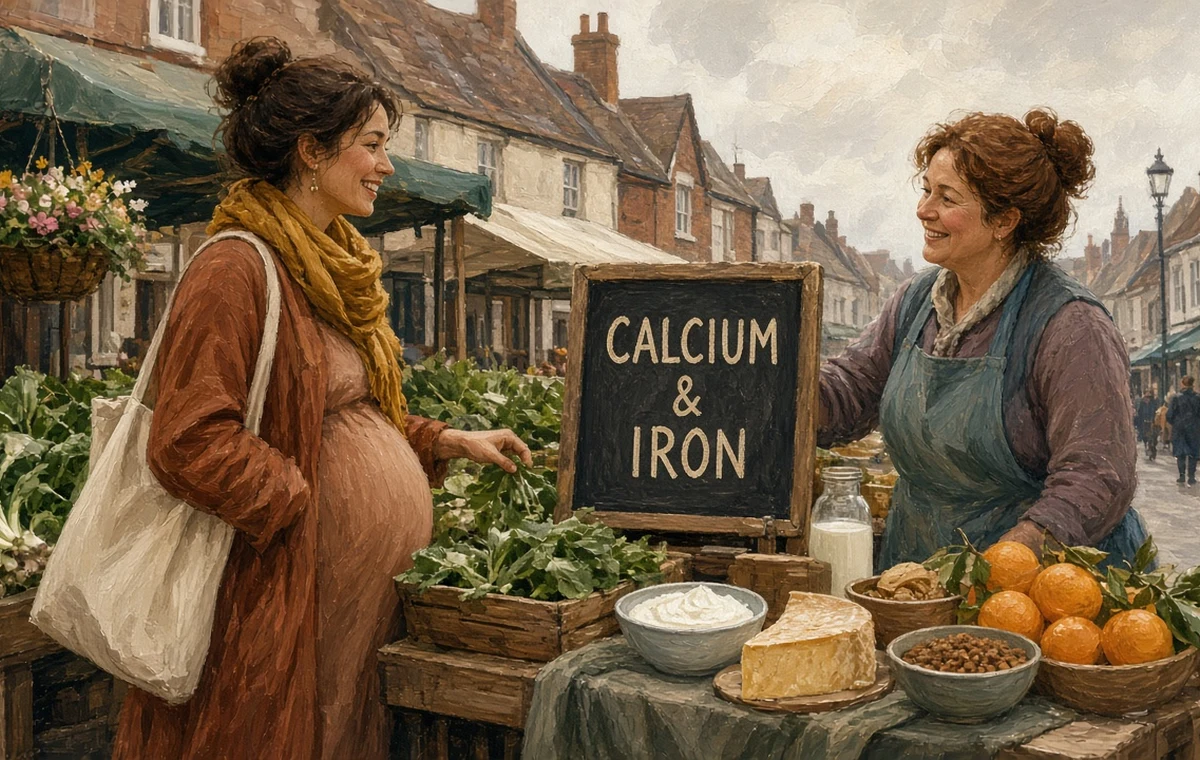
Interestingly, the official targets do not jump much. US guidance keeps the adult figure of about 1,000 milligrams a day (1,300 for teenagers), partly because the body absorbs calcium more efficiently during pregnancy. The NHS pairs calcium with vitamin D and recommends a daily 10 microgram vitamin D supplement for pregnant women, since British sunshine is unreliable for much of the year.
So the practical message is consistency rather than megadoses: dairy or fortified plant milk, tofu set with calcium, canned fish with soft bones and leafy greens, spread across the day.
When is iron needed most?
The baby stores most of its iron in the last three months of pregnancy, which is when demand climbs sharply. According to the source material, poor iron status strongly affects normal fetal growth, mothers with anaemia have a higher rate of preterm birth than other mothers, and a mother's iron stores are linked with her baby's iron status after birth. The condition itself is covered in our explainer on iron deficiency anemia.
- Cut down on things that block iron absorption, such as tea or coffee with meals
- Add things that help absorption, such as vitamin C from fruit or peppers
- Improve the mother's iron status with supplements when a clinician advises it
In the US, ACOG lists 27 milligrams of iron a day during pregnancy and many prenatal vitamins contain it. The NHS takes a test-first approach: blood is checked at booking and around 28 weeks, and iron tablets are offered when levels are low. Both approaches share the study's core lesson: it is not just how much iron you eat, but how much your body can actually absorb.
Help with the cost exists too. In the US, the WIC program offers nutrition support and healthy foods to eligible low-income pregnant women, while in Britain the Healthy Start scheme gives eligible families a prepaid card for milk, fruit, vegetables and pulses plus free vitamins.
How do US and UK guidelines compare?
| Nutrient | Why demand rises | US guidance | UK guidance |
|---|---|---|---|
| Energy | Faster metabolism, placenta and uterus grow | About +340 kcal (2nd) and +450 kcal (3rd trimester) | About +200 kcal in the last trimester only |
| Protein | Fetus cannot make non-essential amino acids early on | Varied sources, low-mercury fish 8 to 12 oz a week | Varied sources, oily fish up to two portions a week |
| Calcium | Baby's bones and maternal changes | About 1,000 mg a day (1,300 mg for teens) | Food first, plus 10 microgram vitamin D supplement |
| Iron | Baby stores iron in the last three months | 27 mg a day, often in prenatal vitamins | Blood tests, iron tablets if levels are low |
| Folic acid | Neural tube forms in early weeks | 400 micrograms daily for anyone who could become pregnant | 400 micrograms from before conception to week 12 |
Student money tip on CampusDown Repair Up: Window AC Cost Per Month: How to Estimate It With Your Own Numbers.
The table shows two health systems reaching the same conclusions from slightly different directions. America leans on clear daily targets and prenatal vitamins, while Britain leans on testing and a short list of supplements. Either way, the plan should be personal, so check with a midwife, obstetrician or registered dietitian rather than copying someone else's routine.
Takeaway for students
If you are writing about pregnancy nutrition, organize your answer around why each need changes: energy for a faster metabolism and new tissue, protein because the fetus cannot yet make some amino acids, calcium for a growing skeleton and iron for the baby's late-pregnancy stores. Then show how real health systems translate those reasons into practical rules.
Reference: King, J. C. (2000). Physiology of pregnancy and nutrient metabolism. The American Journal of Clinical Nutrition, 71(5), 1218S to 1225S, a useful overview of how metabolism changes in pregnancy.
FAQ
Do I really need to eat for two when pregnant?
No. ACOG suggests no extra calories in the first trimester and roughly 340 to 450 extra a day later on, while the NHS suggests about 200 extra only in the last trimester.
Why is protein so important in early pregnancy?
In the first half of pregnancy the baby's liver cannot make non-essential amino acids, so they must come from the mother's diet.
When should I start taking folic acid?
Ideally before conception. The CDC recommends 400 micrograms daily for anyone who could become pregnant, and the NHS advises it until week 12.
What fish should I avoid while pregnant in the US?
The FDA and EPA advise avoiding high-mercury fish such as shark, swordfish, king mackerel and marlin, and choosing lower-mercury options instead.
How can I absorb more iron from food?
Pair iron-rich foods with vitamin C, avoid tea or coffee with meals, and follow your clinician's advice on iron tablets if tests show low levels.