
Where Did the Tambourine Come From? The Persian Daf, Its Ring-Lined Frame and the Sufi Rhythm of Rumi
- The daf is a 50 cm Persian and Kurdish frame drum with metal rings inside the rim, often called the tambourine's ancestor.
- Desert and nomadic cultures favored light hand drums made from skin and a bent wooden hoop.
- Persian art music grew through solo improvisation and is closely tied to Sufism and Rumi's poetry.
Contents
The daf is a large Persian and Kurdish frame drum, about 50 cm across, with skin on one side only and dozens of small metal rings hanging inside its wooden hoop, which is why many musicians call it the grandparent of the modern tambourine. Shake it and the rings hiss like rain on a tin roof; strike it and you get a deep "doum" from the center and a bright "tak" from the rim. Behind that simple circle sits a thousand-year story of Sufi poetry, Rumi's verses and trance-like listening.
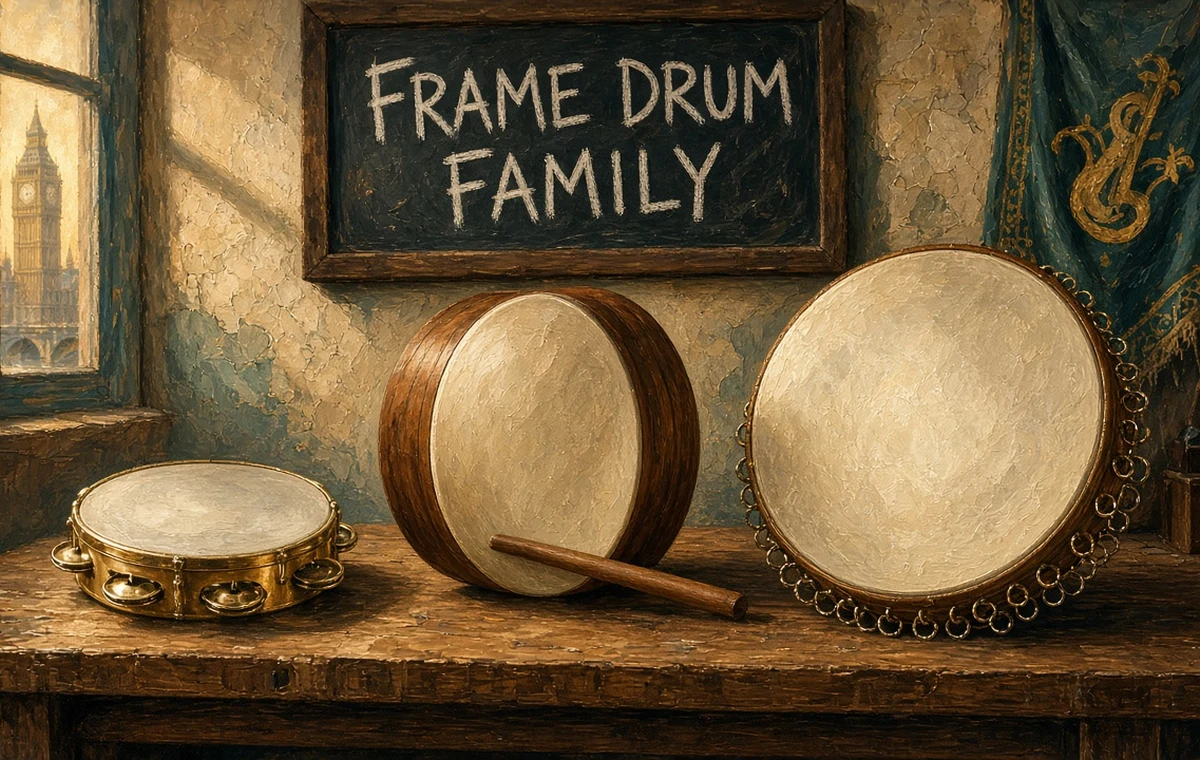
This guide walks through the frame drum family tree, how a daf is built and played, why the desert world favored hand drums, and how Persian classical music and Sufi philosophy shape what you hear, from a Kurdish village ceremony to a world-music night in London or Los Angeles.
Where does the frame drum family come from?
A frame drum is the simplest drum design there is: a thin, wide hoop with a skin stretched across it. Clay figurines and reliefs from ancient Mesopotamia already show people holding round frame drums at shoulder height, and the design traveled with traders, armies and pilgrims in every direction. Go west and it becomes the Roman tympanum, the medieval European timbrel and eventually the orchestral tambourine. Go north-west to Ireland and it becomes the bodhrán. Stay in Iran, Kurdistan and the Caucasus and it grows into the daf.
Student money tip from CampusDown Law UpMy Security Deposit Wasn't Returned. Here's the Calm, Step-by-Step Plan — Security deposit not returned after move-out?
| Drum | Home region | Size and jingles | How it is played |
|---|---|---|---|
| Daf | Iran, Kurdistan, Azerbaijan, Armenia, Turkey, Pakistan | About 45 to 55 cm; many metal rings (halqeh) hung inside the rim | Held upright in both hands, fingers and palms |
| Tambourine | Europe, now worldwide | About 25 cm; pairs of metal discs (zils) set into slots in the frame | Shaken or struck with one hand |
| Bodhrán | Ireland | About 35 to 45 cm; usually no jingles | Struck with a double-headed tipper, other hand changes pitch from behind |
| Riqq / bendir | Arab world, North Africa | Riqq small with brass cymbals; bendir with a gut snare | Fingers, very fast ornaments |
The family resemblance is real, but the daf is not just a big tambourine. Its rings ride loose on hooks along the inside of the frame instead of sitting in cut-out slots, so they keep shimmering after each stroke and blur into a continuous wash of sound.

Why did desert cultures favor hand drums?
The Korean source for this article makes a neat point: the first instrument was the human body, clapping and stamping. Next came whatever the environment offered, such as animal skins, bones, reeds and wood. Arid regions had little timber for big resonating bodies and few metal workshops on the move, so the most practical instrument for nomads and caravans was a light hoop and a skin, played with bare hands and easy to strap onto a camel or carry to a wedding.
That logic still explains why frame drums dominate across North Africa, Arabia, Iran and Central Asia, while forested Europe built big wooden barrels and orchestral timpani. Once you notice that an instrument's shape follows its landscape, unfamiliar folk instruments become much easier to understand.
Skimming the section headings first makes a long guide much easier to map out. Try writing down one question of your own as you read.
How is a Persian daf built?
A daf is basically four ingredients, and each one changes the sound.
- The hoop: a thin strip of hardwood, often walnut or ash, steamed and bent into a circle about 5 to 6 cm deep.
- The skin: traditionally goat, sheep or even fish skin glued over one side; many professionals now use synthetic heads.
- The rings (halqeh): 60 to 70 small iron or brass rings hung on hooks along the inner rim, which add the rain-like shimmer.
- The grip: no handle at all; the player's thumbs hook inside the frame.
| Feature | Natural skin | Synthetic head |
|---|---|---|
| Tone | Warmer, earthier, more complex overtones | Brighter, cleaner, very consistent |
| Weather | Goes slack in humid air, tightens in dry air; players warm it near a heater | Barely changes, good for touring |
| Care | Avoid cars in summer and damp basements | Wipe and go |
If you buy one in the US or UK, a synthetic-head daf is the safer first instrument because central heating and rainy weather will not keep changing its pitch. Natural skin rewards patience with a richer voice.
How do you play the daf?
The player holds the drum upright, usually with the lower edge supported by the left hand while the right hand strikes. Fingertips near the rim give a light, crisp "tak"; the palm or flat fingers in the center give a deep "doum"; a fast finger snap against the frame produces a sharp crack. Advanced players also tilt and shake the whole drum so the rings roll, and even lift it above their heads during climaxes.
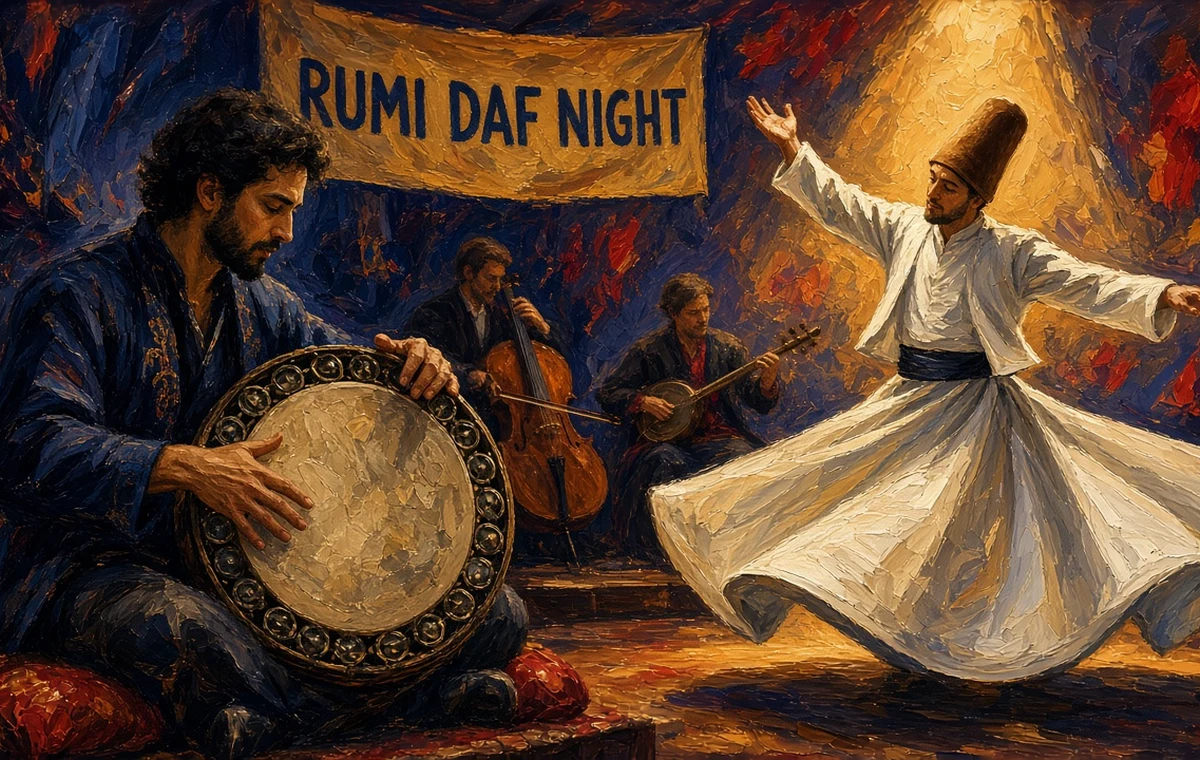
The Korean original compares the daf to the janggu, the hourglass drum that drives Korean shamanic music. For English-speaking readers, a closer comparison might be the bodhrán in an Irish session: one hand-held drum that sets the pulse for everyone else, and a good player who can make a single skin sound like a whole percussion section.
In Kurdish regions of Iran and Iraq the daf is a sacred instrument in the zikr ceremonies of Qadiri dervishes, where dozens of players can drum together for long stretches while the group repeats the names of God.
What does Rumi have to do with drum rhythm?
Iran's state religion is Twelver Shia Islam, and its art music has survived mostly as solo performance and improvisation. Much of that music is tied to Sufism, the mystical and ascetic stream of Islam, and to the poetry of Jalal al-Din Rumi (1207 to 1273), the Persian poet who lived in Konya. After his death his followers formed the Mevlevi order, known in the West as the whirling dervishes. Their ceremony leans on the ney flute and kudüm kettle drums, while frame drums like the daf carry similar spiritual weight in Kurdish and Persian Sufi gatherings.
In Sufi thought, the steady pulse of the drum mirrors the heartbeat and the turning of the heavens. Repetition is the point: the rhythm quiets the restless self until listening becomes a form of prayer, a state close to what psychologists call flow. Rumi is one of the best-selling poets in the United States thanks to Coleman Barks's translations, so many concert-goers meet the daf through his lines before they ever hear the drum.
Musically, Persian classical music is organized in the radif, a repertoire of melodies grouped into modal systems called dastgah. UNESCO added the radif to its intangible heritage list in 2009. Scholars such as Hormoz Farhat argue that Persian art music kept its own identity under Islamic rule and even influenced Arab art music, a reminder that influence in the region flowed in more than one direction.
Where can you hear the daf in the US and UK today?
Since the late twentieth century, Kurdish musicians such as the Kamkar family brought the daf from devotional circles into concert halls, and it has since become a favorite of world-music and film composers.
Student money tip on CampusDown Law Up: My Security Deposit Wasn't Returned. Here's the Calm, Step-by-Step Plan.
| Where | What you might hear |
|---|---|
| Silk Road Ensemble projects | Kamancheh master Kayhan Kalhor and frame drums alongside Western strings |
| London world music venues and the Barbican | Persian and Kurdish ensembles with daf solos |
| Los Angeles, home to a large Iranian-American community | Nowruz concerts and Rumi poetry nights |
| University world music and ethnomusicology programs | Frame drum workshops and Persian music ensembles |
For a first listen, watch a performance video and follow the player's hands: try to tell the rim strokes from the center strokes by ear, then notice how the ring shimmer fills every gap.
Common mistakes
- Calling the daf "just a big tambourine" and missing the ring mechanism and spiritual role.
- Leaving a natural-skin daf in a hot car or damp room.
- Assuming all Sufi orders use the same instruments.
- Treating Persian music as a branch of Arab music rather than a tradition in its own right.
Quick self-check
- Can you explain how daf rings differ from tambourine jingles?
- Do you know which hand position gives "doum" and which gives "tak"?
- Can you link Rumi, Sufism and the idea of rhythm as prayer?
Compiled by the CampusDown editorial team from Hormoz Farhat, The Dastgah Concept in Persian Music (Cambridge University Press, 1990), UNESCO intangible heritage records and published organology references. Reviewed November 2026. Educational overview, not a performance manual.
FAQ
What is a daf?
A large frame drum from Iran and Kurdistan, about 50 cm across, with skin on one side and many small metal rings hung inside the wooden rim.
Is the daf the same as a tambourine?
They are relatives. A tambourine has metal discs set in slots and is smaller; the daf uses loose rings on hooks and is played with both hands for deeper bass and continuous shimmer.
How is the daf held and played?
Upright, supported by the left hand, with the right fingers striking near the rim for bright tones and the palm in the center for deep tones.
Should a beginner buy natural or synthetic skin?
In changeable US or UK weather, a synthetic head is easier because its pitch stays stable; natural skin sounds warmer but needs careful humidity control.
Why is the daf linked to Rumi and Sufism?
Persian and Kurdish Sufi gatherings use frame drums to build a steady pulse that supports meditation and devotional listening, a practice tied to Rumi's mystical poetry.