
Why Does Alice in Wonderland Still Hook Kids? Fantasy Picture Books, Wordless Books and How to Read Them
- A fantasy picture book uses impossible events, from talking animals to flying frogs, to make children's imagination fill the gaps.
- Alice's Adventures in Wonderland grew from an Oxford boat-trip story and was published by Macmillan in 1865 with John Tenniel's illustrations.
- Wordless books such as David Wiesner's Caldecott-winning Tuesday turn the child into the narrator, so talk through each spread together.
Contents
- What exactly is a fantasy picture book?
- Why are young children so drawn to impossible stories?
- How did Alice's Adventures in Wonderland begin?
- How are picture books with words different from wordless ones?
- How do you read a wordless fantasy book like Tuesday?
- Which theme picture books pair well with fantasy?
- FAQ
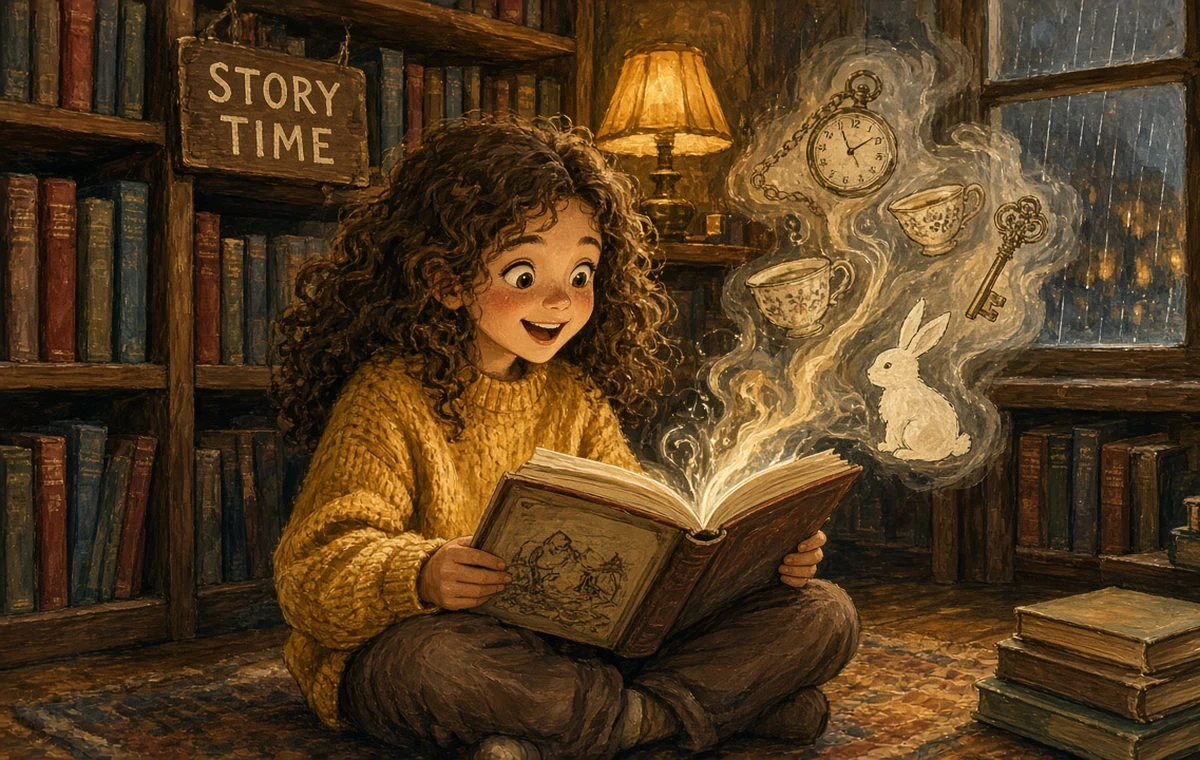
A fantasy picture book is a picture book built on fantasy literature: it shows children things that cannot happen in real life, such as talking animals, shrinking heroes or flying frogs, so that their imagination has to do the work of filling the gaps. Alice's Adventures in Wonderland has been pulling readers down the rabbit hole since 1865, and it is still the template every fantasy picture book quietly measures itself against. This guide explains what makes the genre tick, why young children fall for it so hard, and how books with words and books with no words at all work differently on a child's mind, using classics from Oxford to the Caldecott shelf.
What exactly is a fantasy picture book?
In children's literature, fantasy is the umbrella term for stories that break the rules of the real world on purpose. A fantasy picture book applies that idea to the 32-page format most of us remember from bedtime: the pictures do not just decorate the text, they carry the impossible part of the story. Ghost stories told at bedtime, Harry Potter for older readers and Where the Wild Things Are for toddlers all sit on the same family tree.
Student money tip from CampusDown Repair UpLandlord repair request letter template you can copy — what to include, how to send it, a follow-up version and how to keep a paper trail.
Scholars often borrow the Oxford English Dictionary's older sense of fantasy as the mental faculty that turns what we perceive into images and meaning. That is a useful way to think about the genre: a fantasy picture book hands a child raw strangeness and asks the child's mind to make sense of it, which is exactly the kind of symbolic play described in Piaget's theory of cognitive development.
Western critics began treating fantasy as a proper literary category in the middle of the nineteenth century, just as Victorian Britain produced a wave of books written for children's pleasure rather than their moral instruction.

Why are young children so drawn to impossible stories?
The short answer is that impossible scenes are irresistible puzzles. When a rabbit checks a pocket watch or a girl suddenly grows nine feet tall, a four-year-old has no script for what happens next, so they start inventing one. Fantasy rewards the questions children already ask all day: what if, why not, and what would I do?
- Safe danger: a monster on the page lets children rehearse fear while sitting on a grown-up's lap.
- Control: small children live in a world run by adults; fantasy heroes who outwit giants and queens flip that power balance.
- Language growth: describing a world that does not exist stretches vocabulary further than describing the kitchen does.
That is why the best read-aloud technique for fantasy is not explaining the plot but pausing to ask, "What would you have done?" The child's answer is the real story.
Skimming the section headings first makes a long guide much easier to map out. Try writing down one question of your own as you read.
How did Alice's Adventures in Wonderland begin?
The book started as a story told aloud. On a summer boat trip on the Thames near Oxford in July 1862, Charles Lutwidge Dodgson, a mathematics lecturer at Christ Church who wrote as Lewis Carroll, improvised a tale for the three young Liddell sisters. Alice Liddell asked him to write it down, and the handwritten version eventually grew into the novel published by Macmillan in London in 1865.
Carroll insisted on a professional artist, and John Tenniel, then famous for his cartoons in Punch magazine, drew the original illustrations. Tenniel's Alice, the Mad Hatter and the Cheshire Cat became so definitive that later illustrators, from Arthur Rackham to modern picture-book artists, have had to argue with his images as much as with Carroll's words.
Alice is the classic example of a fantasy story with words. The prose builds absurd situations, logic puzzles and wordplay, and the pictures make those impossibilities concrete, so the reader experiences Wonderland rather than just hearing about it. Oxford still leans into that heritage, with an annual Alice's Day of family events every summer.
How are picture books with words different from wordless ones?
Picture-book researchers describe a spectrum. At one end, words carry the plot and pictures illustrate; in the middle, words and pictures each tell part of the story, sometimes contradicting each other for comic effect; at the far end, the pictures tell everything and the words disappear.
| Feature | Picture book with words | Wordless picture book |
|---|---|---|
| Who tells the story | The author's text, supported by pictures | The reader, guided by visual clues |
| Classic examples | Alice's Adventures in Wonderland, Where the Wild Things Are | Tuesday, The Snowman, The Arrival |
| Best reading style | Read aloud with expression, pause for predictions | Talk through each spread together, let the child narrate |
| Skills it builds | Vocabulary, rhythm, listening | Visual literacy, sequencing, storytelling confidence |
| Good for | Bedtime, shared rereading | Pre-readers, multilingual families, reluctant readers |
Neither type is better. Children benefit most from switching between them, because each trains a different half of what reading really involves: decoding words and decoding pictures.
How do you read a wordless fantasy book like Tuesday?
David Wiesner's Tuesday, published in 1991, won the 1992 Caldecott Medal and made his name. With almost no text beyond a few time stamps, it follows a mysterious evening when frogs rise on their lily pads and float over a sleeping town from around eight in the evening until just before dawn. Wiesner has said the idea grew out of idly sketching frogs, and the whole story came together remarkably fast.
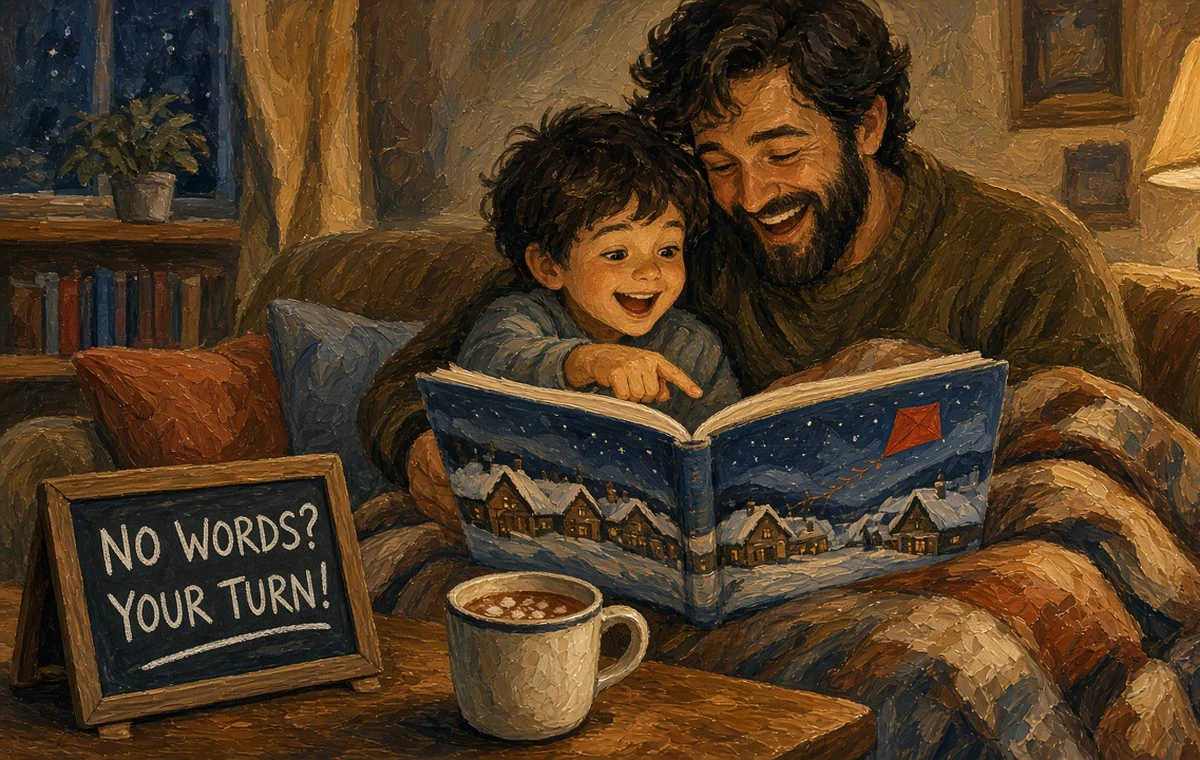
Wordless books are a British and American specialty with a proud history. Raymond Briggs' The Snowman (1978) tells a whole bittersweet friendship in panels, Jerry Pinkney's almost wordless The Lion & the Mouse won the 2010 Caldecott Medal, and Shaun Tan's The Arrival uses sepia pictures alone to tell a migrant's story to teenagers and adults. Try this routine at home:
- Flip through once without speaking, just to see the whole arc.
- On the second pass, ask "What is happening here?" on every spread.
- Hunt for clues together: a clock, a shadow, a character in the background.
- Let the child retell the story the next day; it will change, and that is the point.
The awards are a handy shopping list. The Caldecott Medal, given since 1938 by the American Library Association, and the UK's Kate Greenaway Medal, now presented as the Yoto Carnegie Medal for Illustration, both reward the picture rather than the text, which is why so many wordless and near-wordless books appear on their lists.
Which theme picture books pair well with fantasy?
Fantasy is most powerful when it sits next to books about real life. A good reading shelf mixes worlds that cannot exist with stories about who we are and the world we share.
Student money tip on CampusDown Repair Up: Landlord repair request letter template you can copy.
| Theme | Picture book | What to talk about |
|---|---|---|
| Knowing and respecting yourself | Doggy Poo by Kwon Jeong-saeng | How a sparrow, a chick and the soil each react to a tiny, unwanted character |
| Caring about the wider world | Mediterranean by Armin Greder | A story of migration told almost entirely in pictures, in under 40 pages |
| Fantasy adventure | Alice's Adventures in Wonderland and Tuesday | Comparing a story led by words with a story led by pictures |
Heavier books such as Mediterranean deserve a slower pace: watch the child's reactions, stop when they need to, and afterwards invite them to draw or say what they felt. If you want a framework for that before, during and after conversation, the reading instruction models entry lays out the stages clearly.
Reference: Nikolajeva, M., & Scott, C. (2001). How Picturebooks Work. Garland. A foundational study of how words and pictures share the job of making meaning in picture books.
FAQ
When was Alice's Adventures in Wonderland first published?
Macmillan published it in London in 1865, with illustrations by John Tenniel. The story began as a tale Lewis Carroll told on a boat trip near Oxford in 1862.
What is a fantasy picture book?
It is a picture book based on fantasy literature, showing events that cannot happen in real life so that children use their imagination to make sense of them.
What is Tuesday by David Wiesner about?
It is a nearly wordless picture book in which frogs float over a town on their lily pads one night. It won the Caldecott Medal in 1992.
How should I read a wordless picture book with my child?
Look through it once, then go spread by spread asking what is happening, hunt for visual clues together, and let your child narrate the story in their own words.
Which awards are good guides to great picture books?
In the US, the Caldecott Medal from the American Library Association; in the UK, the Kate Greenaway Medal, now called the Yoto Carnegie Medal for Illustration.