
How Should Dentures Be Cared For? Older Adults' Oral Health Problems and Help With Dental Costs
- Older adults are prone to tooth loss, gum disease and dry mouth, which weaken chewing and nutrition.
- Dentures should be cleaned daily, taken out at night and kept away from hot water and ordinary toothpaste.
- In Korea, people aged 65 and over get insurance cover for dentures and up to two implants, cutting their costs.
Contents
Good denture care means cleaning the denture every day with a soft brush and a non-abrasive cleaner, taking it out at night, keeping it away from hot water, and having its fit checked regularly, because ageing gums keep changing shape. If an older parent has started eating less since getting dentures, it is rarely "just age". The mouth is where we eat, talk and smile, so when oral health slips, nutrition, conversation and confidence slip with it. This guide covers the common oral health problems of later life, why they matter for the whole body, how to look after dentures, and how public schemes in Korea, the UK and the US help with the cost.
What oral health problems are common in older adults?
Four problems come up again and again in later life. They often appear together, and each one makes the others harder to manage.
Related on CampusDown Life UpBroke by the 15th? How to Make a Simple Monthly Budget — How to make a simple monthly budget that sticks, using the CFPB's free Your Money, Your Goals worksheets: take-home pay, bills by due…
| Problem | What it looks like |
|---|---|
| Tooth loss | Weaker chewing, fewer food choices |
| Gum disease | Inflamed gums, bone loss, loose teeth |
| Root caries | Decay on tooth roots exposed by receding gums |
| Dry mouth | Less saliva, often as a side effect of medicines |
People who take several medicines at once are especially prone to a dry mouth. With less saliva, decay and periodontitis (gum disease) move faster, so sipping water through the day and checking the mouth regularly are worth turning into habits.
These changes can look like a natural part of ageing, but much of the damage can be prevented or slowed with steady daily hygiene and regular check-ups. The trouble is that older people tend to visit the dentist less often, and many put off treatment because of the cost.

Why is oral health linked to the health of the whole body?

Why does a loose denture lead to a poorer diet?
With too few teeth, or a denture that rocks, people quietly stop eating crunchy vegetables, nuts and meat. Protein and fibre intake falls and the diet drifts towards soft, starchy food. Gum disease and diabetes are also known to influence each other, and poor mouth hygiene raises the risk of aspiration pneumonia in frail older people, when bacteria from the mouth are breathed into the lungs.
Petersen and Yamamoto (2005), writing for the World Health Organization's oral health programme, argued that oral health is an essential part of older people's general health and quality of life, and called for prevention-led public programmes. Japan's 8020 campaign, launched in 1989 to help people keep at least 20 of their own teeth at age 80, grew from the same idea.
Seen this way, mouth care is not just a dental matter. It touches nutrition, long-term conditions and infection control at once, which is why nurses and care staff treat it as a core part of everyday care.
Skimming the section headings first makes a long guide much easier to map out. Try writing down one question of your own as you read.
How should dentures be looked after?
Daily denture care is simple once it becomes routine. These are the steps most dental guidance agrees on:
- After meals, take the denture out and rinse it under running water, then brush it with a denture brush
- Use a denture cleaner rather than ordinary toothpaste, which is abrasive and leaves scratches where plaque collects
- Use cool or lukewarm water, never hot, which can warp the acrylic
- Take dentures out at night and keep them in water or a soaking solution so the gums can rest
- Brush any remaining teeth, the gums and the tongue as well
- If a denture rubs, hurts or breaks, see a dentist rather than adjusting or gluing it yourself
Over the years the jawbone under a denture slowly shrinks, so a denture that fitted perfectly can become loose. Regular fit checks are worth keeping up even when nothing feels wrong.
When someone can no longer manage their own mouth care, family or care workers need to step in. In the UK, NICE guidance on oral health in care homes (NG48, 2016) asks homes to assess residents' mouth care needs on admission and record them in care plans, and to mark dentures with the owner's name so they are not lost or mixed up. A Care Quality Commission review in 2019, "Smiling matters", found that many homes still fell short.
What help is there with the cost of dental treatment?
Korea is a useful comparison because it covers dentures and implants for older people through national health insurance. The table shows the main schemes.
| Scheme | What it covers |
|---|---|
| Denture insurance | Age 65 and over, about 30% co-payment, one upper and one lower denture every 7 years |
| Implant insurance | Age 65 and over, two implants per lifetime, about 30% co-payment |
| Medical aid recipients | Lower co-payment rates |
| Public health centres | Dental check-ups, fluoride varnish, denture support for low-income older people |
In England, NHS dentures fall under the highest treatment charge band, Band 3, unless the patient qualifies for free treatment, for example through certain benefits or the NHS Low Income Scheme. In the US, Original Medicare generally does not pay for routine dental care or dentures; some Medicare Advantage plans and some state Medicaid programmes do, but cover varies widely.
Rates and rules change, so check with the insurer or health service before treatment. Even generous schemes go unused when people do not know about them, so a good analysis looks beyond what exists on paper to what stops people using it: missing information, difficulty getting to a clinic, and the costs that remain.
How would you plan a dental support programme for an ageing society?
A community programme for older adults' dental care can be set out in four parts, as in the plan below.
Also on CampusDown Life Up: Broke by the 15th? How to Make a Simple Monthly Budget.
| Element | Content |
|---|---|
| Who | Low-income, living alone and housebound older people first |
| What | Dental check-ups, dentures and other prosthetics, mouth care education |
| How | Check-ups at senior centres and day centres, links between dentists and public health teams |
| Evaluation | Chewing ability, nutritional status and oral health-related quality of life |
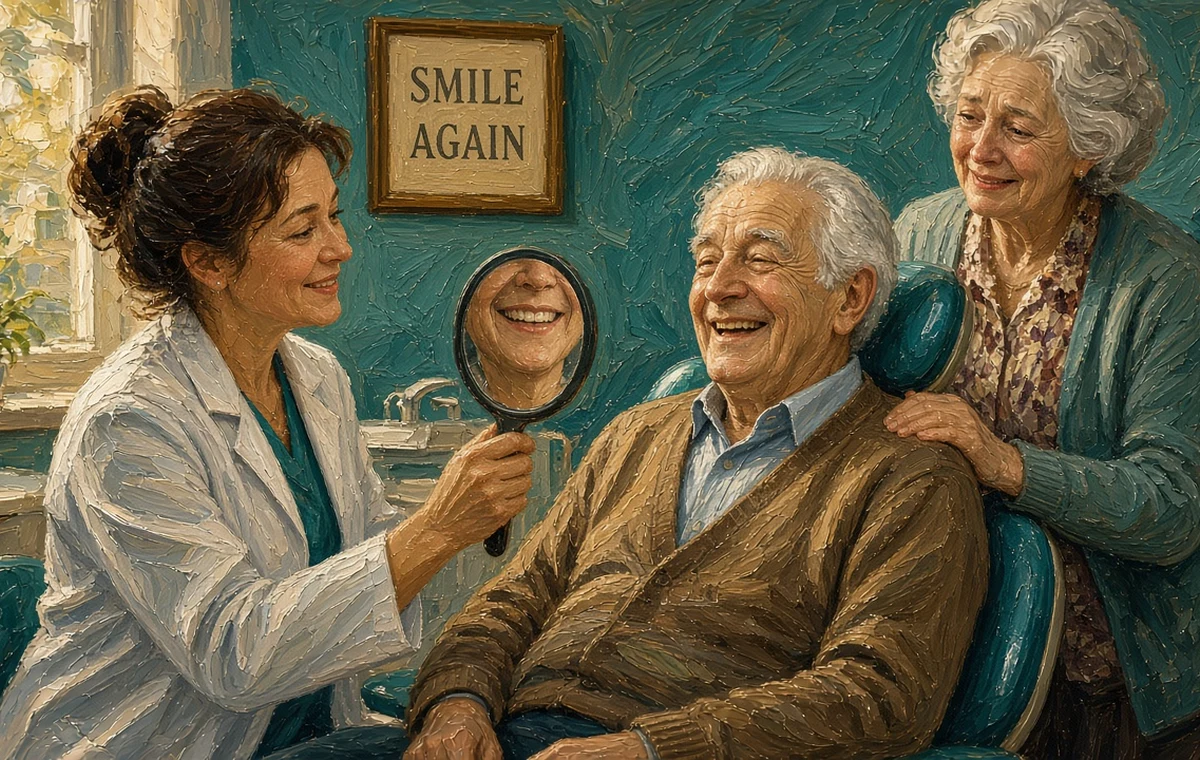
What outcomes can such a programme expect?
When treatment makes eating comfortable again, nutrition and social life tend to improve with it, and quality of life rises. If you want to link the meaning of the mouth to life-stage development, theories of the oral stage offer another angle for an essay.
The goal of older adults' oral health work is not simply to fix a few teeth. It is to help people enjoy the food they love again and to laugh and talk with others without worrying about their mouth.
Compiled by the CampusDown editorial team from a Korean article on older adults' oral health and denture care, adapted with public information on Korea's National Health Insurance Service denture and implant cover, NHS dental charges and NICE guideline NG48 in England, and Medicare in the US. Source: Petersen, P. E., & Yamamoto, T. (2005). Improving the oral health of older people: The approach of the WHO Global Oral Health Programme. Community Dentistry and Oral Epidemiology, 33(2), 81–92. Reviewed November 2026. This is general information, not dental or medical advice.
FAQ
Can I sleep with my dentures in?
It is better to take them out at night so the gums can rest and bacteria do not build up; keep them in water or a soaking solution.
How often should dentures be cleaned?
Rinse them after every meal and brush them thoroughly with a denture brush and cleaner at least once a day.
Why can't I use normal toothpaste on dentures?
Most toothpastes are abrasive and leave fine scratches where plaque and stains collect, so a non-abrasive denture cleaner is better.
Why do dentures become loose over time?
The jawbone under a denture slowly shrinks, so the fit changes and should be checked by a dentist regularly.
At what age does Korean insurance cover dentures?
From age 65, with about a 30% co-payment; the detailed rules can be checked with the National Health Insurance Service.