
How Do You Prioritise Nursing Diagnoses? A Fall, Cirrhosis and Depression, Step by Step
- Priority-setting starts with safety (ABC), then the patient's own complaints and abnormal objective findings.
- Evaluation statements record whether a goal was met using the patient's words and measured values.
- The same nursing process ranks problems differently in physical and mental illness, and priorities change as patients do.
Contents
- How does the nursing process flow?
- Which data should priority-setting start from?
- Case 1: an 84-year-old with a fractured arm after a fall
- Cases 2 and 3: cirrhosis and major depressive disorder
- How can you set priorities more precisely?
- What do the NCLEX and the NMC expect?
- Why does an empty wheelchair by the window make you think of priorities?
- What mistakes do students make most often?
- FAQ
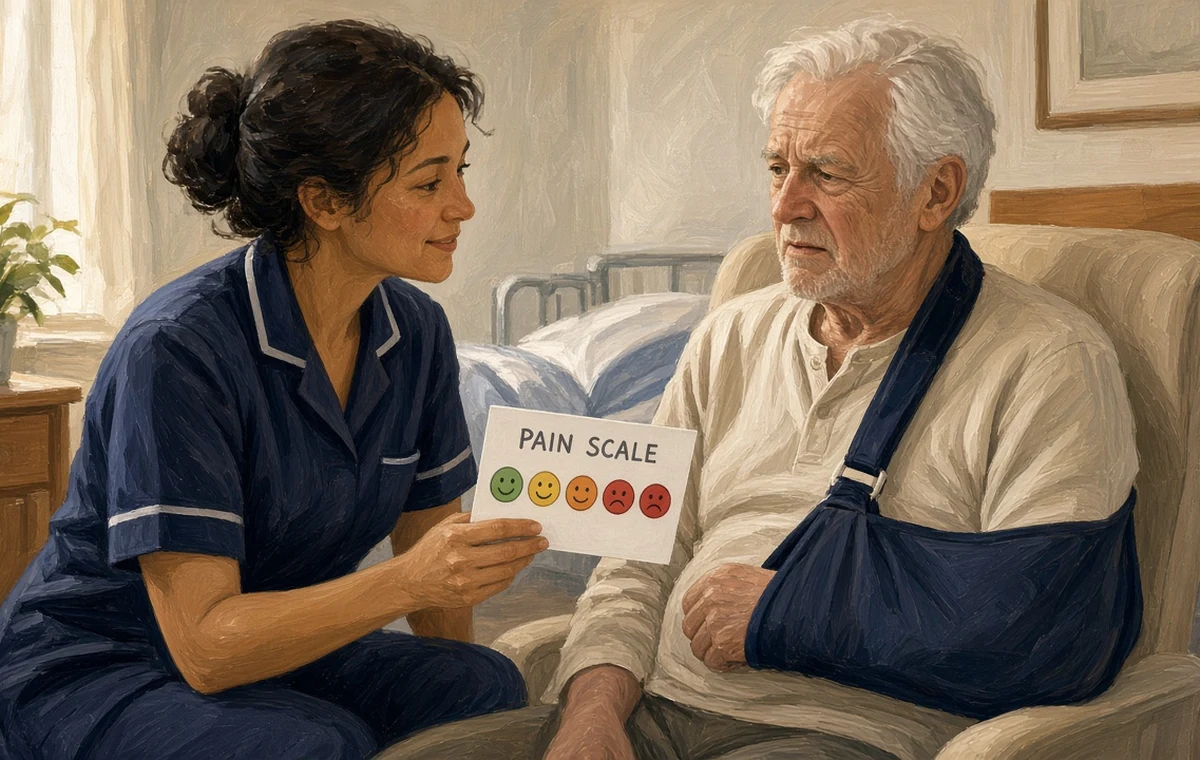
Prioritising nursing diagnoses means deciding which patient problem to tackle first, usually by checking threats to airway, breathing and circulation, then applying Maslow's hierarchy, and starting from what the patient says is most distressing alongside abnormal objective findings. It is the step students find hardest in nursing process assignments and in clinical judgement questions on the Next Generation NCLEX. This guide follows three teaching cases, an 84-year-old with a fractured arm after a fall, a man with alcohol-related cirrhosis and a patient with major depressive disorder, to show how priorities are set and how evaluation statements are written. It is an educational overview: in practice, always follow your local policies and your clinical team.
How does the nursing process flow?
The nursing process has five steps, and each one answers a simple question. The steps are not a straight line but a loop, because evaluation sends you back to assessment whenever a goal is not met.
Student money tip from CampusDown Law UpComplaint Letter Templates: Pick the Right Letter for Your Problem — Free complaint letter templates in one place: hidden charges, billing errors, deposits, debt collectors, demand letters and small claims,…
| Step | Key question |
|---|---|
| Assessment | What data do I have? |
| Diagnosis | What nursing problem do the data point to? |
| Planning | What goal am I aiming for, and which interventions will get there? |
| Implementation | Carry out the planned interventions |
| Evaluation | Was the goal achieved? If not, reassess |
If a goal is not reached at evaluation, it is completely normal to revisit the diagnosis or the plan. That cycle is the point of the process, not a sign that the first plan failed.

Which data should priority-setting start from?
A useful teaching rule is to begin with what the patient reports and then look for findings that stray from normal, always checking first whether anything threatens life.
- First: subjective data the patient reports directly, for example "my arm really hurts" or "can I have something for the pain?"
- Second: objective data that are abnormal or clinically significant
- Always alongside: any threat to life and the urgency of basic needs
Addressing what distresses the patient most builds trust quickly and makes them more willing to cooperate with the rest of their care, so starting from subjective complaints is a meaningful approach on real wards too, provided airway, breathing and circulation are safe.

Many students find that drawing the steps as a circle, with evaluation feeding back into assessment, makes priority questions easier to reason through.
Skimming the section headings first makes a long guide much easier to map out. Try writing down one question of your own as you read.
Case 1: an 84-year-old with a fractured arm after a fall
Mr Park, 84, slipped in the bathroom and fractured his left arm. He was widowed five years ago and lives alone, does not drink, but has smoked more than a pack a day for over 20 years. After surgery his main complaint was arm pain, and he also had difficulty passing urine.
| Nursing diagnosis | Example evaluation statement |
|---|---|
| Acute pain related to the surgical site | Patient states the pain has eased; pain score fell to 1 on the 0 to 10 numeric rating scale (NRS) |
| Impaired urinary elimination | Post-void residual measured by intermittent catheterisation was 30 mL, and the patient says passing urine feels much easier |
| Risk for falls | No further falls during the hospital stay |
Avoid vague evaluations such as "improved". Writing the patient's own words together with measured values such as the pain score and residual volume lets any other nurse judge whether the goal was met using the same yardstick.
Cases 2 and 3: cirrhosis and major depressive disorder
Mr Shin, 38, was admitted with cirrhosis after years of heavy drinking. For a patient like this, fluid problems such as ascites and oedema, nutritional status and changes in drinking behaviour are the main nursing concerns, and physical signs and laboratory values carry a lot of weight in setting priorities.
For a patient admitted with depression, by contrast, the first data to check are risk of self-harm, low energy and withdrawal, and sleep and eating patterns, rather than visible physical symptoms. In physical illness, physiological indicators tend to lead; in mental illness, safety and emotional state are often the key grounds for priority. Comparing the cases side by side is excellent preparation for both assignments and placements.
How can you set priorities more precisely?
Once the basic cases make sense, a handful of frameworks help you justify your choices clearly, which is exactly what markers and exam questions reward.
ABC, Maslow, acute versus chronic, and the unexpected
Life-threatening problems come first, which is why airway, breathing and circulation (ABC) is the first filter. Next comes Maslow's hierarchy of needs: physiological needs, then safety, then love and belonging, esteem and self-actualisation. Add two more rules, acute before chronic and unexpected changes before expected symptoms, and most priority questions become manageable. Ascites is an expected feature of cirrhosis, but sudden confusion is an unexpected change that should raise suspicion of hepatic encephalopathy and be escalated promptly.
Actual versus risk diagnoses
An actual diagnosis describes a problem that is already present; a risk diagnosis describes one that has not happened but is likely. Actual problems usually come first, yet a risk such as falls or bleeding, which could seriously threaten safety, can be placed above other actual problems. For the 84-year-old, preventing another fall may matter more than a sleep problem. Write down the reasoning behind each ranking.
PES statements and SMART goals
The PES format makes a diagnosis precise: Problem, Etiology (related factors) and Signs and symptoms. For example: excess fluid volume related to low albumin from reduced liver function, as evidenced by increasing abdominal girth, leg oedema and a 3 kg weight gain. Risk diagnoses have no symptoms yet, so they are written as the problem plus risk factors. Standard NANDA-I labels help nurses understand each other precisely.
Goals should be specific, measurable, achievable, relevant and time-bound, with the patient as the subject. Instead of "fluid balance improves", write something like "within 3 days, the patient's weight falls by no more than 0.5 kg per day and leg oedema decreases", using the target agreed by the medical and nursing team. Interventions and outcomes can then be named using the Nursing Interventions Classification (NIC) and Nursing Outcomes Classification (NOC) developed at the University of Iowa, which also underpin many electronic records. Broader models behind this thinking are covered under nursing theory.
SBAR handover and re-evaluation
SBAR (Situation, Background, Assessment, Recommendation) puts the most important problem first, states your judgement in the assessment and tells the next shift exactly what needs doing. A fixed order reduces the chance of missing key information. Priorities also change: if the patient with depression begins to talk about thoughts of suicide, safety immediately becomes the top priority and the team must be informed at once under local suicide-risk procedures.
What do the NCLEX and the NMC expect?
Priority-setting is not just an academic exercise; licensing bodies on both sides of the Atlantic test and expect it explicitly, though they frame it differently.
In the US, the Next Generation NCLEX, introduced in April 2023, is built around the NCSBN Clinical Judgment Measurement Model, which asks candidates to recognise cues, analyse them, prioritise hypotheses, generate solutions, take action and evaluate outcomes. Case studies with several linked questions mirror exactly the reasoning in the three cases above. In the UK, the Nursing and Midwifery Council's standards of proficiency for registered nurses require nurses to assess needs, plan and evaluate person-centred care and to escalate deterioration. NANDA-I labels are used less often in UK practice than in the US, but the logic of assessment, prioritisation and evaluation is the same.
| Criterion | What comes first | Example |
|---|---|---|
| ABC | Airway, breathing and circulation problems | Breathlessness, bleeding |
| Maslow | Physiological needs and safety | Fluid imbalance, fall risk, suicide risk |
| Acute vs chronic | New, acute problems | A sudden rise in pain |
| Expected vs unexpected | Changes not expected with the condition | Sudden confusion in a patient with cirrhosis |
When criteria collide, put the problem that most threatens life and safety first, and record your reasoning in the assignment.
Why does an empty wheelchair by the window make you think of priorities?
An empty wheelchair parked in a sunny ward corridor is a tool that helps patients with limited mobility move safely, and for an older patient who has already fallen and broken a bone, how and when it is used is a safety-critical nursing question.
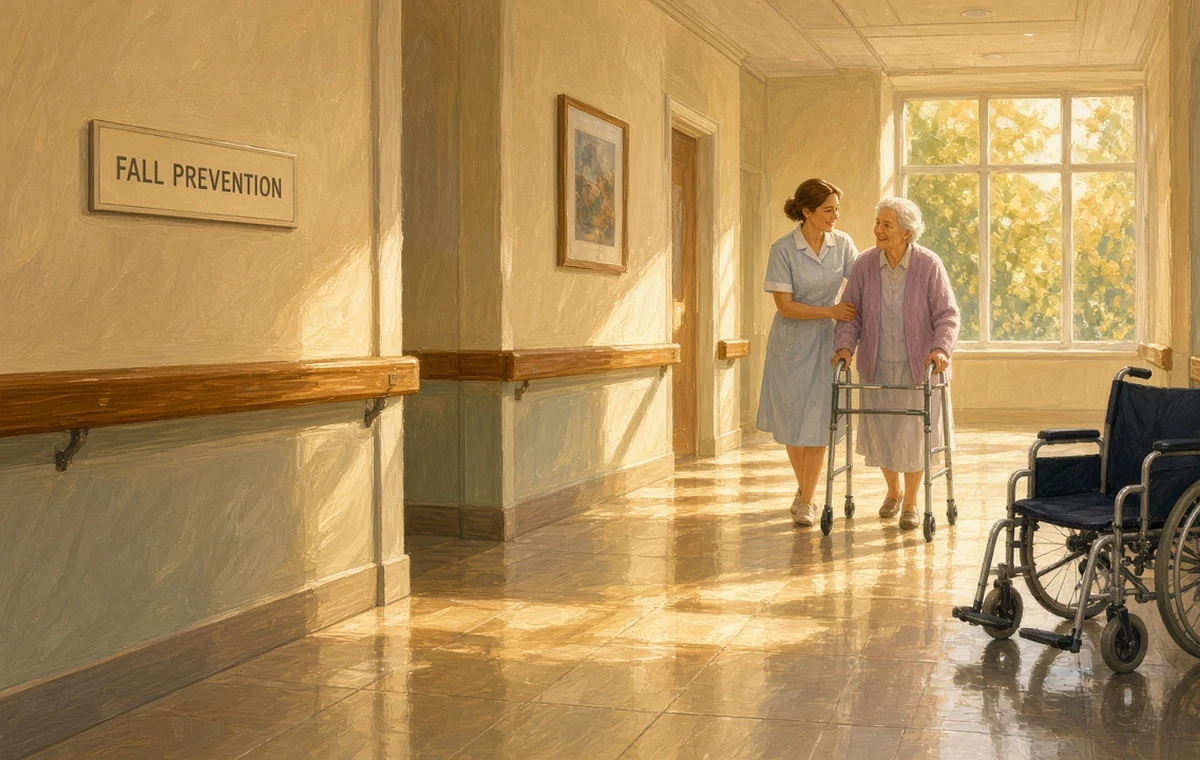
Handrails along the corridor and a wide, uncluttered floor are also part of fall prevention. Many hospitals screen risk with a validated tool such as the Morse Fall Scale. When you write interventions for a risk-for-falls diagnosis, include environmental measures specifically: keeping the bed at its lowest height, teaching the patient to use handrails and call bells, and making sure they wear non-slip footwear.
What mistakes do students make most often?
Most lost marks come from a few predictable slips, and each one is easy to avoid once you know to look for it.
Student money tip on CampusDown Law Up: Complaint Letter Templates: Pick the Right Letter for Your Problem.
- Writing a medical diagnosis as if it were a nursing diagnosis
- Listing problems without related factors
- Setting goals that cannot be measured
- Evaluating against a different standard from the one in the goal
A nursing diagnosis describes the patient's response to illness, not the name of the disease, and a goal needs a time frame and a measure so that evaluation can say clearly whether it was met. The clearer the priorities, the clearer the care.
Compiled by the CampusDown editorial team from a Korean study note on prioritising nursing diagnoses, adapted with public information on the Next Generation NCLEX and the NCSBN Clinical Judgment Measurement Model, the NMC standards of proficiency for registered nurses, NANDA-I, NIC and NOC, SBAR and the Morse Fall Scale. Case details are teaching examples. Reference: Alfaro-LeFevre, R. (2019). Applying nursing process: The foundation for clinical reasoning (9th ed.). Wolters Kluwer. Reviewed November 2026.
FAQ
What is the NRS?
The numeric rating scale, which asks patients to rate their pain from 0 (none) to 10 (worst imaginable).
How many nursing diagnoses should an assignment include?
Usually two or three high-priority diagnoses planned in detail, though your course guidance takes precedence.
What is the difference between subjective and objective data?
Subjective data are what the patient tells you; objective data come from observation, examination and measurement.
How does the Next Generation NCLEX test prioritisation?
Through case studies built on the NCSBN Clinical Judgment Measurement Model, including a step on prioritising hypotheses.
Can a risk diagnosis come before an actual one?
Yes, when the risk, such as falls or bleeding, would seriously threaten safety; state your reasoning.