
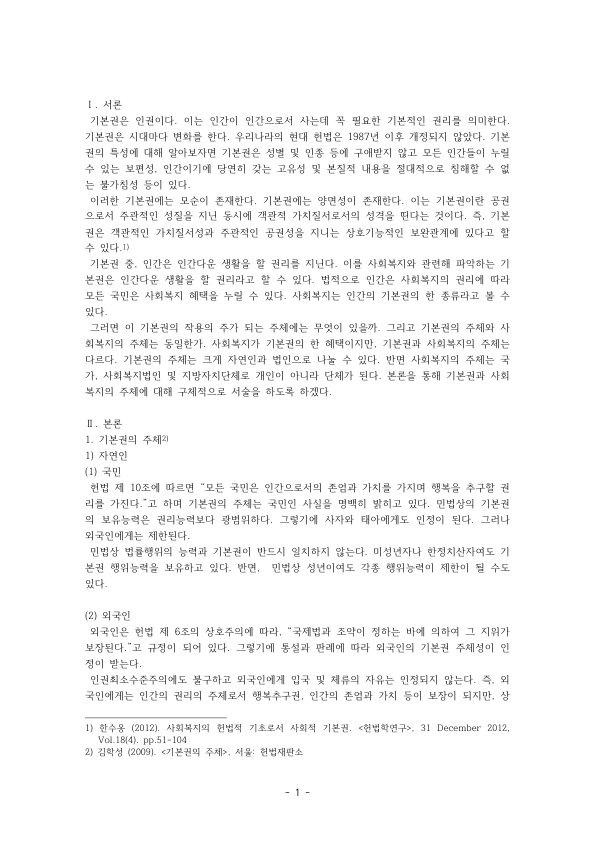
Page 1 is shown as is; from page 2 on, the preview is blurred. Buy it to download the complete original file right away (the file itself is written in Korean).
Packed with real examples and experience. Download it now and save time.
Save your valuable time
Buyer ratings
Fast, accurate and useful.
No ratings yet. Be the first to rate it.
Who Holds Constitutional Rights in Korea and Who Delivers Welfare: Citizens, Foreigners and Corporations as Rights Holders, and the State and Social Welfare Corporations
※ You can preview page 1 as is. Buy it to download the complete original file right away. The file itself is written in Korean.
■ Who Holds Constitutional Rights in Korea and Who Delivers Welfare: Citizens, Foreigners and Corporations as Rights Holders, and the State and Social Welfare Corporations — Overview
A short 3-page Korean social welfare law paper that compares two questions: who holds basic rights under Korea's Constitution, and who is responsible for delivering social welfare. It covers citizens, foreigners and corporations as rights holders, exceptions for public bodies like national universities, and the roles of the state, local governments, public institutions and social welfare corporations.
■ Who Holds Constitutional Rights in Korea and Who Delivers Welfare: Citizens, Foreigners and Corporations as Rights Holders, and the State and Social Welfare Corporations — Excerpt from the original document (English translation)
Such a corporation means a corporation established without capital and run on a nonprofit basis for the public purposes of the state. It starts without capital at establishment but later comes to have capital. Examples are the Korea Veterans Health Service, the Korea Workers' Compensation and Welfare Service, the National Health Insurance Service and the National Pension Service.
This is a corporation established to carry out social welfare services. It is a corporation defined by Article 2 of the Social Welfare Services Act, and the law specifies it directly. It mainly carries out welfare services and services that support institutions or facilities providing welfare services.
Corporations of various forms take part as providers of social welfare, and this is possible. Individuals can also be providers of social welfare. However, the state tends to turn this into corporations. So for an individual to take part as a provider of social welfare, it is desirable to set up a corporation and participate. If a corporation cannot be set up, participation is possible by other means such as a cooperative.
Basic rights are the minimum rights and freedoms that guarantee a humane life that every human being has. One of the elements that helps people meet their needs so they can live as human beings is social welfare. In the main body, I looked in detail at who holds basic rights and who provides social welfare.
First, holders of basic rights can be divided into natural persons and corporations. Natural persons are divided into citizens and foreigners. Legally, foreigners are guaranteed a different scope than citizens. Both citizens and foreigners, as holders of human rights, are equally guaranteed the right to pursue happiness and human dignity and worth, but for foreigners, under the principle of reciprocity, the scope of rights such as voting rights is narrower than for citizens. A corporation means property or an organization whose legal capacity is recognized by law apart from natural persons. Corporations also hold basic rights.
Then who are the providers of social welfare?
Note that the 'person under limited incapacity' mentioned in the paper was replaced by the limited guardianship system in the July 2013 Civil Code amendment, and the Ministry of Security and Public Administration is now the Ministry of the Interior and Safety. The Constitutional Court recognizes human rights such as human dignity and worth and the right to pursue happiness for foreigners as well, and in certain cases it has also recognized their freedom to choose a workplace. A commonly cited exception for public corporations is the decision holding that Seoul National University, a national university, holds academic freedom and university autonomy. Social welfare corporations are established with permission from the city or provincial governor under the Social Welfare Services Act, so note that as well.
■ Who Holds Constitutional Rights in Korea and Who Delivers Welfare: Citizens, Foreigners and Corporations as Rights Holders, and the State and Social Welfare Corporations — Contents and key concepts
Do foreigners and companies have constitutional rights?
✦ At a glance
- Rights holders vs. welfare providers in Korea
- Structure: nature of rights → holders → welfare providers
- Useful for constitutional law and welfare law courses
☰ What the paper covers
- Nature of basic rights
- Citizens and foreigners
- Private and public corporations
- Public and private welfare sectors
- State, local governments and welfare corporations
✎ Korea and the U.S. compared
Korea's Constitutional Court separates human rights, which foreigners also hold, from citizens' rights such as voting, which they generally don't.
The U.S. Constitution protects many rights of "persons," including noncitizens, under the Fourteenth Amendment, and the Supreme Court has recognized some constitutional rights for corporations.
Note: the paper itself is written in Korean and discusses Korean law. This page is general study information, not legal advice.
Related wiki: Public Assistance Programs
■ Who Holds Constitutional Rights in Korea and Who Delivers Welfare: Citizens, Foreigners and Corporations as Rights Holders, and the State and Social Welfare Corporations References
- 한수옹 (2012). 사회복지의 헌법적 기초로서 사회적 기본권. <헌법학연구>, 31 December 2012, Vol.18(4). pp.51-104
- 김학성 (2009). <기본권의 주체>, 서울: 헌법재판소
- 김수연 (2010). 기본권 주체로서의 외국인. <유럽헌법연구>, 30 June 2010, Vol.7. pp.291-321
- 심재신 (2002). 지역사회복지의 주체 및 대상. <자치발전>, Vol.2002(6), p.108
- 김봉채 (2008). 영조물규칙의 법적성질에 관한 고찰. <토지공법연구>, 30 November 2008, Vol.42. pp.461-481
Take a break with a quick personality test?
Ranked by actual participation. Results in about a minute.
Loading…
Most-read content
Loading view counts…

Campusdown is a lifelong-learning community in Korea offering study materials, information on government support, student loans and scholarships, and more. Don't miss our free resources.
Go to the Campusdown home page →Refund policy
- Change of mind / refund requested after partial use / more than 7 days after purchase
◆ Exceptions
- File errors / cannot download or open the file
◆ How to request a refund: send a 1:1 inquiry via Customer Service at the top