
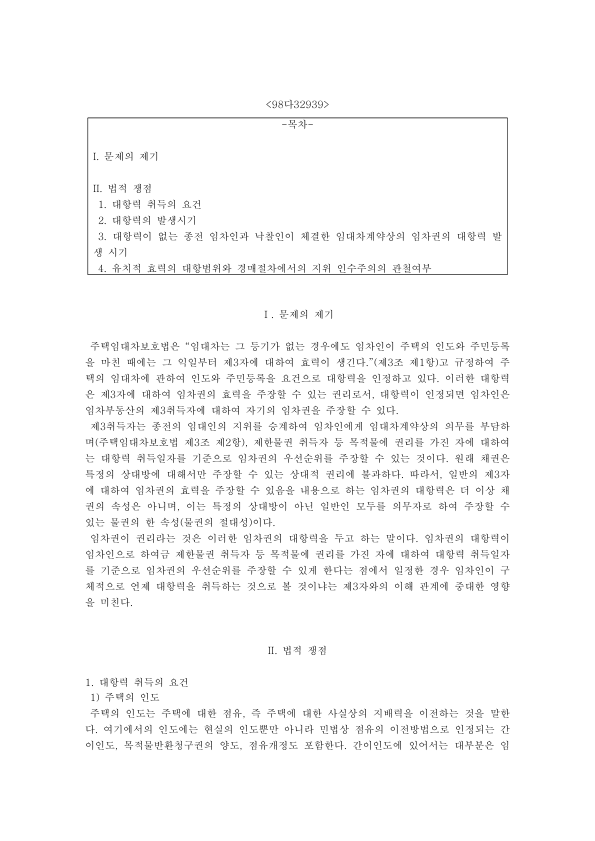
Page 1 is shown as is; from page 2 on, the preview is blurred. Buy it to download the complete original file right away (the file itself is written in Korean).
Packed with real examples and experience. Download it now and save time.
Save your valuable time
Buyer ratings
Fast, accurate and useful.
No ratings yet. Be the first to rate it.

When Does a Korean Tenant's Right Against New Owners Begin? Opposability, Case 98Da32939, and Tenants in Foreclosure Auctions
※ You can preview page 1 as is. Buy it to download the complete original file right away. The file itself is written in Korean.
■ When Does a Korean Tenant's Right Against New Owners Begin? Opposability, Case 98Da32939, and Tenants in Foreclosure Auctions — Overview
A 5-page Korean housing law case comment on 98Da32939. It explains how the Housing Lease Protection Act lets a tenant assert the lease against new owners after moving in and registering residence, why that effect starts the next day, when a former tenant who signs a new lease with the auction buyer gains protection, and how the Civil Execution Act decides which rights survive a foreclosure auction.
■ When Does a Korean Tenant's Right Against New Owners Begin? Opposability, Case 98Da32939, and Tenants in Foreclosure Auctions — Excerpt from the original document (English translation)
Even if a lease contract has been concluded and possession of the house and resident registration have been made, there are cases where opposability cannot yet be regarded as having arisen. These are cases where a lease relationship arises while possession of the house and resident registration continue to be maintained, so that the status of the possessor changes; in such cases, when opposability should be regarded as arising depends on when the existing resident registration is regarded as acquiring effect as a method of public notice that can satisfy the requirements for opposability.
Where the owner becomes a tenant: if the owner of a house, while living there with resident registration, disposes of the house to another person and then leases it back from the buyer and continues to live there, when should the opposability of that lease be said to arise? The reason the time at which opposability arises is a particular issue in such a case is that, for opposability to arise, it is not enough simply to have resident registration; the resident registration must have the effect of publicly notifying the existence of the lease so that third parties can clearly recognize it.
Where a person has resident registration at a certain place and that person is the owner of the real estate, a third party would ordinarily regard that resident registration as representing possession as an owner rather than possession as a tenant. Therefore, even if the owner has internally disposed of the real estate to another and is leasing it back and using it, as long as the registration of transfer of ownership has not been completed, that resident registration has no effect of publicly notifying the lease, and it must be said that only once ownership of the real estate is transferred to a third party does it acquire effect as a valid method of public notice satisfying the requirements for opposability.
In such a case, the court held: "Even though the lessor Eul acquired ownership of the apartment after concluding the lease contract with Gap and after Gap filed the move-in report, since the resident registration showed that Gap, who was not the owner, had been living there from the date of the move-in report, third parties could recognize that Gap's resident registration represented possession mediated by a lease rather than ownership; therefore, the resident registration had been performing the function of publicly notifying the lease from the date Gap completed the move-in report, and accordingly Gap acquired opposability of the lease immediately upon completion of the registration of transfer of ownership in Eul's name."
3. When opposability arises for a lease under a lease contract concluded between a former tenant without opposability and the successful bidder
Another case where a lease relationship arises and the status of the possessor changes is where, in auction proceedings, the successful bidder concludes a new lease contract, before paying the sale price, with a former tenant who has resident registration but no opposability.
For reference, case law holds that opposability arises from 0:00 a.m. on the day after delivery and resident registration are completed, and to get the deposit back with priority, a fixed date must be obtained together with opposability. Regarding when a former tenant who entered into a new lease with the successful bidder acquires opposability, there is a Supreme Court precedent holding that opposability is acquired immediately upon payment of the sale price, so check the original text together with the comparison of theories in the material. It is also useful to note that, under the 2023 amendment, a tenant can request information on senior fixed dates and unpaid taxes at the time of contracting.
■ When Does a Korean Tenant's Right Against New Owners Begin? Opposability, Case 98Da32939, and Tenants in Foreclosure Auctions — Contents and key concepts
Can a tenant stay when a Korean home is sold or auctioned?
✦ At a glance
- Korean tenant protection against new owners
- Structure: requirements → timing → auction rules
- Useful for property and housing law
☰ What the paper covers
- What opposability means
- Move-in and residence registration
- Why it starts the next day
- New leases with auction buyers
- Which rights survive an auction
✎ Tenants and foreclosure in Korea and the U.S.
Korea protects tenants who move in and register their residence, and the protection starts at midnight the next day so same-day mortgages take priority.
In the U.S., the Protecting Tenants at Foreclosure Act generally gives bona fide tenants at least 90 days' notice after a foreclosure sale, and some states give more.
Note: the paper itself is written in Korean and discusses Korean law. This page is general study information, not legal advice.
Take a break with a quick personality test?
Ranked by actual participation. Results in about a minute.
Loading…
Most-read content
Loading view counts…

Campusdown is a lifelong-learning community in Korea offering study materials, information on government support, student loans and scholarships, and more. Don't miss our free resources.
Go to the Campusdown home page →Refund policy
- Change of mind / refund requested after partial use / more than 7 days after purchase
◆ Exceptions
- File errors / cannot download or open the file
◆ How to request a refund: send a 1:1 inquiry via Customer Service at the top