
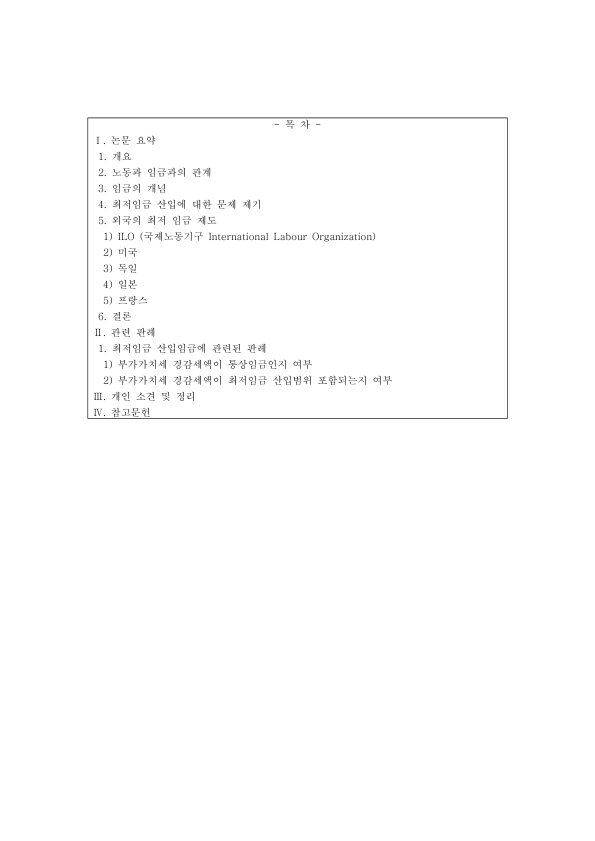
Page 1 is shown as is; from page 2 on, the preview is blurred. Buy it to download the complete original file right away (the file itself is written in Korean).
Packed with real examples and experience. Download it now and save time.
Save your valuable time
Buyer ratings
Fast, accurate and useful.
No ratings yet. Be the first to rate it.
What Counts Toward the Minimum Wage in Korea: Bonuses, Welfare Allowances, Ordinary Wages, and a Five-Country Comparison
※ You can preview page 1 as is. Buy it to download the complete original file right away. The file itself is written in Korean.
■ What Counts Toward the Minimum Wage in Korea: Bonuses, Welfare Allowances, Ordinary Wages, and a Five-Country Comparison — Overview
A 10-page Korean labor law paper on which pay items count when checking minimum wage compliance. It explains Korea's average wage and ordinary wage concepts, why bonuses and meal allowances were left out, how the ILO, the U.S., Germany, Japan and France handle tips, in-kind pay and bonuses, and a 2015 Supreme Court case on taxi drivers' VAT refunds.
■ What Counts Toward the Minimum Wage in Korea: Bonuses, Welfare Allowances, Ordinary Wages, and a Five-Country Comparison — Excerpt from the original document (English translation)
Germany does not run a statutory minimum wage that applies across all sectors at once. As of January 2010, the Posted Workers Act (Arbeitnehmer-Entsendegesetz) sets leave, employment conditions and similar terms in sectors such as construction, mining, laundry services, security services, care services, waste management and vocational training services. The original purpose of the act was to protect German construction workers from competition with cheap foreign labor. Where no collective agreement exists, or where a collective agreement does not fully apply, the Minimum Working Conditions Act (Mindestarbeitsbedingungengesetz) guarantees the minimum wage for the workers concerned. To expand minimum wage coverage, Germany pursued amendments to the Posted Workers Act and the Minimum Working Conditions Act for several years, and a government bill was prepared in July 2008. After the bills went to parliament and much debate, the Federal Council (upper house) on February 13, 2009 passed, with amendments, the two minimum wage
bills (the Posted Workers Act and the Minimum Working Conditions Act). Temporary agency work, the biggest point of dispute, was excluded from the scope of the Posted Workers Act, and the other point of dispute, enforcement and supervision of the minimum wage, was finally consolidated under the federal customs authorities. Both amended laws set out ways of fixing minimum wages that complement collective bargaining autonomy, so together with the existing system of declaring collective agreements generally binding, there came to be three ways of setting minimum wages. For that reason, even without a rising federal minimum wage, the harmful effects on low-wage workers can be said to have already been eased to some degree.
Japan introduced its minimum wage system by enacting the Minimum Wage Act on April 15, 1959. At the time, it adopted four methods of setting the minimum wage: minimum wages based on agreements among employers, regional minimum wages based on agreements among employers, minimum wages based on labor agreements, and minimum wages based on investigation and deliberation by a minimum wage council, so regional and industry minimum wages existed from the start. As regional minimum wages spread and the gaps between regions grew, the Minimum Wage Act was amended to abolish the employer-agreement method so that every worker would be covered by some minimum wage, and it set procedures for deciding, revising and abolishing minimum wages through the council method. When the Minister of Health, Labour and Welfare or a prefectural labor bureau director, on application by the labor and management parties concerned, finds it necessary, they ask the Central Minimum Wages Council or a local minimum wages council to investigate and deliberate on a region, business (industry) or occupation, hear its opinion and decide the minimum wage. The December 2007 amendment required minimum wages, which had been set by the hour, day, week or month, to be set only as an hourly amount (Article 3), sharply raised the maximum fine from 20,000 yen to 500,000 yen (Article 40), and created a legal framework that makes clear the role of regional minimum wages as the general minimum wage, that is, as a safety net protecting all workers from unfairly low wages. Article 9 of the amended act states as the principle of regional minimum wages that every region must set a minimum wage, and that regional minimum wages are set in light of workers' cost of living, wages, and the ability of ordinary businesses to pay wages, while in considering the cost of living, consistency with public assistance measures must be taken into account so that workers can maintain the minimum standard of a healthy and cultured life. Regional minimum wages are set by comprehensively weighing workers' cost of living, workers' wages and the ability of ordinary businesses to pay, and in considering the cost of living, consistency with public assistance measures must be taken into account so that workers can lead the minimum standard of a healthy and cultured life.
Note that the paper reflects the law before the 2018 amendment. From 2019, monthly regular bonuses and cash welfare allowances such as meal money began to be phased into the scope of the minimum wage, and since 2024 they are included in full. For ordinary wages, the Supreme Court en banc in December 2024 abolished the requirement of fixedness, changing the test, and job-seeker benefits are calculated not from base pay alone but as 60% of average wages, with a floor of 80% of the minimum wage, so update those points before using them. The 2026 minimum wage is 10,320 won an hour.
■ What Counts Toward the Minimum Wage in Korea: Bonuses, Welfare Allowances, Ordinary Wages, and a Five-Country Comparison — Contents and key concepts
Which pay items count toward the minimum wage?
✦ At a glance
- Minimum wage scope vs. ordinary wages in Korea
- Structure: wage concepts → problem → five-country comparison → case → author's view
- Useful for labor law and HR courses
☰ What the paper covers
- Korea's wage definitions
- Why bonuses and allowances were excluded
- ILO, U.S., Germany, Japan and France
- Supreme Court case 2012Du22003
- Author's proposal
✎ How Korea and the U.S. count wages
Korea changed its rules in 2018: monthly bonuses and cash welfare allowances were phased in from 2019 and have counted in full since 2024. The 2026 minimum wage is 10,320 won an hour.
In the U.S., the Fair Labor Standards Act lets employers count part of tips toward the $7.25 federal minimum, with a cash wage as low as $2.13 an hour, and many states set higher rates.
Note: the paper itself is written in Korean and discusses Korean law. This page is general study information, not legal advice.
Related wiki: Minimum Wage and Overtime Law
■ What Counts Toward the Minimum Wage in Korea: Bonuses, Welfare Allowances, Ordinary Wages, and a Five-Country Comparison References
- 김상률 (2011) <임금의 개념과 제도상 문제점에 관한 연구 : 근로기준법과 최저임금법을 중심으로 = A study of the concept of wages and related issues>, 경북대학교 법학전문대학원 박사 학위논문
- 대법원 2015. 2. 26. 선고 2012두22003 판결[노동쟁의중재재정재심결정취소] > 종합법률정보 판례)
Take a break with a quick personality test?
Ranked by actual participation. Results in about a minute.
Loading…
Most-read content
Loading view counts…

Campusdown is a lifelong-learning community in Korea offering study materials, information on government support, student loans and scholarships, and more. Don't miss our free resources.
Go to the Campusdown home page →Refund policy
- Change of mind / refund requested after partial use / more than 7 days after purchase
◆ Exceptions
- File errors / cannot download or open the file
◆ How to request a refund: send a 1:1 inquiry via Customer Service at the top