
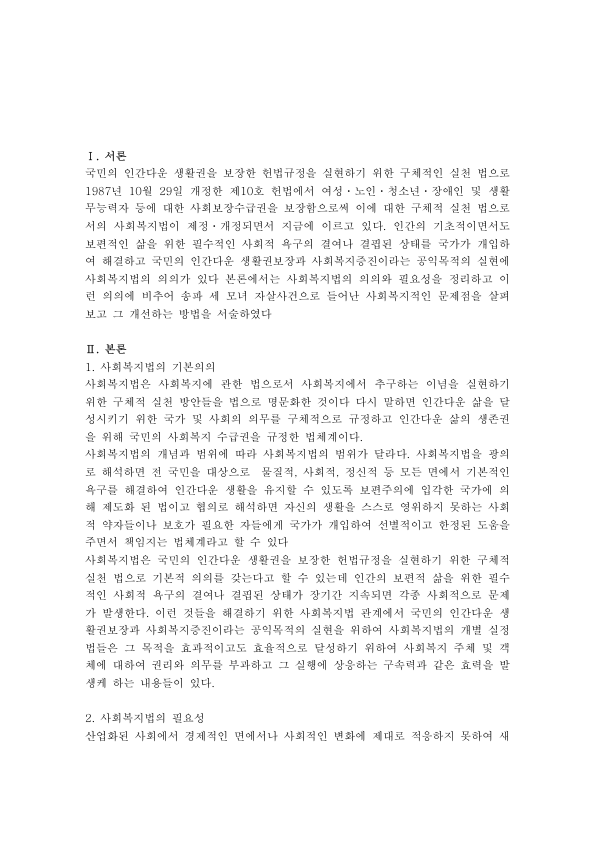
Page 1 is shown as is; from page 2 on, the preview is blurred. Buy it to download the complete original file right away (the file itself is written in Korean).
Packed with real examples and experience. Download it now and save time.
Save your valuable time
Buyer ratings
Fast, accurate and useful.
No ratings yet. Be the first to rate it.
Welfare Blind Spots in Korea: The 2014 Songpa Mother and Daughters Case, the Purpose of Social Welfare Law, and Fixing the Delivery System
※ You can preview page 1 as is. Buy it to download the complete original file right away. The file itself is written in Korean.
■ Welfare Blind Spots in Korea: The 2014 Songpa Mother and Daughters Case, the Purpose of Social Welfare Law, and Fixing the Delivery System — Overview
A 4-page Korean social welfare law paper that uses the 2014 Songpa case, in which a struggling family received no public help, to explain why social welfare law exists. It covers broad and narrow views of welfare law, new vulnerable groups after the 1997 financial crisis, the family support obligation rule and application barriers, and proposals for outreach and public-private cooperation.
■ Welfare Blind Spots in Korea: The 2014 Songpa Mother and Daughters Case, the Purpose of Social Welfare Law, and Fixing the Delivery System — Excerpt from the original document (English translation)
In the Songpa mother and daughters suicide case, the three calculated the welfare benefits they could receive based only on the eligibility conditions of the National Basic Living Security Act. Had they known that the emergency welfare support system existed, the tragedy might have been prevented. To solve this problem, despite efforts at the government level such as stronger publicity for welfare programs, welfare blind spots keep arising because of individuals' lack of information and the limits of Korea's welfare system. No matter how good a policy is, it is useless if the people who would benefit from it do not know about it. Publicity for social welfare policies should be strengthened to reduce welfare blind spots and to prevent mishaps in the delivery system caused by a lack of publicity.
The main body examined the basic purpose and necessity of social welfare law and the problems of social welfare policy revealed by the recent Songpa mother and daughters suicide case, along with directions for improvement.
Socially vulnerable groups and social minorities emerge that cannot properly cope with economic downturns and the social changes that follow, and to overcome this crisis wisely, an efficient support system must be built and pursued through cooperation that divides roles between public programs and private resources. Through stronger publicity for welfare policy and improvements to the delivery system, social welfare law should also be improved in a direction that strengthens such a support system to reduce welfare blind spots. This, too, is a way of putting the purpose of social welfare law into practice and achieving its goals.
Therefore, the state should seek to strengthen the rights tied to citizens' survival needs regarding social welfare in order to address deficits in basic needs, and should make efforts to strengthen its corresponding legal and financial responsibility, while local governments should strengthen their administrative systems, including the delivery system, so they can carry this out effectively.
Note that the case came to light in February 2014, and in December of the same year the Act on the Use and Provision of Social Security Benefits and Search for Eligible Beneficiaries (the Social Security Benefits Act) was enacted and took effect in July 2015. At the same time, the basic livelihood security system was changed to customized benefits that set livelihood, medical, housing and education benefits separately, and the family support obligation rule was abolished for education benefits (2015) and housing benefits (2018); since October 2021 it also no longer applies to livelihood benefits unless the supporting family member has high income or high assets. It still remains for medical benefits, so add the latest details.
■ Welfare Blind Spots in Korea: The 2014 Songpa Mother and Daughters Case, the Purpose of Social Welfare Law, and Fixing the Delivery System — Contents and key concepts
Why didn't the safety net reach this family?
✦ At a glance
- Welfare blind spots and the delivery system
- Structure: purpose of welfare law → need → Songpa case → reforms
- Useful for social welfare law and policy courses
☰ What the paper covers
- Broad and narrow views of welfare law
- New vulnerable groups
- What the Songpa case revealed
- Bringing services to people
- Public-private cooperation
✎ What changed in Korea, and the U.S. parallel
After the case, Korea passed a 2014 law to identify at-risk households using data such as unpaid utility bills, and it later relaxed the family support obligation rule for most basic livelihood benefits.
U.S. programs face a similar take-up problem: many people eligible for SNAP or the Earned Income Tax Credit never apply, so outreach is a constant policy issue.
Note: the paper itself is written in Korean and discusses Korean law. This page is general study information, not legal advice.
Related wiki: Public Assistance Programs
■ Welfare Blind Spots in Korea: The 2014 Songpa Mother and Daughters Case, the Purpose of Social Welfare Law, and Fixing the Delivery System References
- 김수정 저, 사회복지법제론, 학지사, 2015
- 남기민, 홍성로 저, 사회복지법제론, 공동체, 2014
- 한국보건사회연구원, 복지 사각지대의 생계형 사건사고의 유형과 원인, 한국보건사 회연구원, 2013
- 윤찬영, 사회복지법제론, 나남출판, 2013
Take a break with a quick personality test?
Ranked by actual participation. Results in about a minute.
Loading…
Most-read content
Loading view counts…

Campusdown is a lifelong-learning community in Korea offering study materials, information on government support, student loans and scholarships, and more. Don't miss our free resources.
Go to the Campusdown home page →Refund policy
- Change of mind / refund requested after partial use / more than 7 days after purchase
◆ Exceptions
- File errors / cannot download or open the file
◆ How to request a refund: send a 1:1 inquiry via Customer Service at the top