
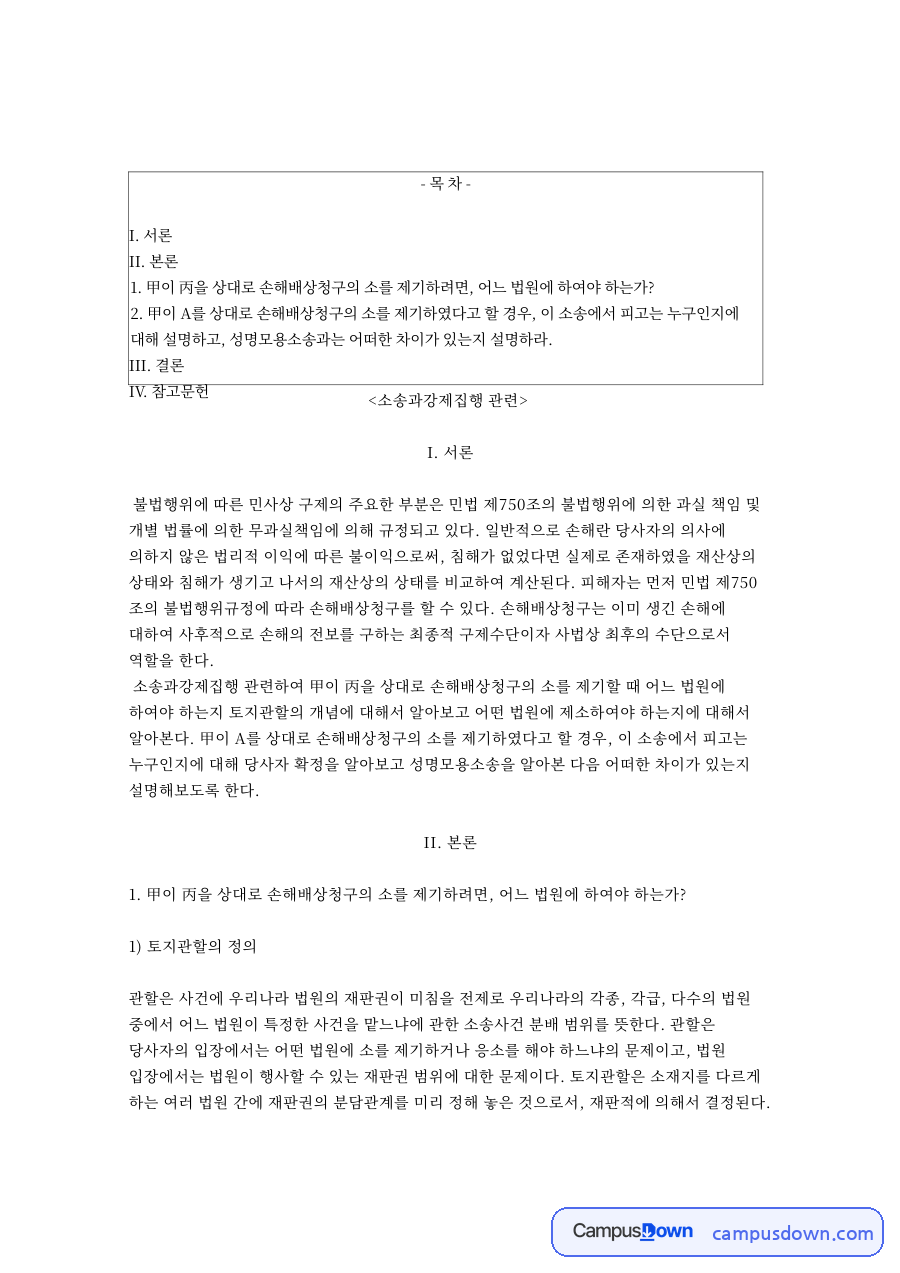
Page 1 is shown as is; from page 2 on, the preview is blurred. Buy it to download the complete original file right away (the file itself is written in Korean).
Packed with real examples and experience. Download it now and save time.
Save your valuable time
Buyer ratings
Fast, accurate and useful.
No ratings yet. Be the first to rate it.


1 / 5
좌우로 밀어서 페이지를 넘겨보세요
과제 개요
| 전체 페이지 수 | 5페이지 |
|---|---|
| 파일 형식 | 한글(HWP) |
| 등록일 | 2025.07.17 |
목차
- 1I. 서론
- 2II. 본론
- 2.11. 甲이 丙을 상대로 손해배상청구의 소를 제기하려면, 어느 법원에 하여야 하는가?
- 2.22. 甲이 A를 상대로 손해배상청구의 소를 제기하였다고 할 경우, 이 소송에서 피고는 누구인지에 대해 설명하고, 성명모용소송과는 어떠한 차이가 있는지 설명하라
- 3III. 결론
- 4IV. 참고문헌
캠퍼스다운 도움말
해당 자료는 No AI 자료입니다. 인싸이트를 얻고 새롭게 가공해 보세요.
자료를 받아서 이용하면 품질이 확 올라갑니다.
- 민사소송법
- 토지관할
- 보통재판적
- 특별재판적
- 재판적의 경합
- 당사자확정
- 성명모용소송
- 표시설
- 손해배상청구
- 소송과 강제집행
Venue and Identifying the Parties in a Korean Damages Lawsuit: General and Special Forum, Competing Venues and Lawsuits Filed Under Someone Else's Name
※ You can preview page 1 as is. Buy it to download the complete original file right away. The file itself is written in Korean.
■ Venue and Identifying the Parties in a Korean Damages Lawsuit: General and Special Forum, Competing Venues and Lawsuits Filed Under Someone Else's Name — Overview
A 6-page Korean civil procedure case study. Question one asks which court should hear a damages claim: territorial jurisdiction, the defendant's domicile as the general forum, special forums such as the place of the tort or the place of performance, and what happens when several forums compete. Question two asks who the real defendant is when a lawsuit runs under another person's name, comparing theories on identifying the parties, the courts' approach and lawsuits conducted by impersonation.
■ Venue and Identifying the Parties in a Korean Damages Lawsuit: General and Special Forum, Competing Venues and Lawsuits Filed Under Someone Else's Name — Excerpt from the original document (English translation)
As to the standard for determining the parties, the theories include the intention theory and the conduct theory, the indication theory (the prevailing view), and the normative classification theory, and court precedents adopt the substantive indication theory among them. Most of the indication theory appearing in current court precedents is a modified indication theory, under which the parties are to be determined by taking into account overall not only the statement of the parties in the complaint but all of its contents, including the purport and grounds of the claim.
Since the court takes the position of the substantive indication theory, determining the parties by considering the entire purport of the grounds of the claim and so on, Byeong, not A, who has nothing to do with the case, will be the true party to this case.
Where the names stated in the complaint are accurate but a third party litigates by usurping another person's name, for example where the usurper simply files suit in the name of the person whose name is usurped and conducts the litigation (usurpation on the plaintiff's side), or where, in a suit concerning the person whose name is usurped, the usurper simply impersonates that person's name and conducts the litigation (usurpation on the defendant's side), this is called name-usurpation litigation. (Choi Woo-jin, "The Discretion of Fact-Finding Courts in Calculating Damages," doctoral dissertation, Korea University Graduate School, 2018, Seoul)
Gap did not, without authority, usurp the defendant under A's name; rather, Gap intended to sue Byeong while clearly aware that the defendant was Byeong, and filed suit trusting the information received about another person's name as it was. This therefore differs from name-usurpation litigation, in which one acts as if one were the plaintiff or the defendant.
In this case, Gap filed a suit for damages against A based on the personal details received from Byeong, but the defendant Gap actually intended was Byeong and A is an unrelated person, so a question of determining the party arises. Under the courts' substantive indication theory, the defendant in this case is Byeong.
Our Civil Act adopts the principle of fault liability for liability for damages, and Article 750 of the Civil Act provides that "a person who causes losses to or inflicts injuries on another person by an unlawful act, intentionally or negligently, shall be liable to make compensation for damages arising therefrom," so the victim must prove the wrongdoer's intent or negligence to claim damages. Here, damages can be divided into positive damages such as medical and other expenses, negative damages, and damages for mental suffering. Mental damages are included within the scope of damages because they are understood not only as damage to property but as an infringement of personality rights.
Territorial jurisdiction is a requirement of the suit, so if a suit is filed with a court lacking jurisdiction, the court does not dismiss it but transfers it to the court with jurisdiction (Civil Procedure Act Article 34). In addition, if the defendant pleads on the merits without raising lack of jurisdiction, jurisdiction by pleading arises, and if the parties agree in writing, jurisdiction by agreement is also recognized. Organizing these jurisdiction rules together with the indication theory for determining parties and the effect of judgments in name-usurpation litigation lets you explain accurately, in civil procedure case questions and everyday-law assignments, where and against whom to start a lawsuit.
■ Venue and Identifying the Parties in a Korean Damages Lawsuit: General and Special Forum, Competing Venues and Lawsuits Filed Under Someone Else's Name — Contents and key concepts
Where do you file a damages suit, and who exactly is the defendant?
✦ At a glance
- How venue rules give a plaintiff several possible courts
- Structure: venue (general and special forum) → identifying parties → impersonation suits
- Useful for civil procedure and everyday law papers
☰ What the paper covers
- Territorial jurisdiction
- General forum: defendant's domicile
- Special forums: place of tort, place of performance
- Competing forums
- Identifying the parties and impersonation suits
✎ Venue and parties in brief
A plaintiff may sue where the defendant lives and, for torts, also where the tort happened. If several courts qualify, the plaintiff chooses.
Korean courts identify the parties mainly from how they are named in the complaint, read in light of the whole complaint.
Note: the paper itself is written in Korean and discusses Korean law. This page is general study information, not legal advice.
■ Venue and Identifying the Parties in a Korean Damages Lawsuit: General and Special Forum, Competing Venues and Lawsuits Filed Under Someone Else's Name References
- 이진아. "자동차 사고로 인한 손해배상 책임의 합리적 조정에 관한 연구." 국내석사학위논문 연세대학교 대학원, 2020.
- 서울 최보국. "손해배상의 소극적 손해에 관한 연구." 국내석사학위논문 국민대학교 법무대학원, 2017.
- 서울 최우진. "손해배상산정에 관한 사실심법원의 재량." 국내박사학위논문 고려대학교 대학원, 2018. 서울
Keyword Prompt
전문가가 만들었어요과제를 직접 쓰는 데 도움이 되는 영어 프롬프트예요.
Tip! Prompt 에 자신의 생각을 추가해서 하면 훨씬 더 ✨ 좋습니다.
캠퍼스다운에서 레포트 받고 잘 쓰는 법 3가지, AI로 참고자료 제대로 재가공하기 →Prompt 1
I'm writing a university assignment on "민사소송 토지관할과 당사자확정 사례: 보통재판적·특별재판적, 성명모용소송과의 차이". Help me build an outline (introduction, 2-3 body sections, conclusion) that covers 민사소송법, 토지관할 and 보통재판적. Don't write the paper for me - give me guiding questions for each section. My own perspective: [자신의 생각 넣는 곳] Please respond in Korean.
Prompt 2
Explain the key concepts "민사소송법" and "토지관할" in simple terms, then show how they connect to the topic "민사소송 토지관할과 당사자확정 사례: 보통재판적·특별재판적, 성명모용소송과의 차이". Point out common misunderstandings students have about them. My own perspective: [자신의 생각 넣는 곳] Please respond in Korean.
Prompt 3
Suggest 3 real-world cases or examples I could analyze in an assignment on "민사소송 토지관할과 당사자확정 사례: 보통재판적·특별재판적, 성명모용소송과의 차이", focusing on "보통재판적". For each, tell me what I should look up and verify in official or academic sources. My own perspective: [자신의 생각 넣는 곳] Please respond in Korean.
Prompt 4
Review my draft paragraph on "민사소송 토지관할과 당사자확정 사례: 보통재판적·특별재판적, 성명모용소송과의 차이" (key idea: "특별재판적"). Give feedback on logic, evidence and clarity, and mark where I need a citation. My paragraph: [paste here] My own perspective: [자신의 생각 넣는 곳] Please respond in Korean.
Take a break with a quick personality test?
Ranked by actual participation. Results in about a minute.
Loading…
Most-read content
Loading view counts…

Campusdown is a lifelong-learning community in Korea offering study materials, information on government support, student loans and scholarships, and more. Don't miss our free resources.
Go to the Campusdown home page →Refund policy
- Change of mind / refund requested after partial use / more than 7 days after purchase
◆ Exceptions
- File errors / cannot download or open the file
◆ How to request a refund: send a 1:1 inquiry via Customer Service at the top