
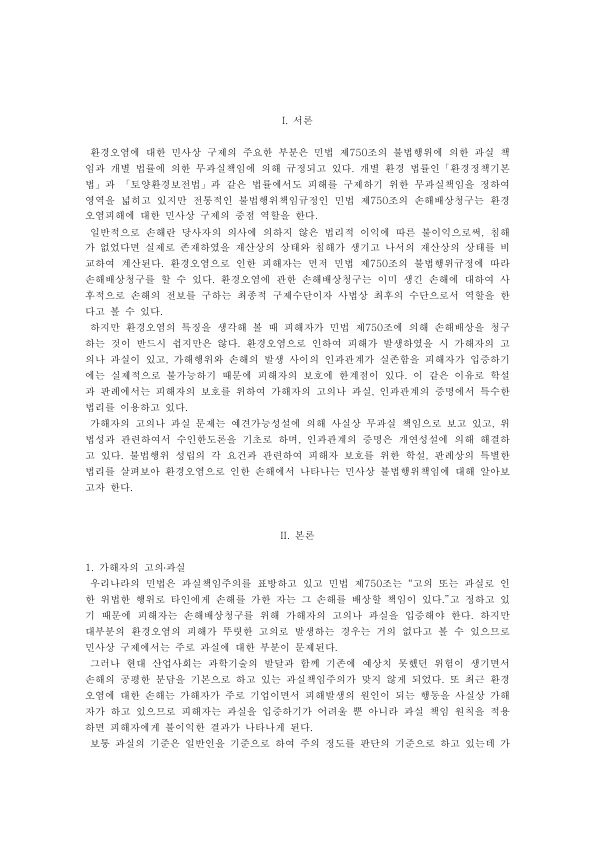
Page 1 is shown as is; from page 2 on, the preview is blurred. Buy it to download the complete original file right away (the file itself is written in Korean).
Packed with real examples and experience. Download it now and save time.
Save your valuable time
Buyer ratings
Fast, accurate and useful.
No ratings yet. Be the first to rate it.

Tort Liability for Environmental Pollution in Korea: Fault, the Tolerance Limit Theory and Proof of Causation by Probability
※ You can preview page 1 as is. Buy it to download the complete original file right away. The file itself is written in Korean.
■ Tort Liability for Environmental Pollution in Korea: Fault, the Tolerance Limit Theory and Proof of Causation by Probability — Overview
A 4-page Korean civil law paper on tort claims for environmental pollution damage under Article 750 of the Civil Act. It explains why victims struggle to prove fault and causation, and how Korean courts and scholars have eased that burden: foreseeability-based fault close to strict liability, the tolerance limit (suinhando) theory for unlawfulness, and the probability theory of causation adopted by the Supreme Court in 1974 (72Da1774).
It also classifies recoverable damages and notes criticism of the probability theory.
■ Tort Liability for Environmental Pollution in Korea: Fault, the Tolerance Limit Theory and Proof of Causation by Probability — Excerpt from the original document (English translation)
Here, damages can be divided into positive damages such as medical expenses and the cost of removing pollution, negative damages caused by environmental pollution, and damages for mental suffering. Mental damages are included within the scope of damages because environmental infringement is understood not only as damage to property but as an infringement of personality rights. The wrongdoer is thus made to compensate not only for property damage, including all positive and negative damages caused by the infringement of rights in things, but also consolation money as special damages arising from property damage and consolation money for mental suffering caused by the infringement of general personality rights.
In bringing a claim for damages for a civil tort arising from environmental pollution, proving causation serves to determine who should bear liability for the damage actually incurred. But the biggest reason victims struggle in damages claims for environmental pollution is proving the causal link between the harmful act and the damage. Environmental pollution is an indirect infringement, such as air or water pollution, and most of the harm arises from harmful substances emitted through lawful business activities of companies, ultimately causing infringements of the lives, bodies and health of nearby residents.
However, environmental pollutants are emitted in small amounts over long periods, and when damage from the causative pollutant occurs it is not easy to reveal in detail the components and pathways of the causative substance, so it is not easy for the victim to prove causation. And where there are multiple wrongdoers, it is also hard to determine whose infringing act triggered the damage, so proving causation is inevitably a difficult problem for the victim.
For these reasons, if, in civil tort liability for environmental pollution, the victim is required to prove causation as in ordinary torts, the victim is very likely to be unable to bring a lawsuit at all. Proving causation in environmental pollution litigation requires expert knowledge about the pollution source, and in reality victims do not have such knowledge. Therefore, the need to ease the degree of proof of causation in environmental pollution litigation has been raised in order to remedy victims' damages.
After the case-law doctrine the material covers, the Act on Liability for Environmental Damage and Relief Thereof took effect in January 2016, so operators of certain facilities bear no-fault liability for environmental pollution damage, and causation is presumed if there is a considerable probability that the facility caused the damage. Adding how the case law's probability theory differs from this Act's presumption-of-causation provision, and how it connects with the no-fault liability in Article 44 of the Framework Act on Environmental Policy, lets you raise the completeness of an assignment spanning environmental law and civil law. Adding one or two related cases is even better.
■ Tort Liability for Environmental Pollution in Korea: Fault, the Tolerance Limit Theory and Proof of Causation by Probability — Contents and key concepts
How do pollution victims prove a tort claim?
✦ At a glance
- The special rules for environmental torts element by element
- Structure: introduction → fault → unlawfulness → causation → damage → conclusion
- Useful for civil law and environmental law assignments
☰ What the paper covers
- Fault and the limits of fault-based liability
- Unlawfulness and the tolerance limit theory
- Causation and the probability theory
- Types of recoverable damage
✎ Environmental torts in Korean law
Korean courts relax the victim's burden of proof in pollution cases because emissions are long-term, technical and often lawful on paper.
Since 2016, the Environmental Damage Relief Act also imposes strict liability on certain facilities and presumes causation in some cases.
Note: the paper itself is written in Korean and discusses Korean law. This page is general study information, not legal advice.
Related wiki: Product Liability
■ Tort Liability for Environmental Pollution in Korea: Fault, the Tolerance Limit Theory and Proof of Causation by Probability References
- 토양오염에 대한 민사책임과 정화책임, 김영경, 경희대학교 법학전문대학원, 2016
- 환경오염의 민사책임에 관한 연구, 안호영, 전북대학교 대학원, 2008
Take a break with a quick personality test?
Ranked by actual participation. Results in about a minute.
Loading…
Most-read content
Loading view counts…

Campusdown is a lifelong-learning community in Korea offering study materials, information on government support, student loans and scholarships, and more. Don't miss our free resources.
Go to the Campusdown home page →Refund policy
- Change of mind / refund requested after partial use / more than 7 days after purchase
◆ Exceptions
- File errors / cannot download or open the file
◆ How to request a refund: send a 1:1 inquiry via Customer Service at the top