
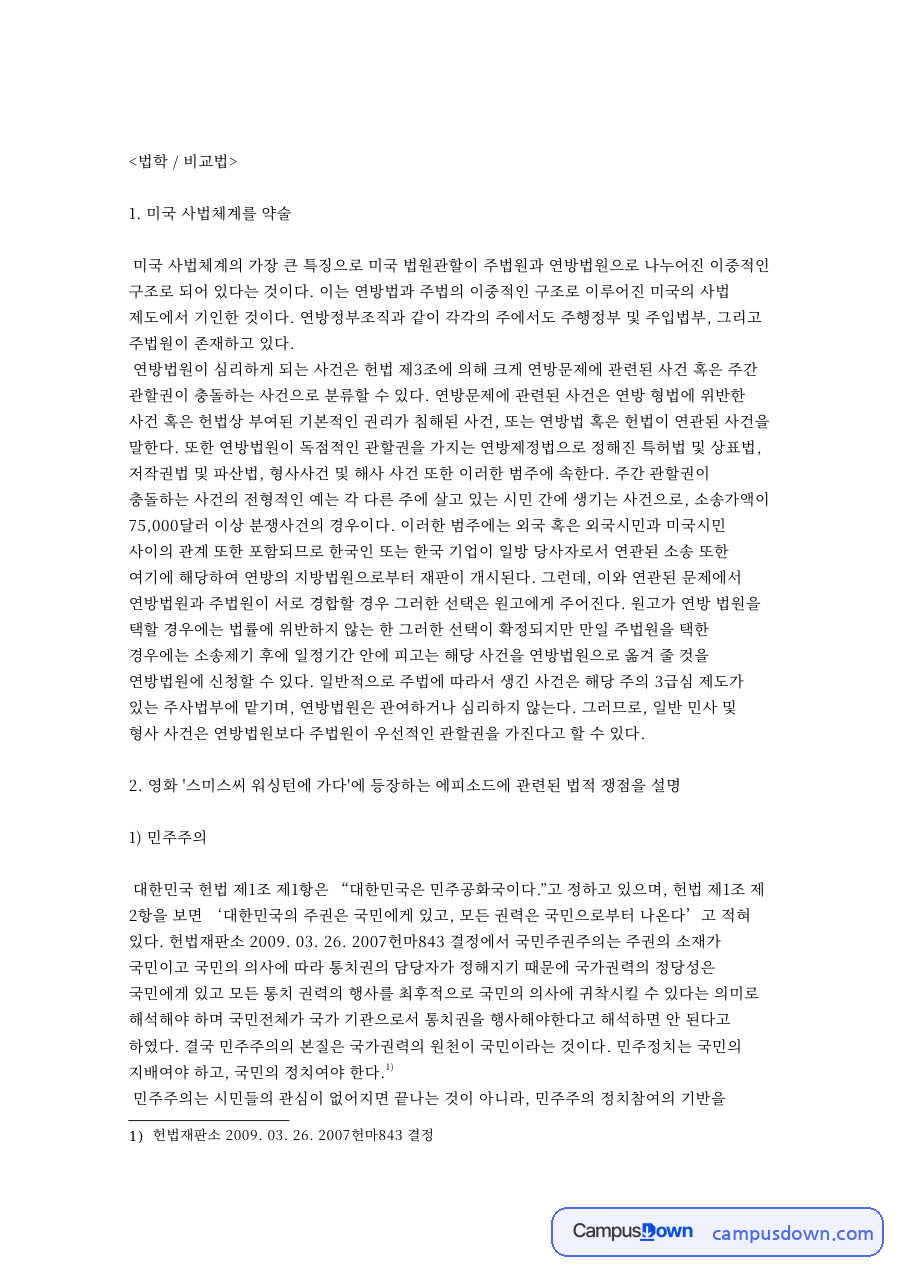
Page 1 is shown as is; from page 2 on, the preview is blurred. Buy it to download the complete original file right away (the file itself is written in Korean).
Packed with real examples and experience. Download it now and save time.
Save your valuable time
Buyer ratings
Fast, accurate and useful.
No ratings yet. Be the first to rate it.


1 / 4
좌우로 밀어서 페이지를 넘겨보세요
과제 개요
| 전체 페이지 수 | 4페이지 |
|---|---|
| 파일 형식 | 한글(HWP) |
| 등록일 | 2025.07.04 |
캠퍼스다운 도움말
해당 자료는 No AI 자료입니다. 인싸이트를 얻고 새롭게 가공해 보세요.
자료를 받아서 이용하면 품질이 확 올라갑니다.
- 비교법
- 연방법원
- 주법원
- 필리버스터
- 무제한 토론
- 국회선진화법
- 국민주권
- 헌법
The US Judicial System and the Filibuster: Mr. Smith Goes to Washington and Korea's Unlimited Debate Rule
※ You can preview page 1 as is. Buy it to download the complete original file right away. The file itself is written in Korean.
■ The US Judicial System and the Filibuster: Mr. Smith Goes to Washington and Korea's Unlimited Debate Rule — Overview
A 4-page Korean comparative law paper. It outlines the dual structure of US federal and state courts, including federal question and diversity jurisdiction and removal. Using the film Mr. Smith Goes to Washington, it discusses democracy and popular sovereignty (citing Korean Constitutional Court decision 2007Hun-Ma843), the filibuster and freedom of the press, then compares the US practice with the unlimited debate rule introduced by Korea's 2012 National Assembly Act amendment, including the cloture requirements.
■ The US Judicial System and the Filibuster: Mr. Smith Goes to Washington and Korea's Unlimited Debate Rule — Excerpt from the original document (English translation)
The sovereignty of the Republic of Korea resides in the "people," and all state authority emanates from the "people." This is Article 1(2) of our Constitution. In a democratic state this is only natural. The beginning and end of power in the Republic of Korea is the people. All power comes from the people. Is the power delegated by the people really being exercised properly? Unfortunately, the gap between political power and public sentiment shows no sign of narrowing. Where did things go wrong? Can today's Republic of Korea really say that all power comes from the "people"?
As the Republic of Korea has recently been shaken by the former president's state-affairs manipulation scandal, many citizens think it should be taken as a good opportunity to become aware once again that they are citizens of a democracy. It planted in our hearts the hope that the great premise of democracy, that all power comes from the people, was not wrong. It showed the civic awareness and solidarity of the Korean people and inspired in them the pride of living in a country where the people defend democracy. Most important of all, this is a stage that calls for more fundamental reflection and practice on what mindset to hold and how to live from now on as democratic citizens. In a democratic state, we must think about the constitutional order and its true value. Can power in our country also change so that it truly comes from the people? Power comes from the people when the people recognize power as their own and when the people themselves exercise that power. The "lack of communication" that has been a chronic problem in our democratic politics can be eased by revitalizing democratic society. But that is possible only when institutional reform is carried out in a direction fundamentally different from what has been judged so far. Above all, democratic political reform must come through a substantial strengthening of the power of the legislature. If we want political parties to properly play the role of mediators of communication, democratic representative bodies to be run responsibly, and more capable politicians, our thinking about the direction of democratic political reform must change fundamentally. Now, such change in democratic society calls for an active expansion of participatory democracy through the opening up of democracy.
Korea's unlimited debate (filibuster) is provided for in Article 106-2 of the National Assembly Act, and it drew great attention when it was used in earnest for the first time since 1969 during the handling of the Anti-Terrorism Act in February 2016. Diversity jurisdiction in U.S. federal courts is recognized only when the amount in controversy exceeds $75,000, so the material's expression "or more" should be read as "exceeding" to be accurate. Supplementing it with such recent cases and details makes it good debate material for comparative law, constitutional law and political science general-education assignments. Watching film scenes together with actual meeting minutes makes it more vivid.
■ The US Judicial System and the Filibuster: Mr. Smith Goes to Washington and Korea's Unlimited Debate Rule — Contents and key concepts
What does a 1939 film teach about the filibuster in Korea?
✦ At a glance
- How the filibuster entered Korean parliamentary law
- Structure: US courts → legal issues in the film → comparison with Korea
- Useful for comparative law, constitutional law and politics classes
☰ What the paper covers
- Federal and state courts in the US
- Popular sovereignty and freedom of expression
- Filibuster and cloture rules
- Korea's 2012 National Assembly Act amendment
✎ Filibuster basics
In the US Senate, debate can be ended by a three-fifths vote under the cloture rule.
Korea introduced unlimited debate in 2012 to reduce physical clashes in the National Assembly and encourage negotiation.
Note: the paper itself is written in Korean and discusses Korean law. This page is general study information, not legal advice.
■ The US Judicial System and the Filibuster: Mr. Smith Goes to Washington and Korea's Unlimited Debate Rule References
- 김범석. "한나 아렌트의 헌법정치에서 권위의 탄생." 국내석사학위논문 연세대학교 대학원, 2017.
- 서울 허미정. "미국 혁신주의 시기의 연방헌법 수정조항 제정에 관한 연구." 국내박사학위논문 강원대학교 대학원, 2021.
- 강원도 이문한. "가짜뉴스 등 허위사실 표현에 대한 형사적 규제와 그 헌법적 한계." 국내박사학위논문 한양대학교 대학원, 2020. 서울
Keyword Prompt
전문가가 만들었어요과제를 직접 쓰는 데 도움이 되는 영어 프롬프트예요.
Tip! Prompt 에 자신의 생각을 추가해서 하면 훨씬 더 ✨ 좋습니다.
캠퍼스다운에서 레포트 받고 잘 쓰는 법 3가지, AI로 참고자료 제대로 재가공하기 →Prompt 1
I'm writing a university assignment on "미국 사법체계와 필리버스터: 스미스씨 워싱턴에 가다로 본 무제한 토론, 국회선진화법과 한국 비교". Help me build an outline (introduction, 2-3 body sections, conclusion) that covers 비교법, 연방법원 and 주법원. Don't write the paper for me - give me guiding questions for each section. My own perspective: [자신의 생각 넣는 곳] Please respond in Korean.
Prompt 2
Explain the key concepts "비교법" and "연방법원" in simple terms, then show how they connect to the topic "미국 사법체계와 필리버스터: 스미스씨 워싱턴에 가다로 본 무제한 토론, 국회선진화법과 한국 비교". Point out common misunderstandings students have about them. My own perspective: [자신의 생각 넣는 곳] Please respond in Korean.
Prompt 3
Suggest 3 real-world cases or examples I could analyze in an assignment on "미국 사법체계와 필리버스터: 스미스씨 워싱턴에 가다로 본 무제한 토론, 국회선진화법과 한국 비교", focusing on "주법원". For each, tell me what I should look up and verify in official or academic sources. My own perspective: [자신의 생각 넣는 곳] Please respond in Korean.
Prompt 4
Review my draft paragraph on "미국 사법체계와 필리버스터: 스미스씨 워싱턴에 가다로 본 무제한 토론, 국회선진화법과 한국 비교" (key idea: "필리버스터"). Give feedback on logic, evidence and clarity, and mark where I need a citation. My paragraph: [paste here] My own perspective: [자신의 생각 넣는 곳] Please respond in Korean.
Take a break with a quick personality test?
Ranked by actual participation. Results in about a minute.
Loading…
Most-read content
Loading view counts…

Campusdown is a lifelong-learning community in Korea offering study materials, information on government support, student loans and scholarships, and more. Don't miss our free resources.
Go to the Campusdown home page →Refund policy
- Change of mind / refund requested after partial use / more than 7 days after purchase
◆ Exceptions
- File errors / cannot download or open the file
◆ How to request a refund: send a 1:1 inquiry via Customer Service at the top