
Page 1 is shown as is; from page 2 on, the preview is blurred. Buy it to download the complete original file right away (the file itself is written in Korean).
Packed with real examples and experience. Download it now and save time.
Save your valuable time
Buyer ratings
Fast, accurate and useful.
No ratings yet. Be the first to rate it.


The Right to a Decent Life and Korean Social Welfare Law: Article 34 of the Constitution, the Legal Nature of Social Rights and Welfare as a Right Rather Than Charity
※ You can preview page 1 as is. Buy it to download the complete original file right away. The file itself is written in Korean.
■ The Right to a Decent Life and Korean Social Welfare Law: Article 34 of the Constitution, the Legal Nature of Social Rights and Welfare as a Right Rather Than Charity — Overview
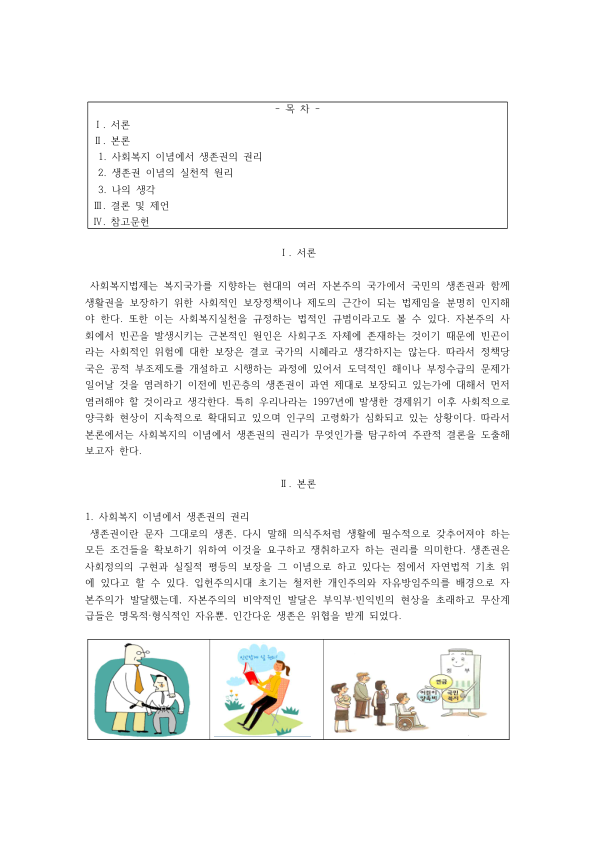
A 6-page Korean social welfare law paper on the right to subsistence. It explains what the right covers, how the Constitution structures it, the debate over whether it is an enforceable right, and how it differs from liberty rights. It argues that welfare is a right rather than charity and that social work is human rights practice.
■ The Right to a Decent Life and Korean Social Welfare Law: Article 34 of the Constitution, the Legal Nature of Social Rights and Welfare as a Right Rather Than Charity — Excerpt from the original document (English translation)
Korea's Code of Ethics for Social Workers, revised in December 2001, treats the practice of human rights as part of the practitioner's role in social work practice and presents practical standards based on human equality and advocacy of rights, human dignity and non-discrimination, and social justice, morality and responsibility. In particular, the preamble of the code states: "Social workers, grounded in humanism and egalitarianism, respect the dignity and worth of every human being and devote themselves to securing the inherent rights to liberty and subsistence. In particular, they stand on the side of the socially and economically vulnerable and take the lead in realizing the values of social justice, equality, freedom and democracy. They also work together with those in need to improve their social status and functioning and take a leading part in all activities related to improving social institutions. Social workers do their best to guarantee the individual's autonomy and right to self-determination and ensure that no individual is unjustly sacrificed under any circumstances. To carry out this mission, they develop professional knowledge and skills and strive to maintain the competence and dignity of professionals who realize social values."
In this way, the field of social welfare can be called a field of practice for protecting people's human rights, and at its forefront is social welfare as a basic right. Yet recent abuse in childcare centers, nursing homes for the elderly and facilities for people with disabilities, as anti-human-rights acts in social welfare settings that should place welfare as a right and the protection of human rights first, has disappointed many people. Although awareness of social welfare development, human rights and welfare as a right is improving, there are clearly still people who go unprotected in the blind spots of human rights. In particular, the fact that abuse by parents, families and welfare service workers, who have a duty to provide protection, is still being reported reflects a grim reality in our society.
I think we need to reconsider what we have forgotten amid rapid social development: the most important "right to enjoy social welfare services, and human dignity." For a society that guarantees the human rights of the socially vulnerable, central and local governments should more faithfully carry out their duty to promote social welfare so that the vulnerable can enjoy welfare services as a right and lead a decent human life. More effort should also be made to ensure that the rights of service providers who quietly work in the field to protect them are guaranteed as well.
In daily life we often hear and use the expression welfare awareness. But I think awareness of welfare as a right is still not very high in our society. Then what must be done to spread awareness of social welfare as a right? As welfare becomes increasingly localized, closer attention is needed to social welfare services, where considerable problems may arise.
To add: in its May 29, 1997 decision in case 94Hun-Ma33, the Constitutional Court held that whether livelihood protection standards violate the right to a decent life is judged by whether the state fulfilled its duty to take at least minimum measures, and dismissed the complaint. The Livelihood Protection Act of 1961 was replaced in October 2000 by the National Basic Living Security Act, which made livelihood benefits a right. In the paper's list of constitutional articles, social security belongs to Article 34, and workers' three labor rights, including the right to organize, are in Article 33. The preamble of the Code of Ethics for Social Workers quoted in the paper is from the 2001 revision, and the code has been revised again since.
■ The Right to a Decent Life and Korean Social Welfare Law: Article 34 of the Constitution, the Legal Nature of Social Rights and Welfare as a Right Rather Than Charity — Contents and key concepts
Is welfare a right or a favor from the state?
✦ At a glance
- Social rights in Korean welfare law
- Structure: concept → constitutional basis → legal nature → practice → author's view
- Useful for social welfare law and constitutional law courses
☰ What the paper covers
- What the right covers
- Constitutional structure
- Programmatic vs. legal right
- Liberty vs. social rights
- Welfare as a right
✎ Social rights in Korea and the U.S.
Korea's Constitution guarantees a right to a life worthy of human beings, and the Constitutional Court reviews whether the state has taken at least minimum measures.
The U.S. Constitution has no right to welfare, and in Dandridge v. Williams (1970) the Supreme Court applied only rational basis review to welfare benefit limits.
Note: the paper itself is written in Korean and discusses Korean law. This page is general study information, not legal advice.
Related wiki: Public Assistance Programs
Related wiki: Americans with Disabilities Act (ADA)
■ The Right to a Decent Life and Korean Social Welfare Law: Article 34 of the Constitution, the Legal Nature of Social Rights and Welfare as a Right Rather Than Charity References
- 편집부. (2017). [토론회] 실질적 평등과 생존권을 보장하는 헌법 개정방안. 월간 복지동향, (225), 76-78.
- 정혜인. (2011). 평화적 생존권의 보호영역에 관한 연구. 한양법학, 35, 383-408.
- 헌법학개론 (금철수, 박영사, 1997)
- 임종대. (2000). 생존권에 대하여. 월간 복지동향, (17), 2-3.
- 모상현, 김희진. (2009). 국제기준 대비 한국아동ㆍ청소년의 인권수준 연구 Ⅳ : 생존권ㆍ보호권 인권실태조사. 한국청소년정책연구원 연구보고서, , 3-7.
Take a break with a quick personality test?
Ranked by actual participation. Results in about a minute.
Loading…
Most-read content
Loading view counts…

Campusdown is a lifelong-learning community in Korea offering study materials, information on government support, student loans and scholarships, and more. Don't miss our free resources.
Go to the Campusdown home page →Refund policy
- Change of mind / refund requested after partial use / more than 7 days after purchase
◆ Exceptions
- File errors / cannot download or open the file
◆ How to request a refund: send a 1:1 inquiry via Customer Service at the top