
Page 1 is shown as is; from page 2 on, the preview is blurred. Buy it to download the complete original file right away (the file itself is written in Korean).
Packed with real examples and experience. Download it now and save time.
Save your valuable time
Buyer ratings
Fast, accurate and useful.
No ratings yet. Be the first to rate it.


1 / 7
좌우로 밀어서 페이지를 넘겨보세요
과제 개요
| 전체 페이지 수 | 7페이지 |
|---|---|
| 파일 형식 | 한글(HWP) |
| 등록일 | 2025.07.20 |
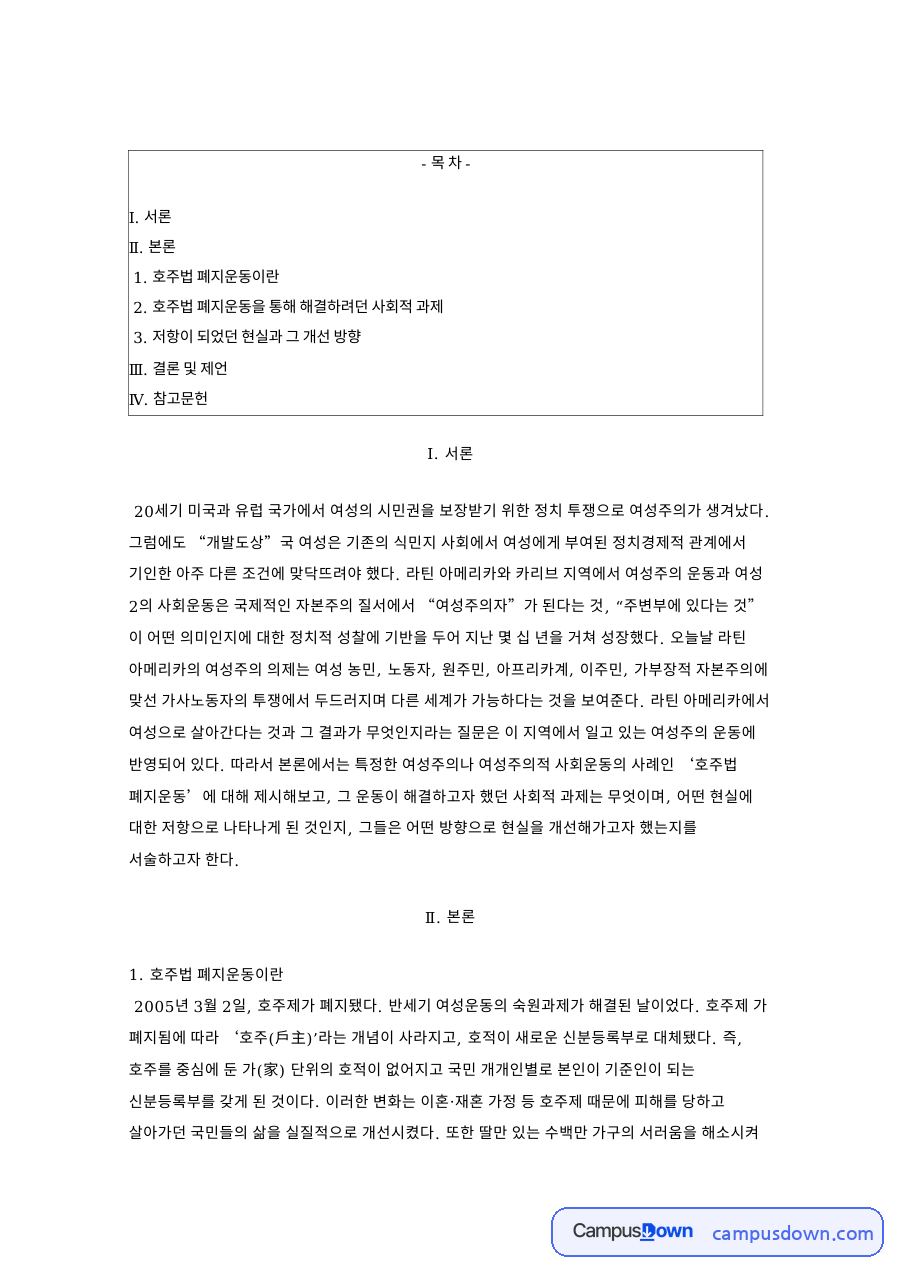
목차
- 1Ⅰ. 서론
- 2Ⅱ. 본론
- 2.11. 호주법 폐지운동이란
- 2.22. 호주법 폐지운동을 통해 해결하려던 사회적 과제
- 2.33. 저항이 되었던 현실과 그 개선 방향
- 3Ⅲ. 결론 및 제언
- 4Ⅳ. 참고문헌
캠퍼스다운 도움말
해당 자료는 No AI 자료입니다. 인싸이트를 얻고 새롭게 가공해 보세요.
자료를 받아서 이용하면 품질이 확 올라갑니다.
- 호주제 폐지
- 호주제
- 가족법 개정운동
- 동성동본 금혼
- 헌법불합치
- 가족관계등록법
- 이태영
- 여성운동
- 양성평등
- 호주법 폐지운동이란
The Movement to Abolish Korea's Hoju (Male Family Head) System: Family Law Reform, the Same-Surname Marriage Ban Ruling, the 2005 Abolition and the Family Relations Register
※ You can preview page 1 as is. Buy it to download the complete original file right away. The file itself is written in Korean.
■ The Movement to Abolish Korea's Hoju (Male Family Head) System: Family Law Reform, the Same-Surname Marriage Ban Ruling, the 2005 Abolition and the Family Relations Register — Overview
A 6-page Korean paper on the decades-long campaign to abolish the hoju system, which placed families on one register under a male head. It traces family law reform efforts from the 1950s, the 1997 ruling against the ban on marriage between people of the same surname and clan origin, the 2005 Constitutional Court decision and the shift to individual family registers.
■ The Movement to Abolish Korea's Hoju (Male Family Head) System: Family Law Reform, the Same-Surname Marriage Ban Ruling, the 2005 Abolition and the Family Relations Register — Excerpt from the original document (English translation)
Put simply, the aim of feminism is "strengthening women's status and power." Feminist thought is usually divided into two broad streams, most commonly described as "waves." The so-called first wave, around the late 19th century, centered on women's suffrage, the core of women's demands for political and legal rights, and began with the history of women gaining political and legal power. The first country to give women the vote was New Zealand in 1893, followed in Europe by Finland in 1906 and Germany in 1918, while France allowed women to vote only in 1944. The second wave arose in the late 1960s, as feminist groups appeared in large numbers alongside the youth protest movements. At that time women's liberation came to the fore and a new generation of feminists emerged. In the 1970s it developed into a radical women's movement, and from then on the word feminist became common. The basic idea of the feminist movement, analyzing the state, its institutions and social structures as patriarchal and resisting and fighting to overthrow patriarchy, continues today. The second wave produced a surge of feminist groups with diverse agendas, and the decades of struggle to change laws and institutions are regarded as a great and proud achievement of a social movement. Today there is no family register. The family register system was abolished on January 1, 2008, and the family relations register is now used instead. When I said in a public lecture last year that the family register had disappeared, the men were very surprised, asking how that could be, when it happened and who abolished it. They apparently thought the family relations register had begun but the old register still remained. The abolition of the hoju system was an important event that greatly advanced gender equality in Korea. The hoju system had been the foundation of the family system since the Civil Code took effect in 1960, defining relations between the head of the family and other members as vertical and authoritarian. The head had the power to consent to various changes in family status, succession to the headship went first to the eldest son, then the second son, and a daughter inherited the headship only when there was no son. From the time the code was enacted, critics argued this violated the constitutional ideals of gender equality and individual dignity. Because it failed to reflect the diverse families of modern society, calls for abolition continued. For example, if a father died leaving a one-year-old son and a daughter over twenty, the infant son inherited the headship; even if there were only young children, the wife could not succeed to her late husband's position, and the children inherited it. Especially since the widowed wife handled all family matters while the head was a small child, problems detached from reality kept arising, and the hoju system was losing its footing. A sign of its coming abolition was the call to end the ban on marriage between people of the same surname and clan origin.
To add: on February 3, 2005, the Constitutional Court ruled the hoju system incompatible with the Constitution (2001Hun-Ga9 and others), and the revised Civil Code passed by the National Assembly in March that year took effect on January 1, 2008, replacing the family register under the Family Register Act with individual family relations registers under the Act on the Registration of Family Relationships. The revised code kept the rule that children take the father's surname but allowed them to take the mother's surname if the parents agree when registering the marriage, and also introduced court-approved surname changes and full adoption. The same-surname marriage ban was replaced in 2005 with a ban on marriage between blood relatives within the eighth degree (Article 809).
■ The Movement to Abolish Korea's Hoju (Male Family Head) System: Family Law Reform, the Same-Surname Marriage Ban Ruling, the 2005 Abolition and the Family Relations Register — Contents and key concepts
How did Korea end its male family head system?
✦ At a glance
- Korea's abolition of the hoju system
- Structure: meaning → goals → resistance → reform
- Useful for family law, gender studies and social policy courses
☰ What the paper covers
- What abolition changed
- Early reform demands
- Family law movement
- Same-surname marriage ruling
- 2005 decision and reform
✎ Family records in Korea and the U.S.
Since 2008, Korea records each person's family relations on an individual register instead of a household register headed by a man.
The U.S. has no national family register; states keep separate birth, marriage and death records, and surname choice for children is largely left to parents.
Note: the paper itself is written in Korean and discusses Korean law. This page is general study information, not legal advice.
■ The Movement to Abolish Korea's Hoju (Male Family Head) System: Family Law Reform, the Same-Surname Marriage Ban Ruling, the 2005 Abolition and the Family Relations Register References
- 성미애. (2017). 건강가정기본법 시행 및 호주제 헌법불일치 판결 이후 일간지에 나타난 가족주의 인식. 한국가정관리학회지, 35(4), 113-139. 김상용, 이제수. (2005). 호주제의 사적 전개와 폐지 그리고 가족관의 변화. 여성학연구, 15(1), 147-156. 남윤인순. (2003). 호주제 폐지와 그 이후 대안. 월간 복지동향, (60), 34-37. 김경희. (2004). 호주제 폐지의 논쟁과 전망. 여성과 사회, (15), 379-392.
Keyword Prompt
전문가가 만들었어요과제를 직접 쓰는 데 도움이 되는 영어 프롬프트예요.
Tip! Prompt 에 자신의 생각을 추가해서 하면 훨씬 더 ✨ 좋습니다.
캠퍼스다운에서 레포트 받고 잘 쓰는 법 3가지, AI로 참고자료 제대로 재가공하기 →Prompt 1
I'm writing a university assignment on "호주제 폐지운동의 과정과 의미: 가족법 개정운동, 동성동본 금혼 헌법불합치, 2005년 호주제 폐지와 가족관계등록제도". Help me build an outline (introduction, 2-3 body sections, conclusion) that covers 호주제 폐지, 호주제 and 가족법 개정운동. Don't write the paper for me - give me guiding questions for each section. My own perspective: [자신의 생각 넣는 곳] Please respond in Korean.
Prompt 2
Explain the key concepts "호주제 폐지" and "호주제" in simple terms, then show how they connect to the topic "호주제 폐지운동의 과정과 의미: 가족법 개정운동, 동성동본 금혼 헌법불합치, 2005년 호주제 폐지와 가족관계등록제도". Point out common misunderstandings students have about them. My own perspective: [자신의 생각 넣는 곳] Please respond in Korean.
Prompt 3
Suggest 3 real-world cases or examples I could analyze in an assignment on "호주제 폐지운동의 과정과 의미: 가족법 개정운동, 동성동본 금혼 헌법불합치, 2005년 호주제 폐지와 가족관계등록제도", focusing on "가족법 개정운동". For each, tell me what I should look up and verify in official or academic sources. My own perspective: [자신의 생각 넣는 곳] Please respond in Korean.
Prompt 4
Review my draft paragraph on "호주제 폐지운동의 과정과 의미: 가족법 개정운동, 동성동본 금혼 헌법불합치, 2005년 호주제 폐지와 가족관계등록제도" (key idea: "동성동본 금혼"). Give feedback on logic, evidence and clarity, and mark where I need a citation. My paragraph: [paste here] My own perspective: [자신의 생각 넣는 곳] Please respond in Korean.
Take a break with a quick personality test?
Ranked by actual participation. Results in about a minute.
Loading…
Most-read content
Loading view counts…

Campusdown is a lifelong-learning community in Korea offering study materials, information on government support, student loans and scholarships, and more. Don't miss our free resources.
Go to the Campusdown home page →Refund policy
- Change of mind / refund requested after partial use / more than 7 days after purchase
◆ Exceptions
- File errors / cannot download or open the file
◆ How to request a refund: send a 1:1 inquiry via Customer Service at the top