
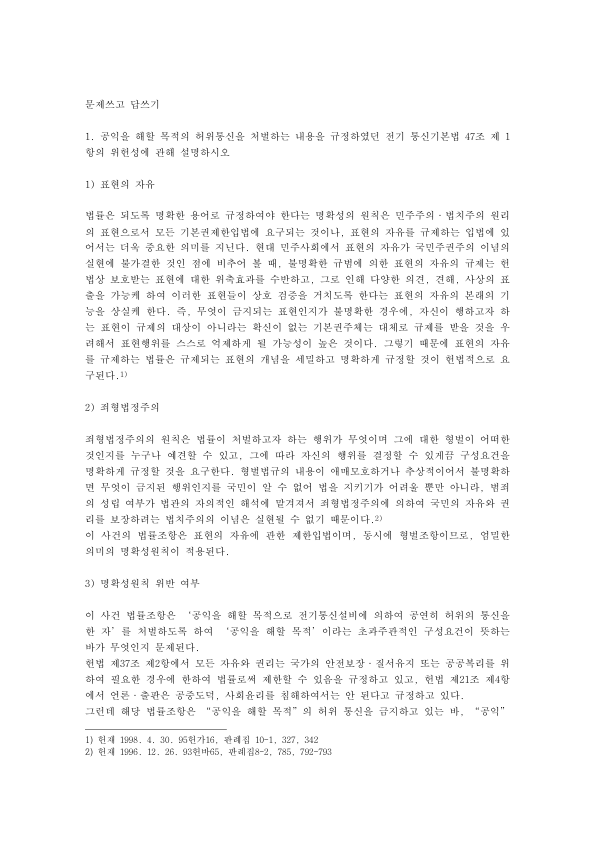
Page 1 is shown as is; from page 2 on, the preview is blurred. Buy it to download the complete original file right away (the file itself is written in Korean).
Packed with real examples and experience. Download it now and save time.
Save your valuable time
Buyer ratings
Fast, accurate and useful.
No ratings yet. Be the first to rate it.
The Minerva Case and the Vagueness Doctrine: Korea's Former False Communication Ban and Consumers' Right of Withdrawal in E-Commerce
※ You can preview page 1 as is. Buy it to download the complete original file right away. The file itself is written in Korean.
■ The Minerva Case and the Vagueness Doctrine: Korea's Former False Communication Ban and Consumers' Right of Withdrawal in E-Commerce — Overview
A 4-page Korean law Q&A paper. Part one explains why former Article 47(1) of the Framework Act on Telecommunications, which punished false communications made 'to harm the public interest', violated the vagueness doctrine required by freedom of expression and the principle of legality, citing Constitutional Court decisions 95Hun-Ga16 and 93Hun-Ba65. Part two summarizes the consumer's right of withdrawal under the Korean E-Commerce Consumer Protection Act: the definition of mail-order sales, exclusions, the five statutory limits, and the basic 7-day period and when it starts.
■ The Minerva Case and the Vagueness Doctrine: Korea's Former False Communication Ban and Consumers' Right of Withdrawal in E-Commerce — Excerpt from the original document (English translation)
2. Explain the consumer's right to withdraw an offer under the Act on Consumer Protection in Electronic Commerce.
The Act on the Consumer Protection in Electronic Commerce, etc. provides a consumer's right of withdrawal for contracts made through mail-order sales. Mail-order sales means providing information on the sale of goods or services (including the right to use certain facilities or receive services) by mail, telecommunications or other methods prescribed by Ordinance of the Prime Minister, and selling goods or services upon a consumer's offer (Article 2(1) of the Act). However, the right of withdrawal cannot be exercised for matters excluded from the Act's application or matters for which the right of withdrawal is restricted.
Matters excluded from the Act's application are, first, telemarketing under Article 2(3) of the Door-to-Door Sales, etc. Act (proviso to the same paragraph of the same Article). Second, transactions in which a business operator (excluding multi-level salespersons under Article 2(6) of the Door-to-Door Sales, etc. Act) purchases for the purpose of commercial activity (Article 3(1) of the Act); however, this does not apply where, even though a business operator, it transacts in effect in the same position as a consumer and on the same terms as other consumers. Third, transactions in securities by investment dealers and investment brokers under the Financial Investment Services and Capital Markets Act; transactions in financial products handled directly by financial institutions falling under Article 38(1) to (12) of the Act on the Establishment, etc. of Financial Services Commission, financial institutions established under other statutes, or financial institutions established with the authorization or permission of central administrative agencies; and transactions for selling daily necessities, food and beverages, etc. to neighboring areas (paragraph 4 of the same Article and Article 3 of the Enforcement Decree).
For matters subject to restriction of the right of withdrawal, the consumer cannot withdraw the offer, etc. against the will of the mail-order business operator. Article 17(2) of the Act on the Consumer Protection in Electronic Commerce, etc.
Matters restricted by law are, first, where the goods, etc. have been lost or damaged for reasons attributable to the consumer, excluding cases where the packaging, etc. was damaged in order to check the content of the goods; and second, where the value of the goods, etc. has decreased significantly due to the consumer's use or partial consumption.
This provision was held unconstitutional by the Constitutional Court in its decision 2008Heonba157, etc. of December 28, 2010 and lost effect; since then, regulation of spreading false information has been handled as a matter for individual statutes, such as defamation under the Information and Communications Network Act or the Public Official Election Act. Withdrawal of an offer under the Electronic Commerce Act also has an exception allowing withdrawal within three months from the date of supply, or within 30 days from the date the consumer learned of the fact, where the goods differ from what was indicated or from the contract; checking this as well lets you use it right away in consumer-law assignments. Adding the legislative discussion after the unconstitutionality decision makes it even better.
■ The Minerva Case and the Vagueness Doctrine: Korea's Former False Communication Ban and Consumers' Right of Withdrawal in E-Commerce — Contents and key concepts
Why could 'harming the public interest' not justify criminal punishment?
✦ At a glance
- The vagueness doctrine applied to speech-restricting criminal law
- Structure: free speech → legality principle → analysis → consumer withdrawal right
- Useful for constitutional rights and consumer law assignments
☰ What the paper covers
- Chilling effect and the demand for clarity
- Why 'public interest' is too abstract for a criminal provision
- Scope of the E-Commerce Consumer Protection Act
- Limits on withdrawal and the 7-day rule
✎ Background in brief
The Korean Constitutional Court struck down the provision in December 2010 in the so-called Minerva case, which concerned online posts about the economy.
Korean e-commerce law lets consumers withdraw from online purchases, generally within 7 days, with listed exceptions to protect sellers.
Note: the paper itself is written in Korean and discusses Korean law. This page is general study information, not legal advice.
■ The Minerva Case and the Vagueness Doctrine: Korea's Former False Communication Ban and Consumers' Right of Withdrawal in E-Commerce References
- 이문한. "가짜뉴스 등 허위사실 표현에 대한 형사적 규제와 그 헌법적 한계." 국내박사학위논문 한양대학교 대학원, 2020.
- 서울 김가희. "가짜뉴스 규제 방안." 국내석사학위논문 이화여자대학교 대학원, 2017. 서울
Take a break with a quick personality test?
Ranked by actual participation. Results in about a minute.
Loading…
Most-read content
Loading view counts…

Campusdown is a lifelong-learning community in Korea offering study materials, information on government support, student loans and scholarships, and more. Don't miss our free resources.
Go to the Campusdown home page →Refund policy
- Change of mind / refund requested after partial use / more than 7 days after purchase
◆ Exceptions
- File errors / cannot download or open the file
◆ How to request a refund: send a 1:1 inquiry via Customer Service at the top