
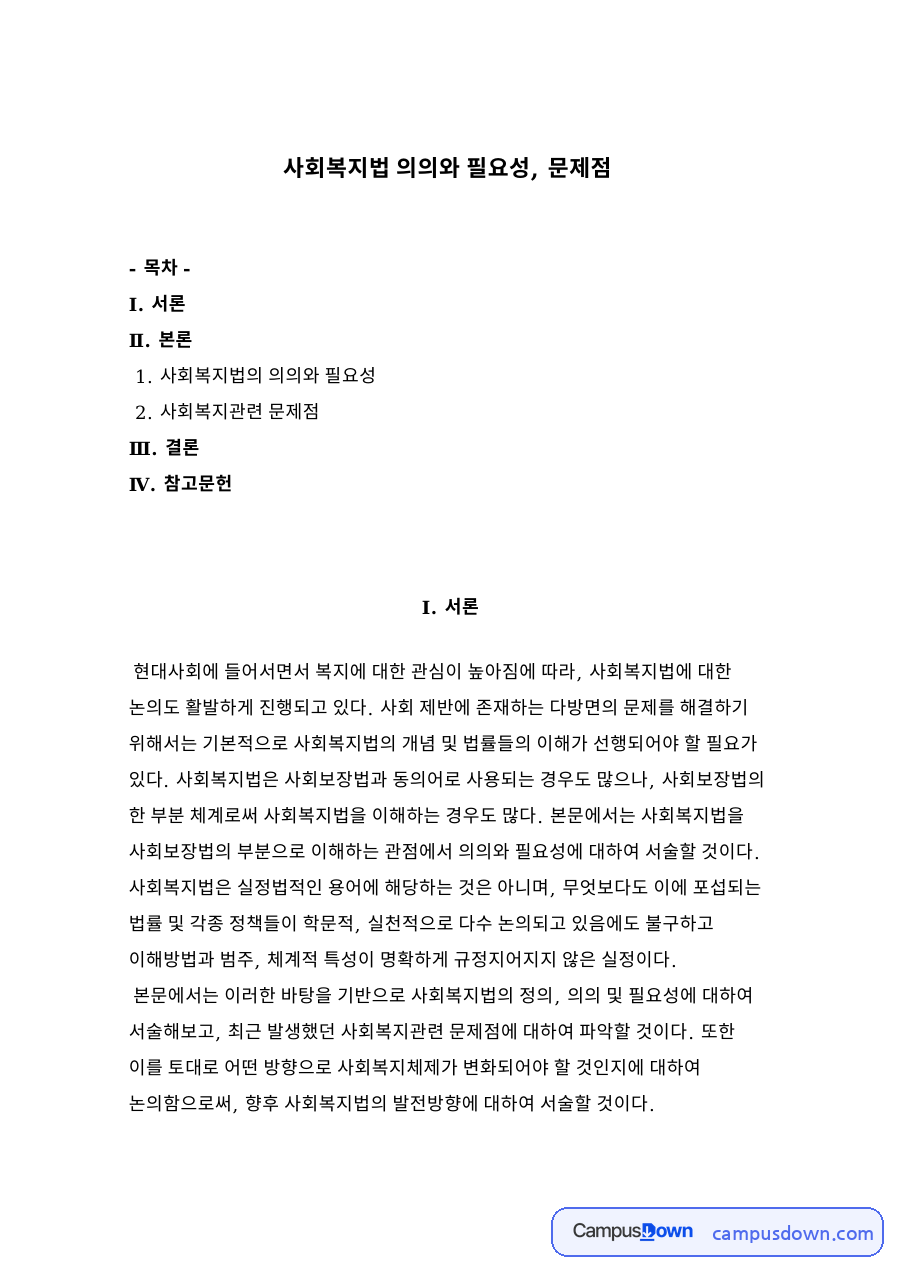
Page 1 is shown as is; from page 2 on, the preview is blurred. Buy it to download the complete original file right away (the file itself is written in Korean).
Packed with real examples and experience. Download it now and save time.
Save your valuable time
Buyer ratings
Fast, accurate and useful.
No ratings yet. Be the first to rate it.


1 / 6
좌우로 밀어서 페이지를 넘겨보세요
과제 개요
| 전체 페이지 수 | 6페이지 |
|---|---|
| 파일 형식 | 한글(HWP) |
| 등록일 | 2025.08.06 |
목차
- 1Ⅰ. 서론
- 2Ⅱ. 본론
- 2.11. 사회복지법의 의의와 필요성
- 2.22. 사회복지관련 문제점
- 3Ⅲ. 결론
- 4Ⅳ. 참고문헌
캠퍼스다운 도움말
해당 자료는 No AI 자료입니다. 인싸이트를 얻고 새롭게 가공해 보세요.
자료를 받아서 이용하면 품질이 확 올라갑니다.
- 사회복지법
- 사회보장법
- 사회복지사업법
- 고용보험
- 비정규직
- 장그래법
- 노동시장 유연화
- 재분배
- 사회복지법제
- 사회복지법의 의의와 필요성
The Meaning and Need for Social Welfare Law in Korea: Its Place in Social Security Law, Employment Insurance and the Fixed-Term Worker Debate
※ You can preview page 1 as is. Buy it to download the complete original file right away. The file itself is written in Korean.
■ The Meaning and Need for Social Welfare Law in Korea: Its Place in Social Security Law, Employment Insurance and the Fixed-Term Worker Debate — Overview
A 5-page Korean social welfare law paper. It defines social welfare law as part of social security law, explains the background of the Social Welfare Services Act and laws for children, older people and people with disabilities, and traces how employment insurance and labor market flexibility reshaped the field. It then uses the 2014 proposal to extend fixed-term contracts, nicknamed the Jang Geu-rae law after a TV drama, to show gaps in protection.
■ The Meaning and Need for Social Welfare Law in Korea: Its Place in Social Security Law, Employment Insurance and the Fixed-Term Worker Debate — Excerpt from the original document (English translation)
Globalization, which developed rapidly from the 1990s, brought about another fundamental change in addition to this relationship between employment and social welfare. The possibility of capital and labor moving across borders increased demand for labor that generates high returns, while labor that could not contribute directly to this became surplus. This became the occasion for unemployment and low-wage labor to become widespread. In addition, each country needed labor policies to attract capital, and accordingly labor-market flexibility was pursued competitively. Since the burden on capital had to be reduced to attract it, policies minimizing capital's share in financing social security were implemented. As a result, temporary, part-time and non-regular forms of employment became widespread. These social problems acted as causes weakening the structure through which social welfare traditionally functions. This is counted as a very big problem in modern society, and social welfare law needs to find a breakthrough in this situation through a shift in thinking.
Since social welfare law has limitations large and small, it needs to be reborn as a legal system suited to the situation through continuous discussion on applying it properly to society. The main text examined the employment-related problems of social welfare law based on a recent social issue, the "Jang Geu-rae law." Through industrial society, a labor surplus arose, and companies minimized capital's share to keep pace with global market trends, which led to an excessive proliferation of non-regular employment. In this situation, social welfare law should no longer target only lifetime, full-time and regular employment; it needs to bring temporary, part-time and non-regular employment within the scope of social welfare as well and prepare policies for them.
Seen in this context, the "Jang Geu-rae law" is significant in that it sought to bring non-regular workers into the scope of social welfare, but it is true that many are skeptical about whether it is truly "welfare" for them. As Yoon Tae-ho, the author of the webtoon "Misaeng," said, it only prolongs the suffering of non-regular workers and never provides opportunities for them. If, after seeing "Misaeng," the aim was to enact a law for the "Jang Geu-rae"s across the country, measures should have been prepared to reduce non-regular employment and regulate in a way that expands regular employment.
For reference, the material writes that employment insurance was introduced in 1996, but the Employment Insurance Act was enacted in 1993 and took effect in July 1995. The so-called Jang Geu-rae law refers to the plan to extend the employment period for fixed-term workers contained in the government's comprehensive measures on non-regular workers in December 2014, and it was not enacted as is. The period for using fixed-term workers is still, in principle, two years under Article 4 of the Act on the Protection, etc. of Fixed-Term and Part-Time Employees, so check the current provision and recent amendments before using it in an assignment.
■ The Meaning and Need for Social Welfare Law in Korea: Its Place in Social Security Law, Employment Insurance and the Fixed-Term Worker Debate — Contents and key concepts
Why does Korea need social welfare law, and where does it fall short?
✦ At a glance
- The purpose of social welfare law
- Structure: concept → changes since employment insurance → fixed-term worker case
- Useful for social policy and welfare law classes
☰ What the paper covers
- Defining social welfare law
- Key statutes and their background
- Employment insurance and diversification
- Redistribution and fiscal pressure
- The fixed-term worker debate
✎ Welfare law and work in Korea and the U.S.
Korea's Framework Act on Social Security divides protection into social insurance, public assistance and social services, and social insurance depends heavily on stable employment.
U.S. social insurance is also tied to work, through payroll taxes for Social Security and state unemployment insurance, so the rise of gig and contract work raises similar coverage-gap debates.
Note: the paper itself is written in Korean and discusses Korean law. This page is general study information, not legal advice.
■ The Meaning and Need for Social Welfare Law in Korea: Its Place in Social Security Law, Employment Insurance and the Fixed-Term Worker Debate References
- 전광석, 『사회복지법의 쟁점과 전망』, 연세대학교, 2009
- 방동희, 『사회복지법제 현황 및 개선방향』, 한국비교공법학회, 2011
Keyword Prompt
전문가가 만들었어요과제를 직접 쓰는 데 도움이 되는 영어 프롬프트예요.
Tip! Prompt 에 자신의 생각을 추가해서 하면 훨씬 더 ✨ 좋습니다.
캠퍼스다운에서 레포트 받고 잘 쓰는 법 3가지, AI로 참고자료 제대로 재가공하기 →Prompt 1
I'm writing a university assignment on "사회복지법의 의의와 필요성, 문제점: 사회보장법 체계 속 사회복지법, 고용보험 이후 변화와 장그래법 비정규직 논쟁". Help me build an outline (introduction, 2-3 body sections, conclusion) that covers 사회복지법, 사회보장법 and 사회복지사업법. Don't write the paper for me - give me guiding questions for each section. My own perspective: [자신의 생각 넣는 곳] Please respond in Korean.
Prompt 2
Explain the key concepts "사회복지법" and "사회보장법" in simple terms, then show how they connect to the topic "사회복지법의 의의와 필요성, 문제점: 사회보장법 체계 속 사회복지법, 고용보험 이후 변화와 장그래법 비정규직 논쟁". Point out common misunderstandings students have about them. My own perspective: [자신의 생각 넣는 곳] Please respond in Korean.
Prompt 3
Suggest 3 real-world cases or examples I could analyze in an assignment on "사회복지법의 의의와 필요성, 문제점: 사회보장법 체계 속 사회복지법, 고용보험 이후 변화와 장그래법 비정규직 논쟁", focusing on "사회복지사업법". For each, tell me what I should look up and verify in official or academic sources. My own perspective: [자신의 생각 넣는 곳] Please respond in Korean.
Prompt 4
Review my draft paragraph on "사회복지법의 의의와 필요성, 문제점: 사회보장법 체계 속 사회복지법, 고용보험 이후 변화와 장그래법 비정규직 논쟁" (key idea: "고용보험"). Give feedback on logic, evidence and clarity, and mark where I need a citation. My paragraph: [paste here] My own perspective: [자신의 생각 넣는 곳] Please respond in Korean.
Take a break with a quick personality test?
Ranked by actual participation. Results in about a minute.
Loading…
Most-read content
Loading view counts…

Campusdown is a lifelong-learning community in Korea offering study materials, information on government support, student loans and scholarships, and more. Don't miss our free resources.
Go to the Campusdown home page →Refund policy
- Change of mind / refund requested after partial use / more than 7 days after purchase
◆ Exceptions
- File errors / cannot download or open the file
◆ How to request a refund: send a 1:1 inquiry via Customer Service at the top