
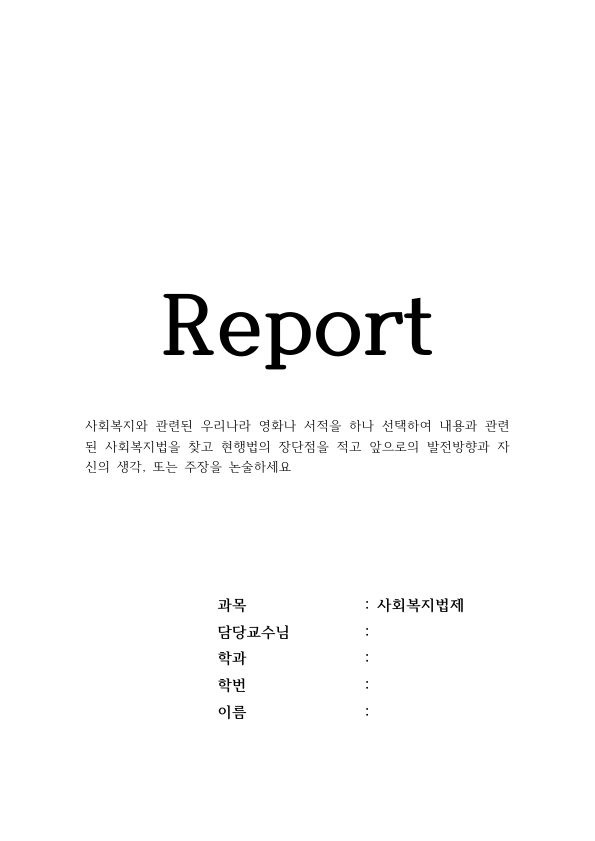
Page 1 is shown as is; from page 2 on, the preview is blurred. Buy it to download the complete original file right away (the file itself is written in Korean).
Packed with real examples and experience. Download it now and save time.
Save your valuable time
Buyer ratings
Fast, accurate and useful.
No ratings yet. Be the first to rate it.


The Film Silenced (Dogani) and Korean Welfare Law: The Inhwa School Case, the Dogani Act's Tougher Penalties and Abolished Time Limits
※ You can preview page 1 as is. Buy it to download the complete original file right away. The file itself is written in Korean.
■ The Film Silenced (Dogani) and Korean Welfare Law: The Inhwa School Case, the Dogani Act's Tougher Penalties and Abolished Time Limits — Overview
A 6-page Korean social welfare law paper built around the 2011 film Dogani (released in English as Silenced). It recounts the Inhwa School abuse case and the film's story, explains how the 2011 amendment to the Sexual Violence Punishment Act raised penalties, removed the statute of limitations and dropped the inability-to-resist requirement, and examines why cases with intellectually disabled victims still fail.
■ The Film Silenced (Dogani) and Korean Welfare Law: The Inhwa School Case, the Dogani Act's Tougher Penalties and Abolished Time Limits — Excerpt from the original document (English translation)
So let us look at the problems in welfare law exposed by Dogani and at the 'Dogani Act' passed to fix them. Rape was in principle an offense prosecutable only on complaint, meaning a crime that can be prosecuted only if the victim or another person specified by law files a complaint. The flaw is that young victims or victims with disabilities have almost no ability to file a complaint themselves. Without a suitable guardian, victims find it hard to obtain redress and offenders go unpunished. There was also a statute of limitations, so cases where time had run out could not be punished. And because sentences for sexual assault were light compared with violent crimes such as murder, offenders tended to take it lightly.
To overcome these problems, the 'Dogani Act' was passed. The amendment was debated and passed by the National Assembly and took effect on November 17, 2011. Under the amended law, minimum sentences for raping disabled people and children under 13 were sharply raised to 7 and 10 years, with life imprisonment as the maximum. The statute of limitations for rape of disabled women and children under 13 was also abolished. In addition, if the head or staff of a care or education facility for disabled people rapes a disabled person, the sentence is increased by up to one half. The provision that had been the basis for lenient sentences in sex crimes against disabled people, recognizing rape only when the victim was 'unable to resist,' was also removed. The old law described offenders as 'a person who has sexual intercourse with a woman or commits indecent acts on a person by taking advantage of a state of inability to resist due to physical or mental disability,' but this was changed to 'a person who commits rape against a woman with a physical or mental disability.' From August 2012, principals, teachers and others who sexually molest minors by abusing their position are also punished regardless of the victim's wishes.
However, this legislation is said to lack practical effect. As the sentences for sex crimes against disabled people rose under the amended law, the victim's burden of proof grew heavier, and in practice victims are required to give specific and precise testimony.
To add: the so-called Dogani Act, an amendment to the Act on Special Cases Concerning the Punishment of Sexual Crimes, passed the National Assembly on October 28, 2011 and took effect on November 17. Rape of a disabled person is punished by life imprisonment or at least seven years, and rape of a child under 13 by life imprisonment or at least ten years; the statute of limitations was removed and the inability-to-resist requirement deleted. The complaint requirement the paper criticizes was abolished for sex crimes in general from June 19, 2013. The Inhwa School victims' claims for state compensation were dismissed by the Seoul Central District Court on September 30, 2014.
■ The Film Silenced (Dogani) and Korean Welfare Law: The Inhwa School Case, the Dogani Act's Tougher Penalties and Abolished Time Limits — Contents and key concepts
A law changed by a film, and the victims it missed
✦ At a glance
- The film Dogani and the law it inspired
- Structure: case and film → old law → new law → limits
- Useful for social welfare law, disability studies and film-and-law courses
☰ What the paper covers
- The Inhwa School case
- Victims' testimony
- Inability-to-resist rule
- Tougher penalties
- Testimony of disabled victims
✎ Protecting disabled victims in Korea and the U.S.
Korea abolished the statute of limitations for rape of disabled people and children under 13 in 2011 and ended complaint-only sex crimes in 2013.
In the U.S., many states have lengthened or removed time limits for child sex abuse, and courts allow accommodations such as support persons for vulnerable witnesses.
Note: the paper itself is written in Korean and discusses Korean law. This page is general study information, not legal advice.
Related wiki: Americans with Disabilities Act (ADA)
Take a break with a quick personality test?
Ranked by actual participation. Results in about a minute.
Loading…
Most-read content
Loading view counts…

Campusdown is a lifelong-learning community in Korea offering study materials, information on government support, student loans and scholarships, and more. Don't miss our free resources.
Go to the Campusdown home page →Refund policy
- Change of mind / refund requested after partial use / more than 7 days after purchase
◆ Exceptions
- File errors / cannot download or open the file
◆ How to request a refund: send a 1:1 inquiry via Customer Service at the top