
Page 1 is shown as is; from page 2 on, the preview is blurred. Buy it to download the complete original file right away (the file itself is written in Korean).
Packed with real examples and experience. Download it now and save time.
Save your valuable time
Buyer ratings
Fast, accurate and useful.
No ratings yet. Be the first to rate it.


1 / 13
좌우로 밀어서 페이지를 넘겨보세요
과제 개요
| 전체 페이지 수 | 13페이지 |
|---|---|
| 파일 형식 | 한글(HWP) |
| 등록일 | 2025.08.06 |
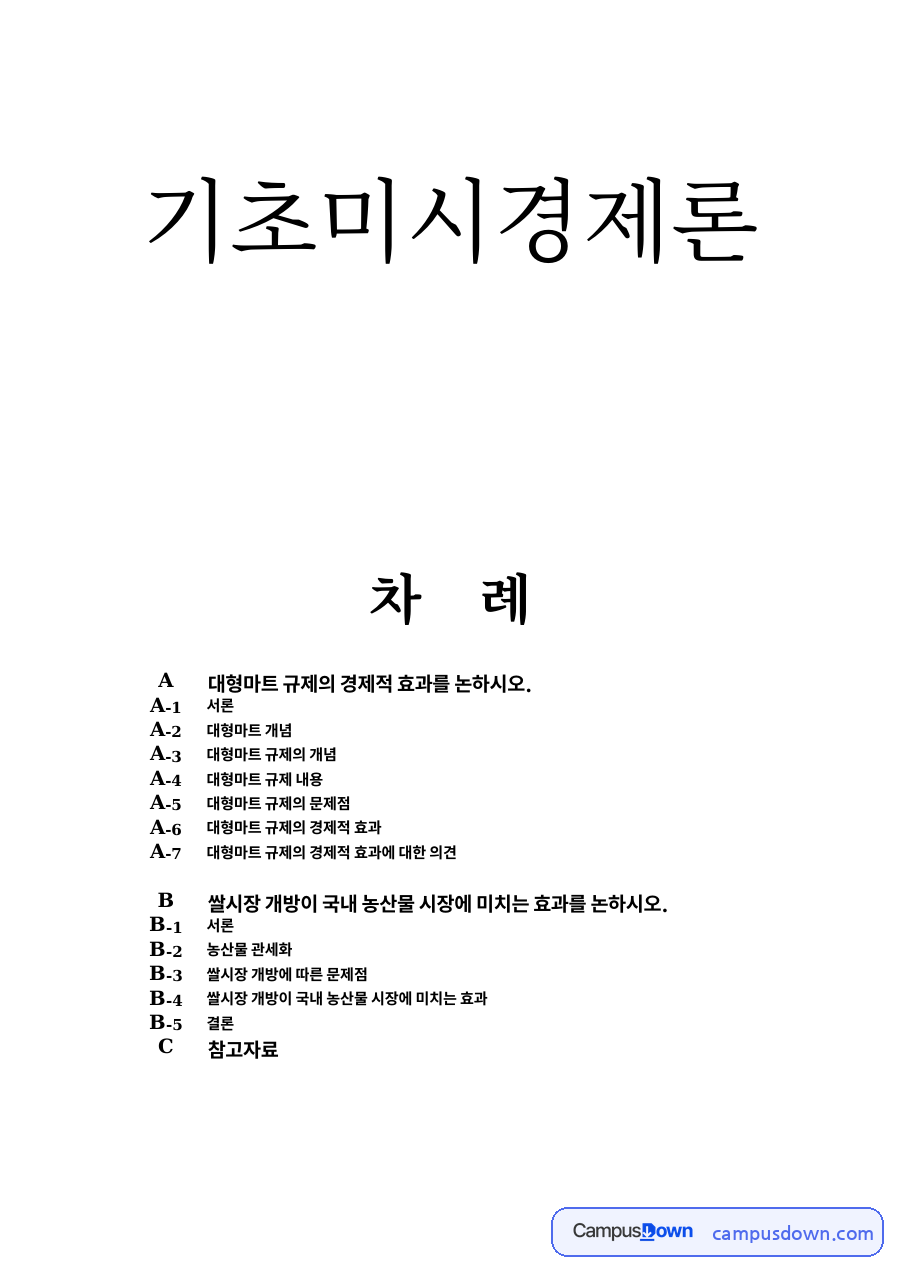
목차
- 1A
- 2대형마트 규제의 경제적 효과를 논하시오
- 3A-1
- 4서론
- 5A-2
- 6대형마트 개념
- 7A-3
- 8대형마트 규제의 개념
- 9A-4
- 10대형마트 규제 내용
- 11A-5
- 12대형마트 규제의 문제점
- 13A-6
- 14대형마트 규제의 경제적 효과
- 15A-7
- 16대형마트 규제의 경제적 효과에 대한 의견
- 17B
- 18쌀시장 개방이 국내 농산물 시장에 미치는 효과를 논하시오
- 19B-1
캠퍼스다운 도움말
해당 자료는 No AI 자료입니다. 인싸이트를 얻고 새롭게 가공해 보세요.
자료를 받아서 이용하면 품질이 확 올라갑니다.
- 대형마트 규제
- 유통산업발전법
- 의무휴업
- 영업시간 제한
- SSM
- 골목상권
- 전통시장
- 쌀 관세화
- 쌀시장 개방
- 형마트 규제의 경제적 효과
The Economic Effects of Korea's Big-Box Store Regulation and Rice Market Opening: Opening-Hour Limits, Mandatory Closing Days and Rice Tariffication
※ You can preview page 1 as is. Buy it to download the complete original file right away. The file itself is written in Korean.
■ The Economic Effects of Korea's Big-Box Store Regulation and Rice Market Opening: Opening-Hour Limits, Mandatory Closing Days and Rice Tariffication — Overview
A 6-page Korean microeconomics and regulation paper. It analyzes how the Distribution Industry Development Act's opening-hour limits and mandatory closing days for large discount stores hurt their sales without clearly reviving traditional markets, defines large stores and corporate supermarkets, and examines rice tariffication and its effects on Korean agriculture.
■ The Economic Effects of Korea's Big-Box Store Regulation and Rice Market Opening: Opening-Hour Limits, Mandatory Closing Days and Rice Tariffication — Excerpt from the original document (English translation)
A large discount store is defined as 'a group of stores with a total sales floor area of 3,000 square meters or more that sells mainly food, home appliances and household goods to consumers without the help of sales staff.' While the Distribution Industry Development Act defines large discount stores fairly clearly, the term SSM does not appear in it.
Scholars define SSMs in different ways. Under the Korean Standard Industrial Classification, SSMs fall under the division 'retail trade,' the group 'general retail,' the class 'general retail mainly of food and beverages,' and the subclass 'supermarkets.' According to the classification, a 'supermarket' is an activity in which a single operator runs a facility of a certain size (165 to 3,000 square meters)
and retails mainly food and beverages along with various household goods, excluding activities run as chain convenience stores.
Lawmakers from both ruling and opposition parties introduced many amendments to the Act on the Promotion of Mutually Beneficial Cooperation between Large Enterprises and SMEs (the 'Win-Win Act') and the Distribution Industry Development Act (the 'Distribution Act') to regulate large stores and SSMs. In April 2010, an amendment reconciled with other bills passed the bill review subcommittee of the Knowledge Economy Committee, but the Ministry of Foreign Affairs and Trade belatedly asked the Legislation and Judiciary Committee to hold off on the Win-Win Act amendment, so the amendments agreed by the parties and the government were not passed. The ministry argued that adding franchise chain stores to business adjustment under the Win-Win Act could breach WTO agreements and cause trade problems. Since regulating large stores and SSMs was meaningful only if both bills passed together, the passage of only the Distribution Act through the committee was controversial. The session ended without either amendment, so no regulation took shape. After the parties agreed to handle the two bills separately, the Distribution Act passed on November 10, 2010 and the Win-Win Act on November 25.
This created rules that restrict the registration of large stores and SSMs and bring franchise SSMs under business adjustment.
Local government heads were allowed to designate traditional commerce preservation zones within 500 meters of the boundary of a traditional market or shopping street.
Stores run directly by companies operating large stores or their affiliates, and stores run as franchise chains, were defined as quasi-large stores and brought under the Distribution Act. The registration system previously applied only to large stores was extended to quasi-large stores, requiring registration with the local government to open in a traditional commerce preservation zone, and local governments may by ordinance restrict or attach conditions to the registration of large and quasi-large stores in such zones.
To add: on November 19, 2015, the Supreme Court sitting en banc held that the opening-hour limits (midnight to 8 a.m.) and two mandatory closing days a month imposed by Seoul's Dongdaemun and Seongdong districts did not exceed or abuse discretion and were lawful (2015Du295). The 500-meter preservation zone the paper describes was widened to 1 kilometer by a 2011 amendment. The government announced rice tariffication in September 2014 and has applied a 513% tariff since January 2015. Studies disagree on how the store rules affected traditional market sales, and as online grocery shopping has grown, some local governments have moved mandatory closing days to weekdays. The paper's sales and import figures are as of the time of writing.
■ The Economic Effects of Korea's Big-Box Store Regulation and Rice Market Opening: Opening-Hour Limits, Mandatory Closing Days and Rice Tariffication — Contents and key concepts
Between a regulation's aim and its effects
✦ At a glance
- Big-box store rules and rice market opening in Korea
- Structure: store regulation and effects → rice tariffication
- Useful for microeconomics, regulatory policy and economic law courses
☰ What the paper covers
- Large stores and SSMs
- The 2010 amendments
- Opening-hour limits
- Costs of regulation
- Rice tariffication
✎ Retail zoning in Korea and the U.S.
Korea lets local governments limit large discount stores' hours and require two closing days a month, rules the Supreme Court upheld in 2015.
In the U.S., big-box stores are mainly regulated through local zoning and size caps rather than mandated closing days, and blue laws limiting Sunday trade survive only in a few places.
Note: the paper itself is written in Korean and discusses Korean law. This page is general study information, not legal advice.
Related wiki: Proportionality and Levels of Scrutiny
■ The Economic Effects of Korea's Big-Box Store Regulation and Rice Market Opening: Opening-Hour Limits, Mandatory Closing Days and Rice Tariffication References
- 대형마트 규제의 경제적 효과를 논하시오.
- 박근혜 대통령은 규제를 '암덩어리', '쳐부숴야할 원수'라하며 개혁의지를 강하게 어필했다. 하지만 예외도 있다. 그것이 바로 대형마트다. 2012년 대선을 앞두고 골목상권 보호가 핫이슈로 떠오른 후 대형마트는 줄곧 규제의 대상이 되어왔다.
- 유통업계에 따르면 2012년 이후 대형마트의 실적이 급속히 악화되어가고 있는 가운데 본래 규제도입 취지였던 골목상권에도 별다른 효과가 없는 것으로 나타나 이에 대한 재검토가 필요한 것으로 보이고 있다.
- 그러나 최근 서울시는 조례·규칙심의회를 열고 대형마트의 의무 휴무일을 동일한 날로 지정할 수 있는 내용의 조례안을 통과시키고 영업제한시간도 늘려 규제를 강화하고 있다.
- L마트는 비상경영체제 돌입을 선언하고 채용을 최소화하며 예산을 재검토를 하기도 했다. 경기불황과 각종 규제가 겹쳐 실적악화가 됐기 때문이다. L마트 뿐 아니다. 산업통산자원부에 따르면 대형마트 규제가 본격화된 이후 대형마트 3사 매출이 올해 1분기까지 8분기 연속 하락하고 있다. 전통시장이 살아난 것도 아니다. 조사한 결과 전통시장의 1일 평균 매출액도 2010년 4,980만원에서 2012년 4,502만원으로 9.5% 소폭 감소했다.
- 결국 대형마트 규제로 인해 이익을 볼 것이라 예상했던 골목상권은 대형마트에 납품하는 업체와 농가만 피해를 봤다는 분석이 나오고 있다.
- 대형마트가 일요일 의무휴업을 할 경우 전날 팔지 못한 물량은 사실상 폐기처분해야하기 떄문에 주문량 줄일 수밖에 없고 이는 각종 납품업체와 농가소득 감소로 이어지게 된 것이다. 서민경제를 살리겠다는 취지로 시작된 규제가 오히려 영세업체를 역차별한 부작용을 낳은 꼴이 됐다.
- 결과적으로 실효성 없이 피해자만 낳고 목적이 무색해 지고 있다.
- A-2. 대형마트의 개념
- 대형마트란 ‘매장면적의 합계가 3천 제곱미터 이상인 점포의 집단으로서 식품ㆍ가전 및 생활용품을 중심으로 점원의 도움 없이 소비자에게 소매하는 점포의 집단’이라고 규정하고 있다. 「유통법」상에 대형마트가 비교적 명확히 규정되어 있는 것과 달리 SSM이라는 표현은 나와 있지 않다.
- SSM이라는 용어자체도 학자마다 다양하게 정의하고 있다. SSM은 한국표준산업분류의 중분류 중 ‘소매업’에 해당하며, 소분류 ‘종합 소매업’, 세 분류 ‘음ㆍ식료품 위주종합 소매업’, 세세분류 ‘슈퍼마켓’의 항목에 분류되고 있다. 한국표준산업분류에 의하면 ‘슈퍼마켓’은 단일 경영주체가 일정 규모의 시설(165㎡-3,000㎡)을 갖추고
- 음ㆍ식료품을 위주로 하여 각종 생활 잡화 등을 함께 소매하는 산업 활동을 말하며 체인화 편의점의 형태로 운영하는 산업 활동을 제외한다고 정의되고 있다.
- A-3. 대형마트 규제의 개념
- 이로써 대형마트․SSM의 등록을 제한하고 가맹점형 SSM을 사업조정대상에 포함하는 규제가 형성되었다.
- A-4. 대형마트 규제 내용
- (가) 전통상업보존구역 지정
- 지방자치단체의 장은 지역 전통시장이나 전통상점가의 경계로부터 500m 이내의 범위에서 전통상업보존구역을 지정할 수 있도록 하였다.
- (나) 대형마트 등록제 강화
- 대규모점포를 경영하는 회사 또는 그 계열회사가 직영하는 점포 및 프랜차이즈형 체인사업의 형태로 운영하는 점포를 준대규모점포로 규정하여 「유통법」의 적용대상이 되도록 하였다. 이와 함께 대규모점포에만 적용되는 등록제를 확대하여 준대규모점포에도 적용하여 전통상업보존구역에 개설하려는 경우에 지방자치단체에 등록하도록 하며 지방자치단체가 조례를 정해 전통상업보존구역 내에 대규모점포 및 준대규모점포를 개설하고자 할 경우에 등록을 제한하거나 조건을 붙일 수 있도록 하였다.
- (다) 가맹점형 SSM에 대한 사업조정
- 대기업뿐만 아니라 직영점형 체인사업(체인본부가 주로 소매점포를 직영하되, 가맹계약을 체결한 일부 소매점포에 대하여 상품의 공급 및 경영지도를 계속하는 형태의 체인사업)및 프랜차이즈형 체인사업(독자적인 상품 또는 판매ㆍ경영 기법을 개발한 체인본부가 상호ㆍ판매방법ㆍ매장운영 및 광고방법 등을 결정하고, 가맹점으로 하여금 그 결정과 지도에 따라 운영하도록 하는 형태의 체인사업)을 사업조정 대상에 포함하였다.
- A-5. 대형마트 규제에 따른 문제점
- SSM에 대한 규제의 내용, 강도 등을 둘러싼 대형유통업체와 중소상인 간의 갈등 속에서 정부는 ‘사업조정제도’를 개정하여 이해당사자 간의 갈등을 해결하는 기제로 활용하도록 권고하였다. 하지만 사업조정제도는 무분별한 SSM 확산과 가맹점 형태의 변종 SSM 출현에 대하여 한계를 드러냈다.
- A-6. 대형마트 규제의 경제적 효과
- 첫째, 물가안정
- 대형마트의 독과점으로 인하여 주변상권이 몰락하면 상품 가격이 대형마트에 의해 좌지우지 될 위험이 크다. 이에 따른 피해는 소비자에게 돌아가고 경제상황을 더욱 악화시킬 수 있다. 대형마트 영업규제는 대형유통업체의 독과점을 방지하고 물가불안정의 위험을 줄이려는 노력이다.
- 둘째, 골목상권 활성화와 전통시장 보존
- 대형마트 영업시간 이외에는 소비자들이 재래시장에서 쇼핑을 하게 될 것이다.
- 대형마트로만 집중되던 소비자를 재래시장과 골목상권으로 분배하는 효과를 볼 수 있고, 이는 침체된 골목상권과 전통시장이 살아나는 긍정적인 결과로 이어질 것이다. 즉, 대형마트 영업규제는 지역자본의 역외유출을 방지하고 지역균형발전과 지역 공동체의 상생을 위한 조치이다.
- 재래시장이 대형마트와 좀 더 동등한 입장에서 경쟁하고 상생할 수 있도록 지원이 필요하다. 대형마트 영업규제는 재래시장의 영화계의 ‘스크린쿼터’와 같은 시스템이다.
- 셋째, 납품업체 보호와 대형마트 직원들의 환경 개선
- 대형유통업체의 출혈경쟁은 납품업체의 희생이 뒤따른다. 대형유통업체도 경쟁을 위해 마진을 낮추든지 마케팅비용을 과다 지급하든 하겠지만 결국에는 가격정책은 협력업체의 납품대금을 낮추는 쪽으로 진행된다.
- 경쟁 대형유통업체가 24시간 영업하면 인근 경쟁업체도 24시간 영업하게 되고, 이에 따라 직원들의 업무시간도 달라진다. 이는 삶의 질의 하락과 업무의 만족도를 저하시키는 결과를 초래할 것이다. 강제휴무를 통해 직원들에게 휴식의 기회를 제공함으로써 생산성 향상을 꾀할 수 있다.
- A-7. 대형마트 규제의 경제적 효과에 대한 의견
- 지역네트워크로 사회안전망
- 문화 오락과 편의의 복합 공간
- 제품 품질과 서비스 등이 더 이상 소비자들의 유일한 점포선택 요인이 될 수 없다. 따라서 현재는 가격, 품질, 서비스 외에 다양한 니즈를 충족시킬 수 있는 다양한 요소들을 제공함으로 고객에게 새로운 가치를 제공하는 것이 비중 있는 사업 방식으로 자리 잡았다. 새로운 쇼핑 공간, 편리성, 라이프스타일과 조화, 개성의 추구 등 소비자에게 실질적 도움을 줄 수 있는 즉, 영업외에 요구되는 가치치중의 사업방향으로 확대해 가고 있다. 최근 등장하고 있는 엔터테인먼트 쇼핑몰의 경우 소비자들의 다양한 욕구를 원 스톱 방식으로 충족시킬 수 있는 퓨전 형 업태를 표방하는 사례가 이것을 입증해 준다. 즉, 쇼핑, 비즈니스, 오락 기능을 한 자리에 모은다.
- 특히 엔터테인먼트에 초점을 두어 소비자들의 흥미와 관심을 유발함은 물론 집객 고객들로 하여금 ‘즐거움’을 통한 쇼핑욕구를 자극함으로써 매출 증대에도 효과를 가져 온다는 전략이다. 소비자들은 보다 다양한 서비스를 원하고 있으며, 단순한 멀티기능의 집합이 아니라 고객에게 진정한 가치를 제공하는 복합기능이 결합된 신개념의 쇼핑몰이 되어야 할 것이다.
- 대형마트의 사회 공헌 프로그램
- 대형마트는 경쟁구도 속에 얼마만큼 지역에 공헌사업을 하고 친화적 운영을 하느냐, 기업이 내부적으로 얼마만큼 윤리 경영을 하느냐에 따라 경쟁의 우위가 달라진다고 할 수 있다. 각 대형마트들은 기업차원의 사회공헌 활동과 봉사 활동의 출발점은 지역사회 친화적 관계이며, 지역친화 정도에 따라 기업의 성장기반이 된다는 점을 충분히 인지하고 있다.
Keyword Prompt
전문가가 만들었어요과제를 직접 쓰는 데 도움이 되는 영어 프롬프트예요.
Tip! Prompt 에 자신의 생각을 추가해서 하면 훨씬 더 ✨ 좋습니다.
캠퍼스다운에서 레포트 받고 잘 쓰는 법 3가지, AI로 참고자료 제대로 재가공하기 →Prompt 1
I'm writing a university assignment on "대형마트 규제의 경제적 효과와 쌀시장 개방: 유통산업발전법의 영업시간 제한·의무휴업, 골목상권 효과 논쟁, 쌀 관세화". Help me build an outline (introduction, 2-3 body sections, conclusion) that covers 대형마트 규제, 유통산업발전법 and 의무휴업. Don't write the paper for me - give me guiding questions for each section. My own perspective: [자신의 생각 넣는 곳] Please respond in Korean.
Prompt 2
Explain the key concepts "대형마트 규제" and "유통산업발전법" in simple terms, then show how they connect to the topic "대형마트 규제의 경제적 효과와 쌀시장 개방: 유통산업발전법의 영업시간 제한·의무휴업, 골목상권 효과 논쟁, 쌀 관세화". Point out common misunderstandings students have about them. My own perspective: [자신의 생각 넣는 곳] Please respond in Korean.
Prompt 3
Suggest 3 real-world cases or examples I could analyze in an assignment on "대형마트 규제의 경제적 효과와 쌀시장 개방: 유통산업발전법의 영업시간 제한·의무휴업, 골목상권 효과 논쟁, 쌀 관세화", focusing on "의무휴업". For each, tell me what I should look up and verify in official or academic sources. My own perspective: [자신의 생각 넣는 곳] Please respond in Korean.
Prompt 4
Review my draft paragraph on "대형마트 규제의 경제적 효과와 쌀시장 개방: 유통산업발전법의 영업시간 제한·의무휴업, 골목상권 효과 논쟁, 쌀 관세화" (key idea: "영업시간 제한"). Give feedback on logic, evidence and clarity, and mark where I need a citation. My paragraph: [paste here] My own perspective: [자신의 생각 넣는 곳] Please respond in Korean.
Take a break with a quick personality test?
Ranked by actual participation. Results in about a minute.
Loading…
Most-read content
Loading view counts…

Campusdown is a lifelong-learning community in Korea offering study materials, information on government support, student loans and scholarships, and more. Don't miss our free resources.
Go to the Campusdown home page →Refund policy
- Change of mind / refund requested after partial use / more than 7 days after purchase
◆ Exceptions
- File errors / cannot download or open the file
◆ How to request a refund: send a 1:1 inquiry via Customer Service at the top