
Page 1 is shown as is; from page 2 on, the preview is blurred. Buy it to download the complete original file right away (the file itself is written in Korean).
Packed with real examples and experience. Download it now and save time.
Save your valuable time
Buyer ratings
Fast, accurate and useful.
No ratings yet. Be the first to rate it.


The Debate over Mandatory CCTV in Operating Rooms in Korea: Arguments Against, Privacy and Wiretap Issues, and the Duty to Explain
※ You can preview page 1 as is. Buy it to download the complete original file right away. The file itself is written in Korean.
■ The Debate over Mandatory CCTV in Operating Rooms in Korea: Arguments Against, Privacy and Wiretap Issues, and the Duty to Explain — Overview
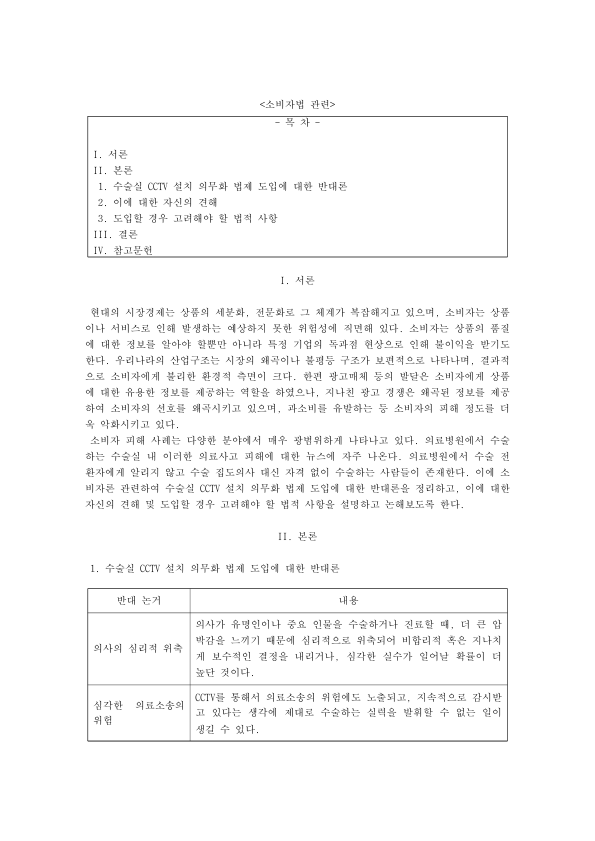
A 5-page Korean consumer and medical law paper. It sets out the arguments against requiring CCTV in operating rooms, such as pressure on surgeons and defensive medicine, argues that strengthening the duty to explain and the ban on ghost surgery is a better answer, and reviews the privacy, recording and patient self-determination issues of adoption.
■ The Debate over Mandatory CCTV in Operating Rooms in Korea: Arguments Against, Privacy and Wiretap Issues, and the Duty to Explain — Excerpt from the original document (English translation)
Article 24(1) of the Protection of Communications Secrets Act provides that no one may 'record conversations between others or listen to them using electronic or mechanical devices.' The Seoul Central District Court has held that 'where secret recording serves a legitimate purpose or interest, is done in an appropriate way within the necessary scope, and can be judged acceptable in light of social ethics or common sense, it does not violate social norms and its illegality is excused.'
Legal questions arise when a patient's right to self-determination, that is, the patient's free decision based on the doctor's full explanation, is excluded or omitted in medical treatment. Medical treatment based on doctors' expertise was traditionally justified by paternalism, but the debate has shifted with the patient's consent as an expression of self-determination. Medical laws require doctors to give a full explanation to patients who can make decisions and to respect their choices, but doctors have no duty to explain where delaying surgery would endanger the patient's life or cause serious physical or mental harm, or where the patient is unconscious. Because the presence of self-determination secures the legitimacy of treatment, a decision grounded in the patient's decision-making capacity and autonomy is an important standard for a valid exercise of that right.
As a standard for judging whether a patient's consent is valid, capacity means the mental ability to understand reasonably the meaning and consequences of one's own decision, at least to the degree of understanding the meaning, content and risks of an invasive procedure and judging what results it may bring. Understanding the explanation also requires the ability to grasp the information the doctor provides and weigh the invasion against the prospects of recovery. Because an individual's decision-making capacity cannot be assessed from outside, the doctor who explains bears the duty to explain in light of the seriousness of the treatment.
As for patients lacking capacity, when an emergency patient cannot make decisions, emergency medical staff must explain the emergency care to the legal representative and obtain consent under Article 9(2) of the Emergency Medical Service Act. If no legal representative is present, they may explain to a companion such as a friend or colleague and provide emergency care based on medical judgment, and if consent cannot be obtained from the legal representative but emergency care is judged essential, they may proceed with the consent of at least one other medical professional.
To add: after the debate this paper covers, a September 2021 amendment to the Medical Service Act created Article 38-2, in force since September 25, 2023. Medical institutions that operate on patients who are unconscious, for example under general anesthesia, must install CCTV in their operating rooms and must record surgery when the patient or guardian asks. They may refuse in cases such as emergency surgery, high-risk surgery or where recording would seriously hinder resident training. Footage must be kept for at least 30 days and may be viewed or provided only in limited cases, such as a request from investigative agencies or the consent of the patient and all participating medical staff. Doctors' groups filed a constitutional complaint just before the law took effect. The provision of the Protection of Communications Secrets Act the paper cites, banning the recording of and listening to others' conversations, is Article 14(1), not Article 24.
■ The Debate over Mandatory CCTV in Operating Rooms in Korea: Arguments Against, Privacy and Wiretap Issues, and the Duty to Explain — Contents and key concepts
Patient safety or surgeons' rights?
✦ At a glance
- The debate over CCTV in Korean operating rooms
- Structure: problem → arguments against → author's view → legal issues
- Useful for medical law, consumer law and debate courses
☰ What the paper covers
- Ghost surgery and patient harm
- Five arguments against
- Duty to explain
- Privacy and wiretap law
- Patient self-determination
✎ Operating room cameras in Korea and the U.S.
Since September 2023, Korean hospitals that operate on unconscious patients must install CCTV and record surgery when the patient or guardian asks, with exceptions such as emergencies.
The U.S. has no federal mandate, and bills requiring operating room video have been proposed in some states without becoming widespread law.
Note: the paper itself is written in Korean and discusses Korean law. This page is general study information, not legal advice.
Related wiki: The Right to Privacy
Related wiki: Medical Malpractice
■ The Debate over Mandatory CCTV in Operating Rooms in Korea: Arguments Against, Privacy and Wiretap Issues, and the Duty to Explain References
- 변지훈. "CCTV의 활용 및 한계에 관한 법적 연구." 국내석사학위논문 동국대학교 대학원, 2020.
- 서울 전현욱 ( Chun¸ Hyun-wook ).
- "수술실 내 CCTV 설치에 관한 규범적 검토." 33.1 (2021): 181-208.
- 김성은,최아름,and 백경희. "수술실 CCTV 설치의 쟁점과 입법방향에 관한 소고()." 의료법학 22.2 (2021): 111-138.
Take a break with a quick personality test?
Ranked by actual participation. Results in about a minute.
Loading…
Most-read content
Loading view counts…

Campusdown is a lifelong-learning community in Korea offering study materials, information on government support, student loans and scholarships, and more. Don't miss our free resources.
Go to the Campusdown home page →Refund policy
- Change of mind / refund requested after partial use / more than 7 days after purchase
◆ Exceptions
- File errors / cannot download or open the file
◆ How to request a refund: send a 1:1 inquiry via Customer Service at the top