
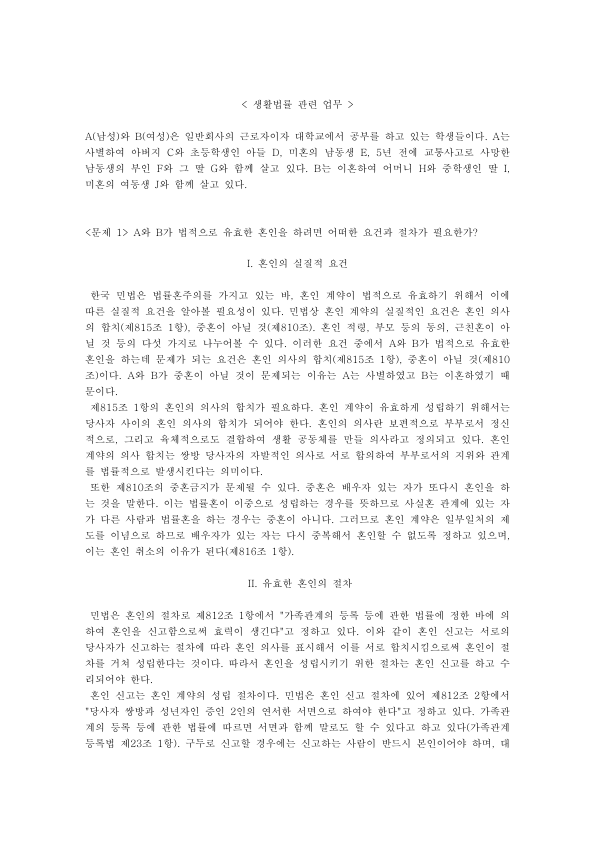
Page 1 is shown as is; from page 2 on, the preview is blurred. Buy it to download the complete original file right away (the file itself is written in Korean).
Packed with real examples and experience. Download it now and save time.
Save your valuable time
Buyer ratings
Fast, accurate and useful.
No ratings yet. Be the first to rate it.
Ten Everyday Law Case Problems in Korea: Marriage Requirements, In-Laws, Full Adoption, Inheritance, Minimum Wage, Leave, Harassment, Unions and Social Insurance
※ You can preview page 1 as is. Buy it to download the complete original file right away. The file itself is written in Korean.
■ Ten Everyday Law Case Problems in Korea: Marriage Requirements, In-Laws, Full Adoption, Inheritance, Minimum Wage, Leave, Harassment, Unions and Social Insurance — Overview
A 7-page Korean everyday law case paper. Built around a remarried couple living with both extended families, it answers ten questions on the requirements and registration of marriage, in-law relationships, full adoption of a stepchild, inheritance, minimum wage and weekly holiday pay, parental and care leave, workplace sexual harassment, forming a union and social insurance.
■ Ten Everyday Law Case Problems in Korea: Marriage Requirements, In-Laws, Full Adoption, Inheritance, Minimum Wage, Leave, Harassment, Unions and Social Insurance — Excerpt from the original document (English translation)
Because Korean civil law follows the principle of legal marriage, it is necessary to examine the substantive requirements for a marriage to be legally valid. The substantive requirements under the Civil Act can be divided into five: agreement to marry (Article 815(1)), no bigamy (Article 810), marriageable age, consent of parents where required, and no marriage between close relatives. Of these, the requirements at issue for A and B are agreement to marry and no bigamy. Bigamy is an issue because A was widowed and B divorced.
Agreement to marry under Article 815(1) is required. For a marriage to be validly formed, the parties must agree to marry. The intention to marry is generally defined as the intention to form a life community as spouses, joined emotionally and physically. Agreement means that both parties voluntarily agree to create the legal status and relationship of husband and wife.
The ban on bigamy in Article 810 may also be an issue. Bigamy means that a person who already has a spouse marries again. Because it refers to two legal marriages existing at once, a person in a de facto marriage who legally marries someone else does not commit bigamy. Since marriage is based on monogamy, a person with a spouse may not marry again, and doing so is a ground for annulment (Article 816(1)).
As for the procedure, Article 812(1) of the Civil Act provides that marriage 'takes effect upon reporting it as prescribed by the Act on the Registration of Family Relationships.' The marriage report is thus the procedure through which both parties express and join their intention to marry. To form a marriage, a report must be filed and accepted.
The marriage report is the procedure that forms the marriage. Article 812(2) requires it to be 'made in writing signed by both parties and two adult witnesses.' Under the Act on the Registration of Family Relationships, a report may also be made orally (Article 23(1)). An oral report must be made in person, and reporting through an agent is not allowed (Article 31(3)).
The marriage report is completed when the family registration official accepts it. The official has only the power of formal review, not substantive review. Once the report is accepted, the marriage is formed retroactively from the time of filing. Even if an accepted report is not entered in the family relationship register or is entered incorrectly, the marriage is validly formed.
Once a marriage report is accepted, the marriage takes effect even if it breaches the law. Only where certain defects exist can a party claim that the marriage is void or seek its annulment.
To add: a 2012 amendment to the Civil Act, in force since July 1, 2013, widened eligibility for full adoption from children 'under 15' to all minors, so the paper's age-15 limit is out of date. To fully adopt a spouse's child, the couple must have been married for at least one year. Leave to care for a sick parent should be requested as family care leave under the Equal Employment Opportunity and Work-Family Balance Assistance Act (up to 90 days a year), not 'sick leave' as the paper says. The minimum wage should be checked against the amount announced each year, not the paper's 2016 figure of 6,030 won an hour. For the 65-year-old mother to receive long-term care, basic livelihood benefits or the basic pension, she must meet each program's care grade or income and asset criteria.
■ Ten Everyday Law Case Problems in Korea: Marriage Requirements, In-Laws, Full Adoption, Inheritance, Minimum Wage, Leave, Harassment, Unions and Social Insurance — Contents and key concepts
The legal relationships of one family
✦ At a glance
- Ten everyday law questions built around one Korean family
- Structure: marriage → family → adoption → inheritance → work → social insurance
- Useful for everyday law and introduction to law courses
☰ What the paper covers
- Marriage requirements
- In-laws and relatives
- Full adoption
- Wages and leave
- Harassment, unions, insurance
✎ Blended families in Korea and the U.S.
In Korea, remarriage makes a stepchild an in-law only, and inheritance rights require formal adoption.
In the U.S., stepparent adoption is also needed for a stepchild to inherit by default, and the rules vary by state.
Note: the paper itself is written in Korean and discusses Korean law. This page is general study information, not legal advice.
Related wiki: Minimum Wage and Overtime Law, Marriage Law in the U.S.
Related wiki: Intestate Succession
Take a break with a quick personality test?
Ranked by actual participation. Results in about a minute.
Loading…
Most-read content
Loading view counts…

Campusdown is a lifelong-learning community in Korea offering study materials, information on government support, student loans and scholarships, and more. Don't miss our free resources.
Go to the Campusdown home page →Refund policy
- Change of mind / refund requested after partial use / more than 7 days after purchase
◆ Exceptions
- File errors / cannot download or open the file
◆ How to request a refund: send a 1:1 inquiry via Customer Service at the top