
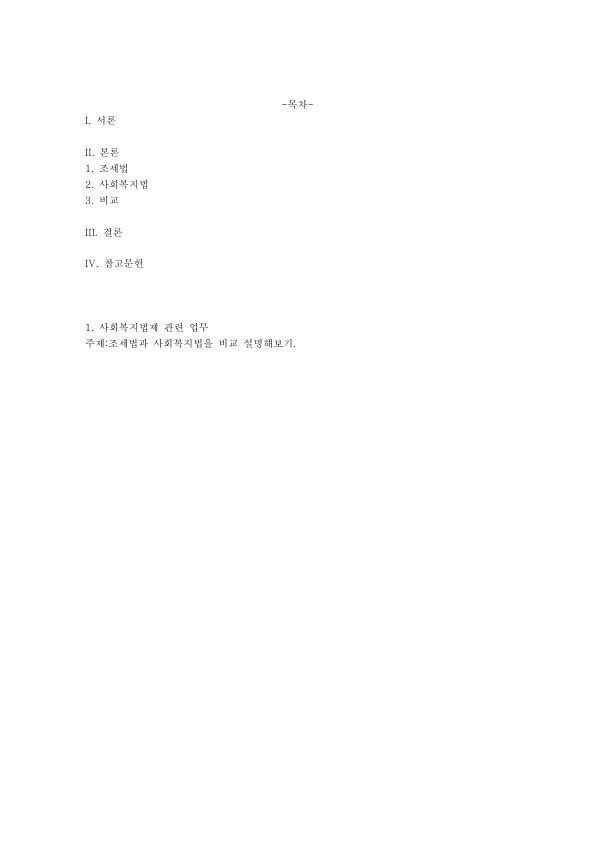
Page 1 is shown as is; from page 2 on, the preview is blurred. Buy it to download the complete original file right away (the file itself is written in Korean).
Packed with real examples and experience. Download it now and save time.
Save your valuable time
Buyer ratings
Fast, accurate and useful.
No ratings yet. Be the first to rate it.


Tax Law vs. Social Welfare Law in Korea: Public Law, Private Law and Social Law, the No Taxation Without Law Principle, and the Rise of Social Law
※ You can preview page 1 as is. Buy it to download the complete original file right away. The file itself is written in Korean.
■ Tax Law vs. Social Welfare Law in Korea: Public Law, Private Law and Social Law, the No Taxation Without Law Principle, and the Rise of Social Law — Overview
A 4-page Korean social welfare law paper comparing tax law and social welfare law. It explains the public law and private law divide, the rise of social law as a third field after industrialization and the Weimar Constitution, how Korean tax law is organized, and why tax law sits in public law while welfare law belongs to social law.
■ Tax Law vs. Social Welfare Law in Korea: Public Law, Private Law and Social Law, the No Taxation Without Law Principle, and the Rise of Social Law — Excerpt from the original document (English translation)
Social welfare law belongs to social law, and social law is a mixture of public and private law, a law in which the state intervenes in individuals' lives and sets out relationships of rights and duties. This was originally the domain of private law, where the state should not intervene, but the state came to intervene to protect the socially vulnerable and to guarantee substantive equality. That is why social law has the characteristic of making private law public. Moreover, these laws appeared mainly in the era of monopoly capitalism, when laws that had dealt with horizontal relationships between individuals could no longer maintain those horizontal relationships as the economically weak emerged. Workers, who are economically weak, receive unequal treatment from companies, and consumers easily suffer unfair harm, and social law is what emerged to look after them.
Also, the most fundamental difference concerns the field: the most notable difference is that tax law is a law about money and debts, while social welfare law is a law about welfare. In that respect, the fact that both operate between the relationships of individuals can rather be called a point in common.
To look at tax law and social welfare law, I had to know the concepts of public law and private law, and the two clearly differed in what they cover. In contrast, I learned that social law, which mixes the two, has the characteristics of both fields. The fact that the Constitution, the law most familiar to us, belongs to public law and that laws about us as individuals belong to private law is something basically everyone would know, but I felt that the concept of social law, which lies between those two lines, needs to be organized again for all of us, because social law is what best considers and cares for our position. Labor law, social security law and economic law, which we encounter and can use most, all belong to social law, just like social welfare law discussed above.
To add: the principle of no taxation without law rests on Article 38 (duty to pay taxes) and Article 59 (types and rates of taxes are set by law) of the Constitution, and it is made concrete through statutory specification of taxation requirements, clarity, and the ban on retroactive taxation. On the social welfare side, the Framework Act on Social Security enacted in 1995 divides social security into social insurance, public assistance and social services. The two fields meet in compulsory charges collected under law, such as national pension and health insurance premiums, and in welfare benefits paid through tax law, such as the earned income tax credit, so using these points of contact as examples makes the comparison richer.
■ Tax Law vs. Social Welfare Law in Korea: Public Law, Private Law and Social Law, the No Taxation Without Law Principle, and the Rise of Social Law — Contents and key concepts
Is welfare law public law, private law, or something else?
✦ At a glance
- Tax law vs. welfare law by legal field
- Structure: legal fields → tax law → social law → comparison
- Useful for social welfare law and intro to law courses
☰ What the paper covers
- Public law, private law and social law
- Korean tax law system
- Origins of social law
- Comparison of the two
- Author's conclusion
✎ The comparison in Korea and the U.S.
Korea's Constitution requires taxes to be set by statute (Articles 38 and 59) and guarantees a right to a decent life (Article 34), so both fields start from the Constitution.
In the U.S., the two often meet in the tax code itself: the Earned Income Tax Credit delivers a large anti-poverty benefit through the IRS rather than a welfare agency.
Note: the paper itself is written in Korean and discusses Korean law. This page is general study information, not legal advice.
Related wiki: Public Assistance Programs
■ Tax Law vs. Social Welfare Law in Korea: Public Law, Private Law and Social Law, the No Taxation Without Law Principle, and the Rise of Social Law References
- 한국 사회복지법 강의 / 박차상, 정상양 조세법총론 / 김병욱, 박승재
Take a break with a quick personality test?
Ranked by actual participation. Results in about a minute.
Loading…
Most-read content
Loading view counts…

Campusdown is a lifelong-learning community in Korea offering study materials, information on government support, student loans and scholarships, and more. Don't miss our free resources.
Go to the Campusdown home page →Refund policy
- Change of mind / refund requested after partial use / more than 7 days after purchase
◆ Exceptions
- File errors / cannot download or open the file
◆ How to request a refund: send a 1:1 inquiry via Customer Service at the top