
Page 1 is shown as is; from page 2 on, the preview is blurred. Buy it to download the complete original file right away (the file itself is written in Korean).
Packed with real examples and experience. Download it now and save time.
Save your valuable time
Buyer ratings
Fast, accurate and useful.
No ratings yet. Be the first to rate it.


Succession Writs and Compulsory Auctions in Korea: When an Heir Enforces a Final Judgment, and the Subjective Scope of Enforceability
※ You can preview page 1 as is. Buy it to download the complete original file right away. The file itself is written in Korean.
■ Succession Writs and Compulsory Auctions in Korea: When an Heir Enforces a Final Judgment, and the Subjective Scope of Enforceability — Overview
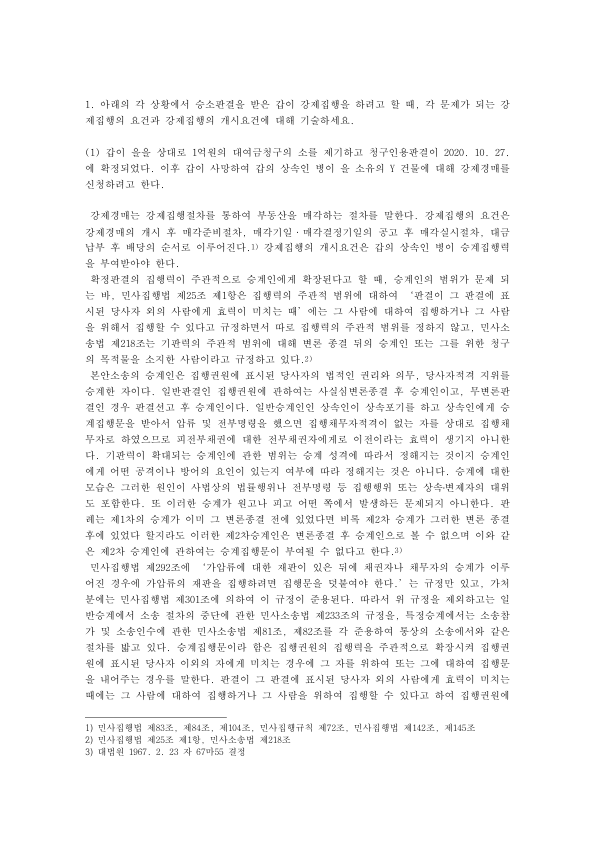
A 2-page Korean civil execution law study note built on one scenario: a creditor wins a final judgment for a 100 million won loan, then dies, and the heir wants to seek a compulsory auction of the debtor's building. It outlines the auction steps, explains that the heir must obtain a succession execution clause (seunggye jiphaengmun), and links the subjective scope of enforceability (Civil Execution Act Article 25) with that of res judicata (Civil Procedure Act Article 218), including a 1967 Supreme Court ruling on second-step successors.
■ Succession Writs and Compulsory Auctions in Korea: When an Heir Enforces a Final Judgment, and the Subjective Scope of Enforceability — Excerpt from the original document (English translation)
A successor in the main lawsuit is a person who has succeeded to the legal rights and obligations and the standing as a party of the party indicated in the title of execution. For a title of execution that is an ordinary judgment, it is a successor after the close of pleadings at the fact-finding instance; for a judgment without pleadings, it is a successor after the judgment is pronounced. If an heir who is a general successor renounces the inheritance and a seizure and assignment order is obtained after receiving a writ of execution for succession against that heir, the execution has been taken against a person who lacks standing as the execution debtor, so the effect of transferring the assigned claim to the assignee creditor does not arise. The scope of successors to whom res judicata extends is determined by the nature of the succession, not by whether the successor has any grounds for attack or defense. The forms of succession include causes such as juristic acts under private law, acts of execution such as assignment orders, inheritance, and subrogation by a person who has made performance. It also does not matter whether the succession occurs on the plaintiff's or the defendant's side.
For reference, the provision underlying the writ of execution for succession is Article 31 of the Civil Execution Act, which provides that a writ of execution may be issued for a successor of the creditor indicated in the judgment, or for execution against a successor of the debtor, only where the succession is evident to the court or is proven by a certificate. To start execution with a writ of execution for succession, under Article 39(2) of the same Act the writ of execution and a copy of the certificate must also be served in advance or at the same time, so mentioning this when writing about the requirements for commencement makes an answer solid. Also confirm that, where there are several heirs, each succeeds according to their share of the inheritance.
■ Succession Writs and Compulsory Auctions in Korea: When an Heir Enforces a Final Judgment, and the Subjective Scope of Enforceability — Contents and key concepts
Can an heir enforce a judgment won by a deceased creditor?
✦ At a glance
- Enforcing a judgment through a succession execution clause
- Structure: auction steps → requirements → subjective scope → case law
- Useful for civil execution and civil procedure assignments
☰ What the paper covers
- The scenario and the compulsory auction process
- Requirements to start enforcement
- Successors after the close of argument
- Successors in provisional attachment and injunctions
✎ Enforcement titles and execution clauses in Korea
Korean enforcement requires an enforcement title such as a final judgment plus an execution clause issued by the court. If a party has changed, a succession clause is issued only when the succession is obvious to the court or proven by documents.
This is roughly comparable to substituting a successor or reviving a judgment before a U.S. writ of execution issues, though procedures differ by state.
Note: the paper itself is written in Korean and discusses Korean law. This page is general study information, not legal advice.
Related wiki: Res Judicata, Possessory Lien
■ Succession Writs and Compulsory Auctions in Korea: When an Heir Enforces a Final Judgment, and the Subjective Scope of Enforceability References
- 박흥원, 2019,강제집행 절차에 있어서 채권자 및 채무자 보호의 비교법적 연구, 호서대학교 대학원, 국내박사 김용길, 2019, 부동산공매의 제도적 개선방안 : - 부동산경매제도와의 비교를 중심으로 -, 명지대학교 부동산대학원, 국내석사 윤현욱, 2018, 부동산경매절차에서 배당이익 조정 및 불복방법에 관한 연구, 고려대학교 법무대학원, 국내석사
Take a break with a quick personality test?
Ranked by actual participation. Results in about a minute.
Loading…
Most-read content
Loading view counts…

Campusdown is a lifelong-learning community in Korea offering study materials, information on government support, student loans and scholarships, and more. Don't miss our free resources.
Go to the Campusdown home page →Refund policy
- Change of mind / refund requested after partial use / more than 7 days after purchase
◆ Exceptions
- File errors / cannot download or open the file
◆ How to request a refund: send a 1:1 inquiry via Customer Service at the top