
Page 1 is shown as is; from page 2 on, the preview is blurred. Buy it to download the complete original file right away (the file itself is written in Korean).
Packed with real examples and experience. Download it now and save time.
Save your valuable time
Buyer ratings
Fast, accurate and useful.
No ratings yet. Be the first to rate it.


1 / 9
좌우로 밀어서 페이지를 넘겨보세요
과제 개요
| 전체 페이지 수 | 9페이지 |
|---|---|
| 파일 형식 | 한글(HWP) |
| 등록일 | 2025.07.21 |
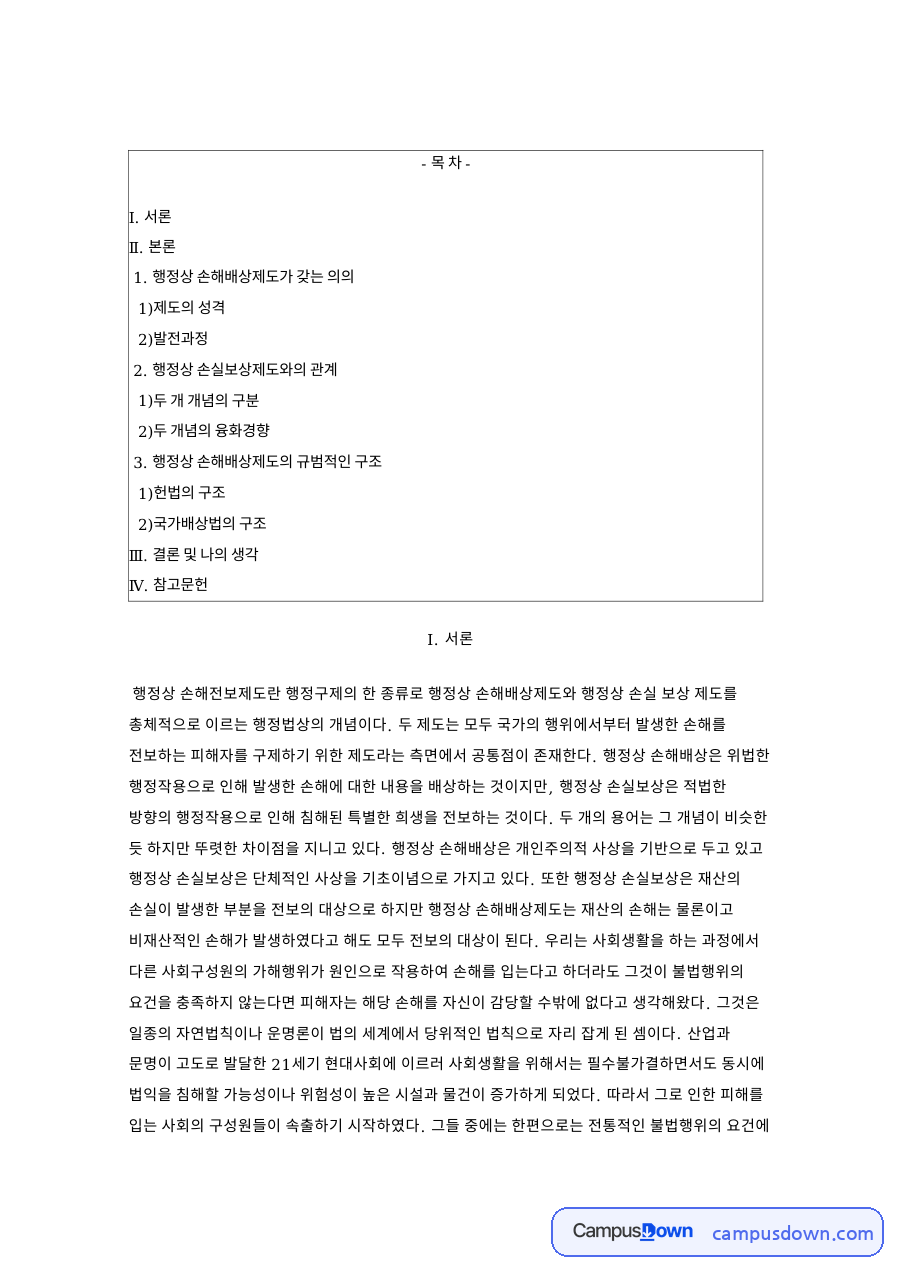
목차
- 1Ⅰ. 서론
- 2Ⅱ. 본론
- 2.11. 행정상 손해배상제도가 갖는 의의
- 2.21)제도의 성격
- 2.32)발전과정
- 2.42. 행정상 손실보상제도와의 관계
- 2.51)두 개 개념의 구분
- 2.62)두 개념의 융화경향
- 2.73. 행정상 손해배상제도의 규범적인 구조
- 2.81)헌법의 구조
- 2.92)국가배상법의 구조
- 3Ⅲ. 결론 및 나의 생각
- 4Ⅳ. 참고문헌
캠퍼스다운 도움말
해당 자료는 No AI 자료입니다. 인싸이트를 얻고 새롭게 가공해 보세요.
자료를 받아서 이용하면 품질이 확 올라갑니다.
- 행정법
- 행정구제
- 행정상 손해배상
- 행정상 손실보상
- 국가배상법
- 국가배상청구권
- 헌법 제29조
- 영조물 책임
- 이중배상금지
- 발전과정
State Compensation for Damages in Korean Administrative Law: The State Compensation Act, Loss Compensation and Comparative History
※ You can preview page 1 as is. Buy it to download the complete original file right away. The file itself is written in Korean.
■ State Compensation for Damages in Korean Administrative Law: The State Compensation Act, Loss Compensation and Comparative History — Overview
An 8-page Korean administrative law report on administrative compensation for damages. It distinguishes damages for unlawful administrative acts from loss compensation for lawful acts, traces how state liability developed in France (the Blanco decision), Germany (Weimar Constitution and Basic Law Article 34), the United States (Federal Tort Claims Act 1946) and the United Kingdom (Crown Proceedings Act 1947), and explains Article 29 of the Korean Constitution and the State Compensation Act, including liability for public officials' unlawful acts, defects in public facilities, the ban on double compensation and the order in which laws apply.
■ State Compensation for Damages in Korean Administrative Law: The State Compensation Act, Loss Compensation and Comparative History — Excerpt from the original document (English translation)
This chapter considers the status of the State Compensation Act. First of all, the State Compensation Act has the status of a general law under which the state or local governments bear liability for torts. Article 8 of the State Compensation Act states: "With respect to the liability of the state or local governments for damages, the Civil Act shall apply except as provided in this Act; however, where other statutes besides the Civil Act have different provisions, those provisions shall apply," making clear that the Act has the character of a general law only for compensation arising from public administrative actions. Accordingly, if there is a related special law, that law applies first; if no special law exists, the State Compensation Act applies; and for matters judged not to be provided for in the State Compensation Act, the Civil Act supplements it. In conclusion, therefore, the order of laws applied to the concept of state compensation can be explained as special laws, then the State Compensation Act, then the Civil Act.
The holders of the right to claim state compensation are Korean nationals and foreigners. First, regarding nationals: the holder of the right to claim damages is a national who has suffered personal damage due to the unlawful performance of official duties. In this case, nationals include natural persons and legal persons with Korean nationality. The second holders, foreigners and foreign legal persons, are characterized by being subject to the principle of reciprocity. In particular, for foreigners, the State Compensation Act applies only where there is a mutual guarantee, under Article 7 of the Constitution. A mutual guarantee here means that, if a Korean suffers damage in the victim foreigner's home country, the Korean must likewise be able to claim damages in that country. Article 23(5) of the Korea-US Status of Forces Agreement provides that, even for acts occurring while members or employees of the U.S. armed forces stationed in Korea, or members of the Korean Augmentation to the United States Army (KATUSA), are performing official duties, appropriate compensation can be claimed from the Korean government under the procedures of the State Compensation Act.
(1) Liability for damages caused by public officials' unlawful acts in the course of duty (Article 2); (2) Liability for damages caused by defects in the installation or management of public facilities (Article 5)
In modern society, where countless people live competing fiercely for their own reasons, infringements of others' rights, whether intended or not, occur very often. An act that unlawfully infringes another's rights through one's own fault is called a tort, and a person who commits a tort is obliged to compensate the victim for damages. Some human activities in modern society are carried out alone, but in most cases they take place within organizations such as companies or public bodies. For example, if oil spills into the sea through the mistake of a tanker crew member and causes enormous damage to nearby coastal fish farmers and related businesses, recognizing liability only for the poor crew member while saying the wealthy shipping company is not liable would be a very unreasonable system, and vulnerable groups whose rights are not legally guaranteed would fall even further. Hence the need to hold organizations liable was raised. In modern times this system has become established, and among the systems holding organizations liable, the system that provides that, for unlawful acts committed by public officials, the state compensates the injured individual is the state compensation system. The main body examined in detail what the concept of administrative compensation for damage is and what sub-concepts it includes. It also considered the significance and purposes of legal compensation for damage.
The text of the material explains foreigners' state compensation claims by linking them to Article 7 of the Constitution, but the basis for requiring a mutual guarantee is Article 7 of the State Compensation Act, so it is good to correct this part when citing it in an assignment. In addition, Article 2 of the State Compensation Act also provides for liability under the Guarantee of Automobile Accident Compensation Act, and the prohibition of double compensation in Article 29(2) of the Constitution applies to damage suffered by military personnel, military civilian employees, police officers and the like in connection with the performance of duties such as combat and training. Organizing these details together lets you write much more accurate answers for the administrative remedies unit.
■ State Compensation for Damages in Korean Administrative Law: The State Compensation Act, Loss Compensation and Comparative History — Contents and key concepts
Who pays when the state causes harm?
✦ At a glance
- The structure of state liability under Korean law
- Structure: meaning → comparative history → loss compensation → constitutional and statutory basis
- Useful for administrative remedies coursework
☰ What the paper covers
- Administrative remedies: appeals, litigation and compensation
- State liability in France, Germany, the US and the UK
- Damages versus loss compensation
- Article 29 of the Constitution and the State Compensation Act
✎ State liability in brief
Korea's State Compensation Act of 1951 makes the state liable for unlawful acts of public officials in the course of duty and for defects in public facilities such as roads.
Loss compensation, by contrast, covers special sacrifices caused by lawful public acts, such as expropriation.
Note: the paper itself is written in Korean and discusses Korean law. This page is general study information, not legal advice.
■ State Compensation for Damages in Korean Administrative Law: The State Compensation Act, Loss Compensation and Comparative History References
- 김동호(2007). <과실책임과 손해전보의 원리>. 전남대학교 법학연구소, 법학논총 27(2). 1-34.
- 한견우(1989). <행정상 손해전보제도의 이해>. 고시계사 34(11). 78-93. 위키백과 - 행정상 손해전보
Keyword Prompt
전문가가 만들었어요과제를 직접 쓰는 데 도움이 되는 영어 프롬프트예요.
Tip! Prompt 에 자신의 생각을 추가해서 하면 훨씬 더 ✨ 좋습니다.
캠퍼스다운에서 레포트 받고 잘 쓰는 법 3가지, AI로 참고자료 제대로 재가공하기 →Prompt 1
I'm writing a university assignment on "행정상 손해배상과 국가배상법: 손해배상·손실보상 비교, 각국 국가배상제도 발전과 헌법 제29조". Help me build an outline (introduction, 2-3 body sections, conclusion) that covers 행정법, 행정구제 and 행정상 손해배상. Don't write the paper for me - give me guiding questions for each section. My own perspective: [자신의 생각 넣는 곳] Please respond in Korean.
Prompt 2
Explain the key concepts "행정법" and "행정구제" in simple terms, then show how they connect to the topic "행정상 손해배상과 국가배상법: 손해배상·손실보상 비교, 각국 국가배상제도 발전과 헌법 제29조". Point out common misunderstandings students have about them. My own perspective: [자신의 생각 넣는 곳] Please respond in Korean.
Prompt 3
Suggest 3 real-world cases or examples I could analyze in an assignment on "행정상 손해배상과 국가배상법: 손해배상·손실보상 비교, 각국 국가배상제도 발전과 헌법 제29조", focusing on "행정상 손해배상". For each, tell me what I should look up and verify in official or academic sources. My own perspective: [자신의 생각 넣는 곳] Please respond in Korean.
Prompt 4
Review my draft paragraph on "행정상 손해배상과 국가배상법: 손해배상·손실보상 비교, 각국 국가배상제도 발전과 헌법 제29조" (key idea: "행정상 손실보상"). Give feedback on logic, evidence and clarity, and mark where I need a citation. My paragraph: [paste here] My own perspective: [자신의 생각 넣는 곳] Please respond in Korean.
Take a break with a quick personality test?
Ranked by actual participation. Results in about a minute.
Loading…
Most-read content
Loading view counts…

Campusdown is a lifelong-learning community in Korea offering study materials, information on government support, student loans and scholarships, and more. Don't miss our free resources.
Go to the Campusdown home page →Refund policy
- Change of mind / refund requested after partial use / more than 7 days after purchase
◆ Exceptions
- File errors / cannot download or open the file
◆ How to request a refund: send a 1:1 inquiry via Customer Service at the top