
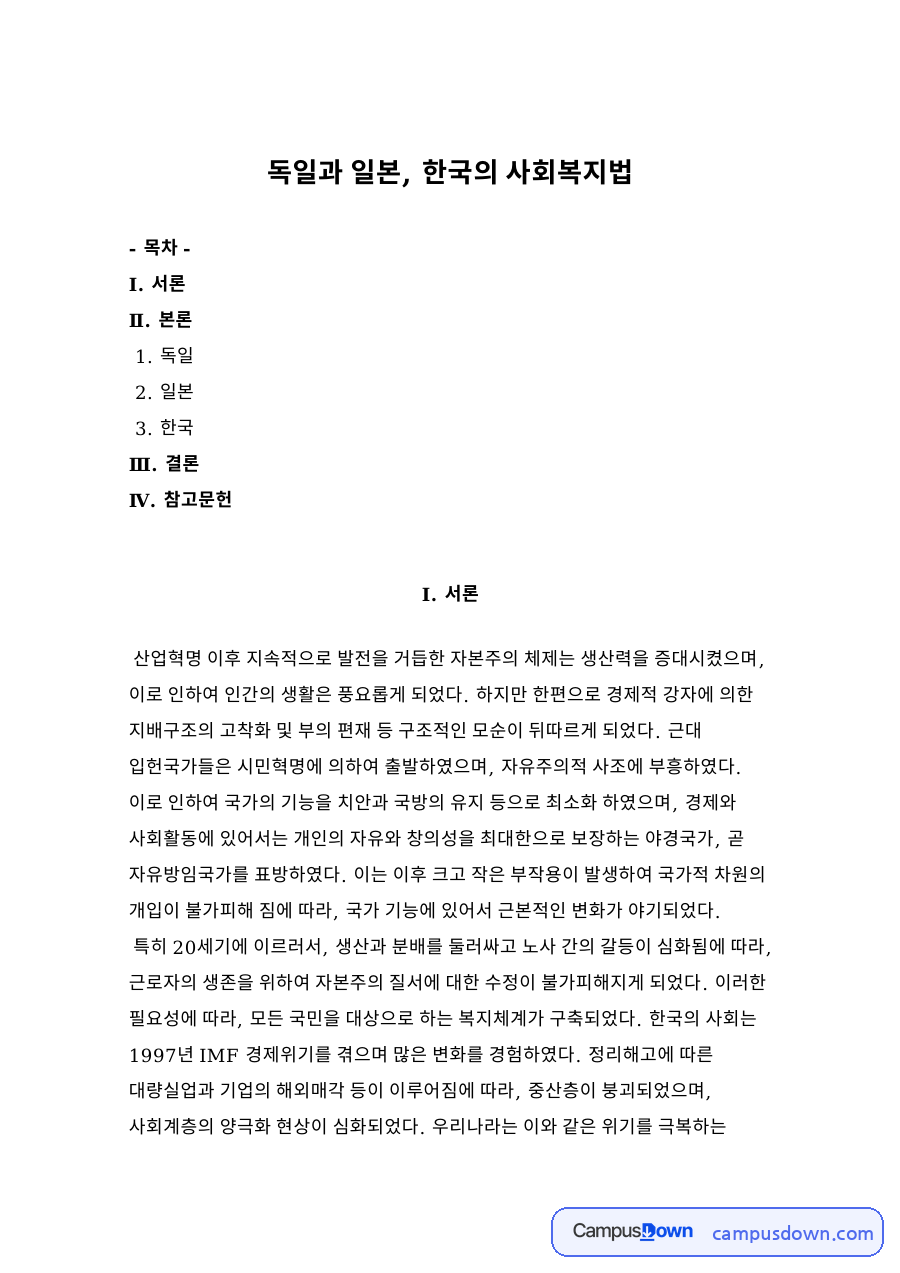
Page 1 is shown as is; from page 2 on, the preview is blurred. Buy it to download the complete original file right away (the file itself is written in Korean).
Packed with real examples and experience. Download it now and save time.
Save your valuable time
Buyer ratings
Fast, accurate and useful.
No ratings yet. Be the first to rate it.


1 / 6
좌우로 밀어서 페이지를 넘겨보세요
과제 개요
| 전체 페이지 수 | 6페이지 |
|---|---|
| 파일 형식 | 한글(HWP) |
| 등록일 | 2025.08.06 |
목차
- 1Ⅰ. 서론
- 2Ⅱ. 본론
- 2.11. 독일
- 2.22. 일본
- 2.33. 한국
- 3Ⅲ. 결론
- 4Ⅳ. 참고문헌
캠퍼스다운 도움말
해당 자료는 No AI 자료입니다. 인싸이트를 얻고 새롭게 가공해 보세요.
자료를 받아서 이용하면 품질이 확 올라갑니다.
- 비스마르크
- 사회보험
- 일본 사회보장법
- 한국 사회복지법
- 복지국가
- 조선구호령
- 사회복지법제
- 독일
- 일본
- 한국
Social Welfare Law in Germany, Japan and Korea Compared: Bismarck's Social Insurance, Japan's Social Security Laws, and Korea's Development
※ You can preview page 1 as is. Buy it to download the complete original file right away. The file itself is written in Korean.
■ Social Welfare Law in Germany, Japan and Korea Compared: Bismarck's Social Insurance, Japan's Social Security Laws, and Korea's Development — Overview
A 5-page Korean social welfare law paper comparing how social welfare law developed in Germany, Japan and Korea. It explains Bismarck's carrot-and-stick social insurance laws and later German legislation, Japan's piecemeal path from the 1874 relief rules to postwar social security laws, and Korea's path from the 1944 relief ordinance to modern pension and disability laws.
■ Social Welfare Law in Germany, Japan and Korea Compared: Bismarck's Social Insurance, Japan's Social Security Laws, and Korea's Development — Excerpt from the original document (English translation)
Bismarck was strongly influenced by two circumstances in introducing these social institutions. The first was the direct repression mentioned above. Starting with two assassination attempts on the emperor in 1878, he enacted the Anti-Socialist Law and began to suppress the socialist and labor movements severely. The second was providing social protection legislation to give the working class material benefits. Bismarck's social insurance is often likened to 'the carrot and the stick,' because policies of repression and appeasement were used at the same time. Germany enacted the world's first social insurance legislation, which can be explained by its tradition of Germanic law with collectivist tendencies. It was also a reaction to the rising socialist movement, aimed at finding a way to create a direct bond between the state and workers. But Bismarck's social insurance laws, far from achieving their original goal of breaking up social democracy and the union movement, raised workers' participation and rights consciousness and strengthened workers' organizations. In the end, contrary to their original political intent, Bismarck's social insurance laws contributed to the development of social welfare.
Germany later enacted an unemployment insurance law in 1919 and the Federal Social Assistance Act in 1962. The latter is significant in that its Article 4 expressly recognized the right to social assistance benefits as an enforceable claim. The Federal Maintenance Act was enacted in 1950, the Equalization of Burdens Act in 1952, the Federal Expellees Act and the Foreign Pensions Insurance Act in 1953, and the Federal Compensation Act in 1956. In the 1960s Germany enjoyed steady economic growth, on the basis of which welfare administration law, centered on social insurance law, was expanded in both structure and content. In 1969 miners' pension insurance and the federal miners' insurance fund were integrated, and after World War II the division of East and West Germany and West Germany's economic recovery led to a period of reorganizing social insurance law. Development continued, as in 1975 when insurance benefits for abortion procedures were not recognized under health insurance law, and this quantitative expansion of social security largely accompanied West Germany's economic growth. After reunification in 1990, social security spending became excessive and Germany faced great difficulties. To overcome this, Germany carried out a pension reform in 1992. German social welfare law has continued to develop and change since.
Japan first attempted Western-style social security legislation with the Meiji Restoration.
Note: Bismarck's three social insurance laws were the Sickness Insurance Act (1883), the Accident Insurance Act (1884) and the Old Age and Invalidity Insurance Act (1889); the paper's date of 1887 for the last should be 1889. Germany's unemployment insurance law (the Employment Services and Unemployment Insurance Act) was enacted on July 16, 1927, not in 1919, and the Federal Social Assistance Act was enacted on June 30, 1961 and took effect on July 1, 1962. Korean dates follow the paper's summary; the National Pension Act was a 1986 full revision of the 1973 National Welfare Pension Act. The source of the paper's statement about abortion insurance benefits in 1975 could not be confirmed.
■ Social Welfare Law in Germany, Japan and Korea Compared: Bismarck's Social Insurance, Japan's Social Security Laws, and Korea's Development — Contents and key concepts
How three countries became welfare states
✦ At a glance
- The development of social welfare law in Germany, Japan and Korea
- Structure: welfare state → Germany → Japan → Korea → conclusion
- Useful for social welfare law and comparative social policy courses
☰ What the paper covers
- From night-watchman to welfare state
- Bismarck's carrot and stick
- First social insurance
- Japan's piecemeal laws
- Korea's development
✎ Social insurance in Korea and the U.S.
Germany created the first social insurance laws in the 1880s, and Korea later built a German-style system of health, pension and employment insurance.
In the U.S., the Social Security Act of 1935 created old-age insurance and unemployment insurance, and Medicare and Medicaid followed in 1965.
Note: the paper itself is written in Korean and discusses Korean law. This page is general study information, not legal advice.
Related wiki: Social Security Benefits, Public Assistance Programs
■ Social Welfare Law in Germany, Japan and Korea Compared: Bismarck's Social Insurance, Japan's Social Security Laws, and Korea's Development References
- 최종찬, 인간다운 생활의 사회복지법상의 보장에 관한 연구, 원광대학교 석사학위논문, 2006
- 권영성, 헌법학원론, 법문사 2002
- 남일재 외, 사회복지행정론, 현학사, 2004
Keyword Prompt
전문가가 만들었어요과제를 직접 쓰는 데 도움이 되는 영어 프롬프트예요.
Tip! Prompt 에 자신의 생각을 추가해서 하면 훨씬 더 ✨ 좋습니다.
캠퍼스다운에서 레포트 받고 잘 쓰는 법 3가지, AI로 참고자료 제대로 재가공하기 →Prompt 1
I'm writing a university assignment on "독일과 일본, 한국의 사회복지법 비교: 비스마르크 사회보험 입법, 일본 사회보장법의 형성, 한국 사회복지법의 발달". Help me build an outline (introduction, 2-3 body sections, conclusion) that covers 비스마르크, 사회보험 and 일본 사회보장법. Don't write the paper for me - give me guiding questions for each section. My own perspective: [자신의 생각 넣는 곳] Please respond in Korean.
Prompt 2
Explain the key concepts "비스마르크" and "사회보험" in simple terms, then show how they connect to the topic "독일과 일본, 한국의 사회복지법 비교: 비스마르크 사회보험 입법, 일본 사회보장법의 형성, 한국 사회복지법의 발달". Point out common misunderstandings students have about them. My own perspective: [자신의 생각 넣는 곳] Please respond in Korean.
Prompt 3
Suggest 3 real-world cases or examples I could analyze in an assignment on "독일과 일본, 한국의 사회복지법 비교: 비스마르크 사회보험 입법, 일본 사회보장법의 형성, 한국 사회복지법의 발달", focusing on "일본 사회보장법". For each, tell me what I should look up and verify in official or academic sources. My own perspective: [자신의 생각 넣는 곳] Please respond in Korean.
Prompt 4
Review my draft paragraph on "독일과 일본, 한국의 사회복지법 비교: 비스마르크 사회보험 입법, 일본 사회보장법의 형성, 한국 사회복지법의 발달" (key idea: "한국 사회복지법"). Give feedback on logic, evidence and clarity, and mark where I need a citation. My paragraph: [paste here] My own perspective: [자신의 생각 넣는 곳] Please respond in Korean.
Take a break with a quick personality test?
Ranked by actual participation. Results in about a minute.
Loading…
Most-read content
Loading view counts…

Campusdown is a lifelong-learning community in Korea offering study materials, information on government support, student loans and scholarships, and more. Don't miss our free resources.
Go to the Campusdown home page →Refund policy
- Change of mind / refund requested after partial use / more than 7 days after purchase
◆ Exceptions
- File errors / cannot download or open the file
◆ How to request a refund: send a 1:1 inquiry via Customer Service at the top