
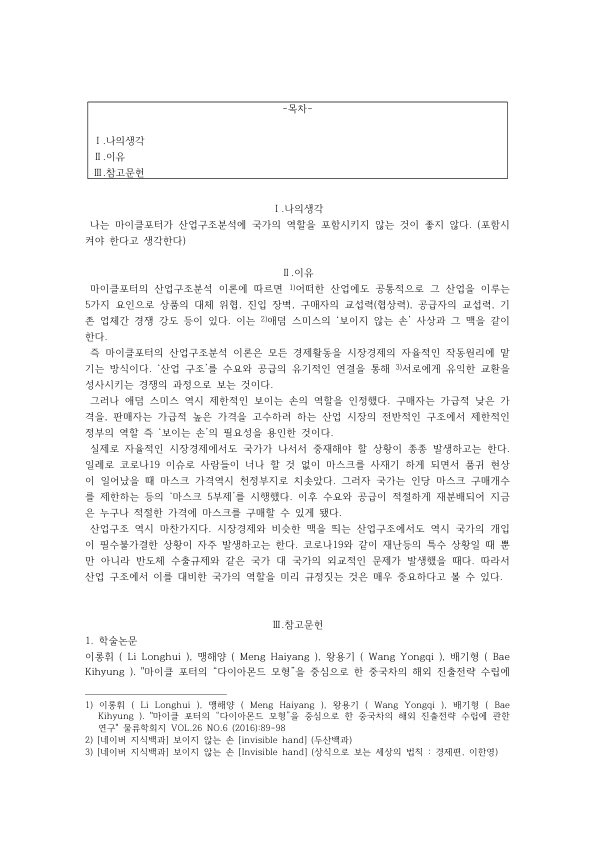
— Overview
This is one writer’s argument, not a later official finding. Porter’s industry analysis explains an industry through five competitive forces: the threat of substitutes, barriers to entry, buyer bargaining power, supplier bargaining power, and rivalry among existing firms. That model, the writer says, is of a piece with the invisible hand — leaving adjustment to the autonomous working of the market. Even Adam Smith, the writer adds, allowed a limited role for government, a visible hand.
When mask prices soared during COVID-19, the state stabilized supply with a five-day purchase rotation. Not only in disaster, the writer says, but also in diplomatic problems such as semiconductor export controls, the intervention of the state is needed. So the state, in this view, should be included as a variable in the analysis. No later official market figures are added here.
— Contents and key concepts
Five forces, and a family likeness with the invisible hand
The question this writer asks is plain: can a market be left only to an invisible hand? Porter’s industry analysis, as the account first sets it out, explains an industry through five competitive forces: the threat of substitutes, barriers to entry, the bargaining power of buyers, the bargaining power of suppliers, and rivalry among existing firms. The industry is seen as a competitive process of exchanges that can be useful to both sides.
That model, the writer says, is of a piece with leaving adjustment to the autonomous working of demand and supply — the invisible hand. The likeness is the starting point, not the end of the argument.
A visible hand, in a shortage and in a diplomatic dispute
Even Adam Smith, the writer notes, allowed a limited role for government, a visible hand. The cases that follow are offered as reasons to include the state as a variable in the analysis. When mask prices soared during COVID-19, the state limited purchases with a five-day rotation, and supply was stabilized. Not only in disaster, the writer says, but also in diplomatic problems between states, such as semiconductor export controls, the intervention of the state is needed.
The conclusion is therefore modest and firm: there are situations in which the market needs the mediation of the state, and Porter’s five forces should include that role. No later official price series, and no later official trade figures, are added here. The argument stays with the cases the writer gave.
Sources
- one writer’s argument that Porter’s five-forces industry analysis, akin to Adam Smith’s invisible hand, should include the role of the state, illustrated by mask rationing during COVID-19 and by semiconductor export controls.
Last updated: 14 November 2026
Refund policy
- Change of mind / refund requested after partial use / more than 7 days after purchase
◆ Exceptions
- File errors / cannot download or open the file
◆ How to request a refund: send a 1:1 inquiry via Customer Service at the top